

15 Studies on Hypernuclei and Superheavy Elements
213
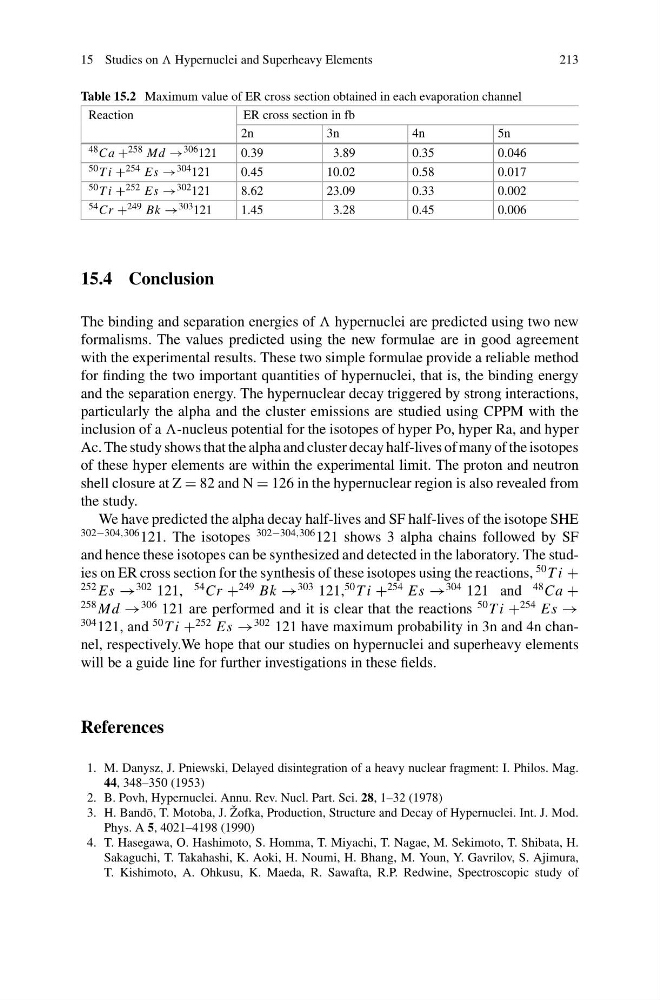
Table 15.2 Maximum value of ER cross section obtained in each evaporation channel
Reaction
ER cross section in fb
2n
3n
4n
5n
48 Ca + 258 Md → 306 121
0.39
3.89
0.35
0.046
50 T i + 254 Es → 304 121
0.45
10.02
0.58
0.017
50 T i + 252 Es → 302 121
8.62
23.09
0.33
0.002
54 Cr + 249 Bk → 303 121
1.45
3.28
0.45
0.006
15.4 Conclusion
The binding and separation energies of hypernuclei are predicted using two new
formalisms. The values predicted using the new formulae are in good agreement
with the experimental results. These two simple formulae provide a reliable method
for finding the two important quantities of hypernuclei, that is, the binding energy
and the separation energy. The hypernuclear decay triggered by strong interactions,
particularly the alpha and the cluster emissions are studied using CPPM with the
inclusion of a -nucleus potential for the isotopes of hyper Po, hyper Ra, and hyper
Ac. The study shows that the alpha and cluster decay half-lives of many of the isotopes
of these hyper elements are within the experimental limit. The proton and neutron
shell closure at Z = 82 and N = 126 in the hypernuclear region is also revealed from
the study.
We have predicted the alpha decay half-lives and SF half-lives of the isotope SHE
302−304,306 121. The isotopes
302−304,306 121 shows 3 alpha chains followed by SF
and hence these isotopes can be synthesized and detected in the laboratory. The studies on ER cross section for the synthesis of these isotopes using the reactions,
50 T i +
252 Es →
302 121,
54 Cr +
249 Bk →
303 121,
50 T i +
254 Es →
304 121 and
48 Ca +
258 Md →
306 121 are performed and it is clear that the reactions
50 T i +
254 Es →
304 121, and
50 T i +
252 Es →
302 121 have maximum probability in 3n and 4n channel, respectively.We hope that our studies on hypernuclei and superheavy elements
will be a guide line for further investigations in these fields.
References
1. M. Danysz, J. Pniewski, Delayed disintegration of a heavy nuclear fragment: I. Philos. Mag.
44, 348–350 (1953)
2. B. Povh, Hypernuclei. Annu. Rev. Nucl. Part. Sci. 28, 1–32 (1978)
3. H. Band¯ o, T. Motoba, J. Žofka, Production, Structure and Decay of Hypernuclei. Int. J. Mod.
Phys. A 5, 4021–4198 (1990)
4. T. Hasegawa, O. Hashimoto, S. Homma, T. Miyachi, T. Nagae, M. Sekimoto, T. Shibata, H.
Sakaguchi, T. Takahashi, K. Aoki, H. Noumi, H. Bhang, M. Youn, Y. Gavrilov, S. Ajimura,
T. Kishimoto, A. Ohkusu, K. Maeda, R. Sawafta, R.P. Redwine, Spectroscopic study of
213
Table 15.2 Maximum value of ER cross section obtained in each evaporation channel
Reaction
ER cross section in fb
2n
3n
4n
5n
48 Ca + 258 Md → 306 121
0.39
3.89
0.35
0.046
50 T i + 254 Es → 304 121
0.45
10.02
0.58
0.017
50 T i + 252 Es → 302 121
8.62
23.09
0.33
0.002
54 Cr + 249 Bk → 303 121
1.45
3.28
0.45
0.006
15.4 Conclusion
The binding and separation energies of hypernuclei are predicted using two new
formalisms. The values predicted using the new formulae are in good agreement
with the experimental results. These two simple formulae provide a reliable method
for finding the two important quantities of hypernuclei, that is, the binding energy
and the separation energy. The hypernuclear decay triggered by strong interactions,
particularly the alpha and the cluster emissions are studied using CPPM with the
inclusion of a -nucleus potential for the isotopes of hyper Po, hyper Ra, and hyper
Ac. The study shows that the alpha and cluster decay half-lives of many of the isotopes
of these hyper elements are within the experimental limit. The proton and neutron
shell closure at Z = 82 and N = 126 in the hypernuclear region is also revealed from
the study.
We have predicted the alpha decay half-lives and SF half-lives of the isotope SHE
302−304,306 121. The isotopes
302−304,306 121 shows 3 alpha chains followed by SF
and hence these isotopes can be synthesized and detected in the laboratory. The studies on ER cross section for the synthesis of these isotopes using the reactions,
50 T i +
252 Es →
302 121,
54 Cr +
249 Bk →
303 121,
50 T i +
254 Es →
304 121 and
48 Ca +
258 Md →
306 121 are performed and it is clear that the reactions
50 T i +
254 Es →
304 121, and
50 T i +
252 Es →
302 121 have maximum probability in 3n and 4n channel, respectively.We hope that our studies on hypernuclei and superheavy elements
will be a guide line for further investigations in these fields.
References
1. M. Danysz, J. Pniewski, Delayed disintegration of a heavy nuclear fragment: I. Philos. Mag.
44, 348–350 (1953)
2. B. Povh, Hypernuclei. Annu. Rev. Nucl. Part. Sci. 28, 1–32 (1978)
3. H. Band¯ o, T. Motoba, J. Žofka, Production, Structure and Decay of Hypernuclei. Int. J. Mod.
Phys. A 5, 4021–4198 (1990)
4. T. Hasegawa, O. Hashimoto, S. Homma, T. Miyachi, T. Nagae, M. Sekimoto, T. Shibata, H.
Sakaguchi, T. Takahashi, K. Aoki, H. Noumi, H. Bhang, M. Youn, Y. Gavrilov, S. Ajimura,
T. Kishimoto, A. Ohkusu, K. Maeda, R. Sawafta, R.P. Redwine, Spectroscopic study of