

200
L. Kumar
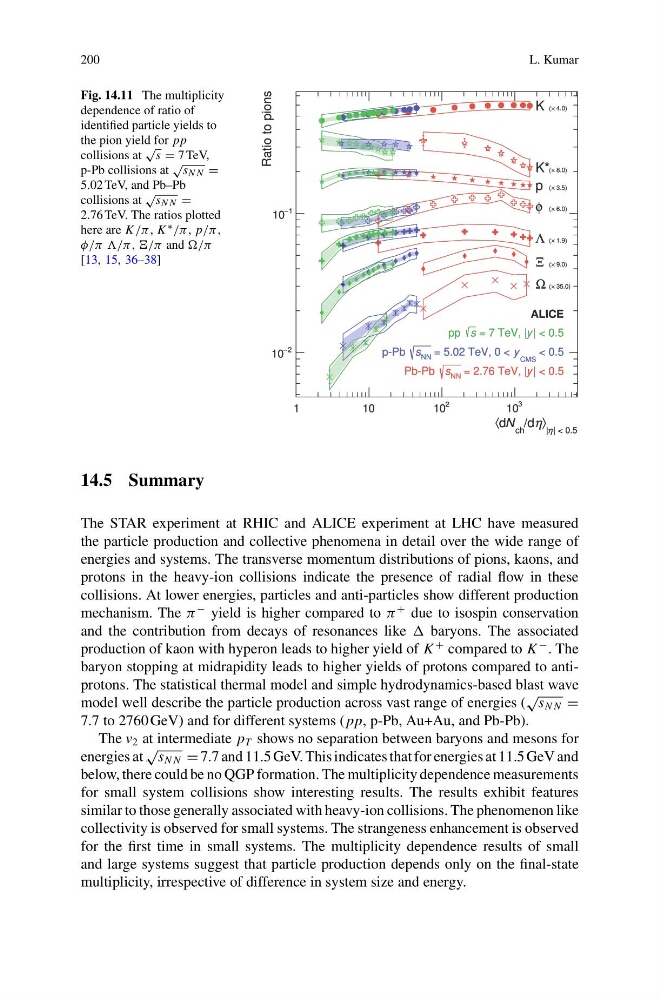
Fig. 14.11 The multiplicity
dependence of ratio of
identified particle yields to
the pion yield for pp
collisions at
√
s = 7 TeV,
p-Pb collisions at
√ s N N =
5.02 TeV, and Pb–Pb
collisions at
√
s N N =
2.76 TeV. The ratios plotted
here are K /π , K ∗ /π , p/π ,
φ/π π/π, /π and
[13, 15, 36–38]
14.5 Summary
The STAR experiment at RHIC and ALICE experiment at LHC have measured
the particle production and collective phenomena in detail over the wide range of
energies and systems. The transverse momentum distributions of pions, kaons, and
protons in the heavy-ion collisions indicate the presence of radial flow in these
collisions. At lower energies, particles and anti-particles show different production
mechanism. The π
− yield is higher compared to π
+ due to isospin conservation
and the contribution from decays of resonances like baryons. The associated
production of kaon with hyperon leads to higher yield of K
+ compared to K
− . The
baryon stopping at midrapidity leads to higher yields of protons compared to antiprotons. The statistical thermal model and simple hydrodynamics-based blast wave
model well describe the particle production across vast range of energies (
√
s N N =
7.7 to 2760 GeV) and for different systems ( pp, p-Pb, Au+Au, and Pb-Pb).
The v 2 at intermediate p T shows no separation between baryons and mesons for
energies at
√ s N N = 7.7 and 11.5 GeV. This indicates that for energies at 11.5 GeV and
below, there could be no QGP formation. The multiplicity dependence measurements
for small system collisions show interesting results. The results exhibit features
similar to those generally associated with heavy-ion collisions. The phenomenon like
collectivity is observed for small systems. The strangeness enhancement is observed
for the first time in small systems. The multiplicity dependence results of small
and large systems suggest that particle production depends only on the final-state
multiplicity, irrespective of difference in system size and energy.
L. Kumar
Fig. 14.11 The multiplicity
dependence of ratio of
identified particle yields to
the pion yield for pp
collisions at
√
s = 7 TeV,
p-Pb collisions at
√ s N N =
5.02 TeV, and Pb–Pb
collisions at
√
s N N =
2.76 TeV. The ratios plotted
here are K /π , K ∗ /π , p/π ,
φ/π π/π, /π and
[13, 15, 36–38]
14.5 Summary
The STAR experiment at RHIC and ALICE experiment at LHC have measured
the particle production and collective phenomena in detail over the wide range of
energies and systems. The transverse momentum distributions of pions, kaons, and
protons in the heavy-ion collisions indicate the presence of radial flow in these
collisions. At lower energies, particles and anti-particles show different production
mechanism. The π
− yield is higher compared to π
+ due to isospin conservation
and the contribution from decays of resonances like baryons. The associated
production of kaon with hyperon leads to higher yield of K
+ compared to K
− . The
baryon stopping at midrapidity leads to higher yields of protons compared to antiprotons. The statistical thermal model and simple hydrodynamics-based blast wave
model well describe the particle production across vast range of energies (
√
s N N =
7.7 to 2760 GeV) and for different systems ( pp, p-Pb, Au+Au, and Pb-Pb).
The v 2 at intermediate p T shows no separation between baryons and mesons for
energies at
√ s N N = 7.7 and 11.5 GeV. This indicates that for energies at 11.5 GeV and
below, there could be no QGP formation. The multiplicity dependence measurements
for small system collisions show interesting results. The results exhibit features
similar to those generally associated with heavy-ion collisions. The phenomenon like
collectivity is observed for small systems. The strangeness enhancement is observed
for the first time in small systems. The multiplicity dependence results of small
and large systems suggest that particle production depends only on the final-state
multiplicity, irrespective of difference in system size and energy.