

13 Elliptic Flow in Relativistic Heavy-Ion Collisions
167
v
obs
2 = =cos2(φ −
E P
2 )
= =cos(2(φ −
E P
2 ) + 2(( R P − R P ))
= =cos(2(φ − R P ) + 2(( R P −
E P
2 ))
= =cos(2(φ − R P )cos(2(( R P −
E P
2 ))
= v
true
2 cos(2(( R P −
E P
2 ))
(13.9)
v
true
2
= v
obs
2 /cos(2(( R P −
E P
2 ))
(13.10)
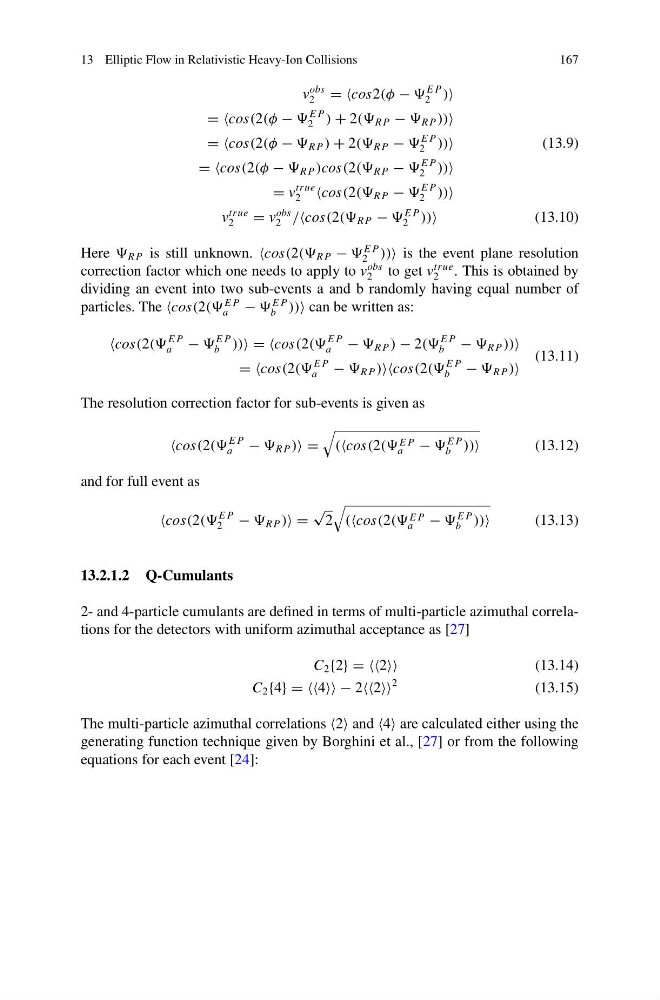
Here R P is still unknown. cos(2(( R P −
E P
2 )) is the event plane resolution
correction factor which one needs to apply to v
obs
2
to get v
true
2 . This is obtained by
dividing an event into two sub-events a and b randomly having equal number of
particles. The cos(2((
E P
a
−
E P
b )) can be written as:
cos(2((
E P
a
−
E P
b )) = =cos(2((
E P
a
− R P ) − 2((
E P
b
− R P ))
= =cos(2((
E P
a
− R P )cos(2((
E P
b
− R P )
(13.11)
The resolution correction factor for sub-events is given as
cos(2((
E P
a
− R P ) =
(cos(2(( E P
a
−
E P
b ))
(13.12)
and for full event as
cos(2((
E P
2
− R P ) =
√
2
(cos(2(( E P
a
−
E P
b ))
(13.13)
13.2.1.2 Q-Cumulants
2- and 4-particle cumulants are defined in terms of multi-particle azimuthal correlations for the detectors with uniform azimuthal acceptance as [27]
C 2 {2} = ==2
(13.14)
C 2 {4} = ==4 − 22
2
(13.15)
The multi-particle azimuthal correlations 2 and 4 are calculated either using the
generating function technique given by Borghini et al., [27] or from the following
equations for each event [24]:
167
v
obs
2 = =cos2(φ −
E P
2 )
= =cos(2(φ −
E P
2 ) + 2(( R P − R P ))
= =cos(2(φ − R P ) + 2(( R P −
E P
2 ))
= =cos(2(φ − R P )cos(2(( R P −
E P
2 ))
= v
true
2 cos(2(( R P −
E P
2 ))
(13.9)
v
true
2
= v
obs
2 /cos(2(( R P −
E P
2 ))
(13.10)
Here R P is still unknown. cos(2(( R P −
E P
2 )) is the event plane resolution
correction factor which one needs to apply to v
obs
2
to get v
true
2 . This is obtained by
dividing an event into two sub-events a and b randomly having equal number of
particles. The cos(2((
E P
a
−
E P
b )) can be written as:
cos(2((
E P
a
−
E P
b )) = =cos(2((
E P
a
− R P ) − 2((
E P
b
− R P ))
= =cos(2((
E P
a
− R P )cos(2((
E P
b
− R P )
(13.11)
The resolution correction factor for sub-events is given as
cos(2((
E P
a
− R P ) =
(cos(2(( E P
a
−
E P
b ))
(13.12)
and for full event as
cos(2((
E P
2
− R P ) =
√
2
(cos(2(( E P
a
−
E P
b ))
(13.13)
13.2.1.2 Q-Cumulants
2- and 4-particle cumulants are defined in terms of multi-particle azimuthal correlations for the detectors with uniform azimuthal acceptance as [27]
C 2 {2} = ==2
(13.14)
C 2 {4} = ==4 − 22
2
(13.15)
The multi-particle azimuthal correlations 2 and 4 are calculated either using the
generating function technique given by Borghini et al., [27] or from the following
equations for each event [24]: