

12 Nuclear Matter Properties at High Densities…
157
12.2.3 Density Tested in the ASY-EOS Experiment
Since microscopic transport models are reproducing reasonably well the experimental data it seems to be appropriate to deduce the density range relevant for the
sensitivity to the symmetry energy in this reaction by using one of those codes.
For this investigation the Tübingen Version of the QMD model, TüQMD, [21] was
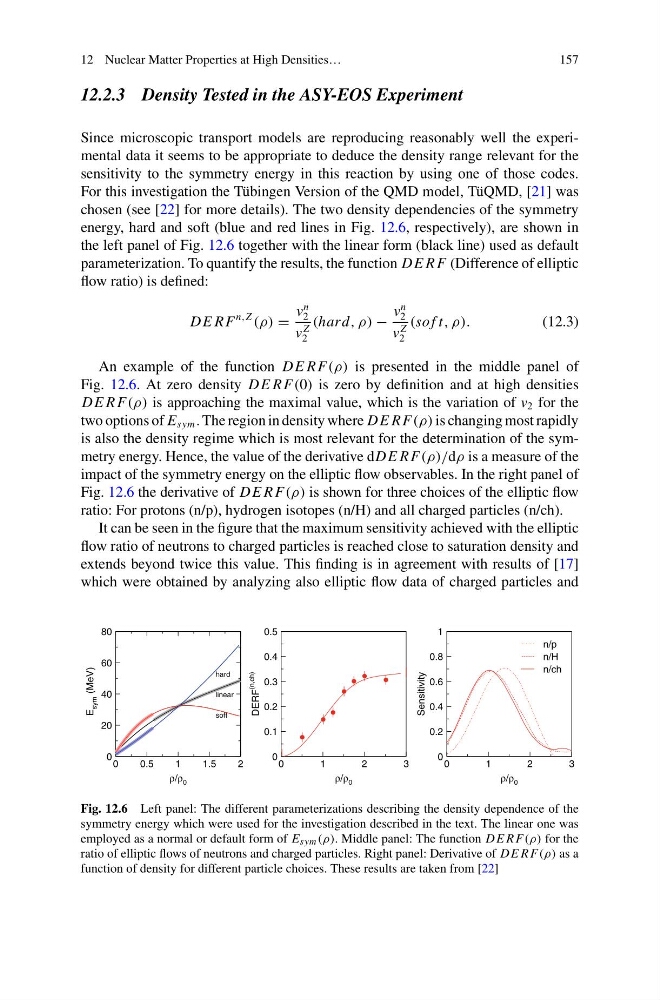
chosen (see [22] for more details). The two density dependencies of the symmetry
energy, hard and soft (blue and red lines in Fig. 12.6, respectively), are shown in
the left panel of Fig. 12.6 together with the linear form (black line) used as default
parameterization. To quantify the results, the function DE R F (Difference of elliptic
flow ratio) is defined:
DE R F
n,Z
(ρ) =
v
n
2
v
Z
2
(hard, ρ) −
v
n
2
v
Z
2
(so f t, ρ).
(12.3)
An example of the function DE R F(ρ) is presented in the middle panel of
Fig. 12.6. At zero density DE R F(0) is zero by definition and at high densities
DE R F(ρ) is approaching the maximal value, which is the variation of v 2 for the
two options of E sym . The region in density where DE R F(ρ) is changing most rapidly
is also the density regime which is most relevant for the determination of the symmetry energy. Hence, the value of the derivative dDE R F(ρ)/dρ is a measure of the
impact of the symmetry energy on the elliptic flow observables. In the right panel of
Fig. 12.6 the derivative of DE R F(ρ) is shown for three choices of the elliptic flow
ratio: For protons (n/p), hydrogen isotopes (n/H) and all charged particles (n/ch).
It can be seen in the figure that the maximum sensitivity achieved with the elliptic
flow ratio of neutrons to charged particles is reached close to saturation density and
extends beyond twice this value. This finding is in agreement with results of [17]
which were obtained by analyzing also elliptic flow data of charged particles and
0
20
40
60
80
0
0.5
1
1.5
2
ρ/ρ 0
E
sym (MeV)
soft
linear
hard
0
0.1
0.2
0.3
0.4
0.5
0
1
2
3
ρ/ρ 0
DERF
(n,ch)
0
0.2
0.4
0.6
0.8
1
0
1
2
3
ρ/ρ 0
Sensitivity
n/ch
n/H
n/p
Fig. 12.6 Left panel: The different parameterizations describing the density dependence of the
symmetry energy which were used for the investigation described in the text. The linear one was
employed as a normal or default form of E sym (ρ). Middle panel: The function DE R F(ρ) for the
ratio of elliptic flows of neutrons and charged particles. Right panel: Derivative of DE R F(ρ) as a
function of density for different particle choices. These results are taken from [22]
157
12.2.3 Density Tested in the ASY-EOS Experiment
Since microscopic transport models are reproducing reasonably well the experimental data it seems to be appropriate to deduce the density range relevant for the
sensitivity to the symmetry energy in this reaction by using one of those codes.
For this investigation the Tübingen Version of the QMD model, TüQMD, [21] was
chosen (see [22] for more details). The two density dependencies of the symmetry
energy, hard and soft (blue and red lines in Fig. 12.6, respectively), are shown in
the left panel of Fig. 12.6 together with the linear form (black line) used as default
parameterization. To quantify the results, the function DE R F (Difference of elliptic
flow ratio) is defined:
DE R F
n,Z
(ρ) =
v
n
2
v
Z
2
(hard, ρ) −
v
n
2
v
Z
2
(so f t, ρ).
(12.3)
An example of the function DE R F(ρ) is presented in the middle panel of
Fig. 12.6. At zero density DE R F(0) is zero by definition and at high densities
DE R F(ρ) is approaching the maximal value, which is the variation of v 2 for the
two options of E sym . The region in density where DE R F(ρ) is changing most rapidly
is also the density regime which is most relevant for the determination of the symmetry energy. Hence, the value of the derivative dDE R F(ρ)/dρ is a measure of the
impact of the symmetry energy on the elliptic flow observables. In the right panel of
Fig. 12.6 the derivative of DE R F(ρ) is shown for three choices of the elliptic flow
ratio: For protons (n/p), hydrogen isotopes (n/H) and all charged particles (n/ch).
It can be seen in the figure that the maximum sensitivity achieved with the elliptic
flow ratio of neutrons to charged particles is reached close to saturation density and
extends beyond twice this value. This finding is in agreement with results of [17]
which were obtained by analyzing also elliptic flow data of charged particles and
0
20
40
60
80
0
0.5
1
1.5
2
ρ/ρ 0
E
sym (MeV)
soft
linear
hard
0
0.1
0.2
0.3
0.4
0.5
0
1
2
3
ρ/ρ 0
DERF
(n,ch)
0
0.2
0.4
0.6
0.8
1
0
1
2
3
ρ/ρ 0
Sensitivity
n/ch
n/H
n/p
Fig. 12.6 Left panel: The different parameterizations describing the density dependence of the
symmetry energy which were used for the investigation described in the text. The linear one was
employed as a normal or default form of E sym (ρ). Middle panel: The function DE R F(ρ) for the
ratio of elliptic flows of neutrons and charged particles. Right panel: Derivative of DE R F(ρ) as a
function of density for different particle choices. These results are taken from [22]