

9 PHQMD—A Microscopic Transport Approach for Heavy-Ion …
115
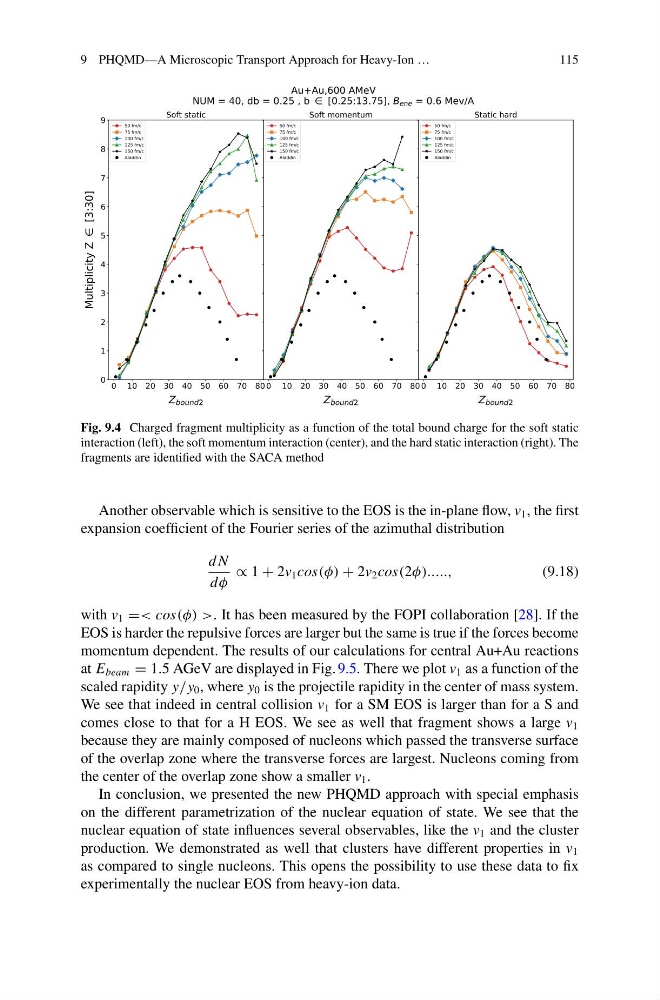
Fig. 9.4 Charged fragment multiplicity as a function of the total bound charge for the soft static
interaction (left), the soft momentum interaction (center), and the hard static interaction (right). The
fragments are identified with the SACA method
Another observable which is sensitive to the EOS is the in-plane flow, v 1 , the first
expansion coefficient of the Fourier series of the azimuthal distribution
d N
dφ
∝ 1 + 2v 1 cos(φ) + 2v 2 cos(2φ).....,
(9.18)
with v 1 =< cos(φ) >. It has been measured by the FOPI collaboration [28]. If the
EOS is harder the repulsive forces are larger but the same is true if the forces become
momentum dependent. The results of our calculations for central Au+Au reactions
at E beam = 1.5 AGeV are displayed in Fig. 9.5. There we plot v 1 as a function of the
scaled rapidity y/y 0 , where y 0 is the projectile rapidity in the center of mass system.
We see that indeed in central collision v 1 for a SM EOS is larger than for a S and
comes close to that for a H EOS. We see as well that fragment shows a large v 1
because they are mainly composed of nucleons which passed the transverse surface
of the overlap zone where the transverse forces are largest. Nucleons coming from
the center of the overlap zone show a smaller v 1 .
In conclusion, we presented the new PHQMD approach with special emphasis
on the different parametrization of the nuclear equation of state. We see that the
nuclear equation of state influences several observables, like the v 1 and the cluster
production. We demonstrated as well that clusters have different properties in v 1
as compared to single nucleons. This opens the possibility to use these data to fix
experimentally the nuclear EOS from heavy-ion data.
115
Fig. 9.4 Charged fragment multiplicity as a function of the total bound charge for the soft static
interaction (left), the soft momentum interaction (center), and the hard static interaction (right). The
fragments are identified with the SACA method
Another observable which is sensitive to the EOS is the in-plane flow, v 1 , the first
expansion coefficient of the Fourier series of the azimuthal distribution
d N
dφ
∝ 1 + 2v 1 cos(φ) + 2v 2 cos(2φ).....,
(9.18)
with v 1 =< cos(φ) >. It has been measured by the FOPI collaboration [28]. If the
EOS is harder the repulsive forces are larger but the same is true if the forces become
momentum dependent. The results of our calculations for central Au+Au reactions
at E beam = 1.5 AGeV are displayed in Fig. 9.5. There we plot v 1 as a function of the
scaled rapidity y/y 0 , where y 0 is the projectile rapidity in the center of mass system.
We see that indeed in central collision v 1 for a SM EOS is larger than for a S and
comes close to that for a H EOS. We see as well that fragment shows a large v 1
because they are mainly composed of nucleons which passed the transverse surface
of the overlap zone where the transverse forces are largest. Nucleons coming from
the center of the overlap zone show a smaller v 1 .
In conclusion, we presented the new PHQMD approach with special emphasis
on the different parametrization of the nuclear equation of state. We see that the
nuclear equation of state influences several observables, like the v 1 and the cluster
production. We demonstrated as well that clusters have different properties in v 1
as compared to single nucleons. This opens the possibility to use these data to fix
experimentally the nuclear EOS from heavy-ion data.