

9 PHQMD—A Microscopic Transport Approach for Heavy-Ion …
113
9.3 Energy Conservation
One of the essential conditions for a successful description of heavy-ion collisions
is the energy conservation during the interaction. We use here a 4th order Runge
Kutta approach to solve the system of coupled equations with a fixed time step (0.2
fm/c) method. Since all particles move on curved trajectories the time step should be
small. Also for the stability of fragments a time step of this order is necessary. Figure
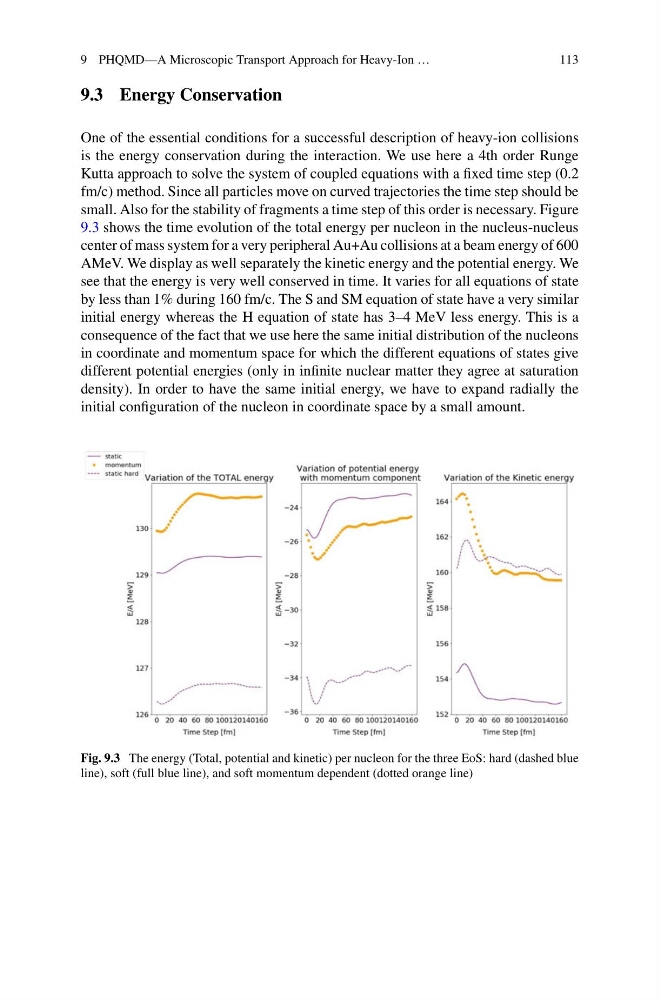
9.3 shows the time evolution of the total energy per nucleon in the nucleus-nucleus
center of mass system for a very peripheral Au+Au collisions at a beam energy of 600
AMeV. We display as well separately the kinetic energy and the potential energy. We
see that the energy is very well conserved in time. It varies for all equations of state
by less than 1% during 160 fm/c. The S and SM equation of state have a very similar
initial energy whereas the H equation of state has 3–4 MeV less energy. This is a
consequence of the fact that we use here the same initial distribution of the nucleons
in coordinate and momentum space for which the different equations of states give
different potential energies (only in infinite nuclear matter they agree at saturation
density). In order to have the same initial energy, we have to expand radially the
initial configuration of the nucleon in coordinate space by a small amount.
Fig. 9.3 The energy (Total, potential and kinetic) per nucleon for the three EoS: hard (dashed blue
line), soft (full blue line), and soft momentum dependent (dotted orange line)
113
9.3 Energy Conservation
One of the essential conditions for a successful description of heavy-ion collisions
is the energy conservation during the interaction. We use here a 4th order Runge
Kutta approach to solve the system of coupled equations with a fixed time step (0.2
fm/c) method. Since all particles move on curved trajectories the time step should be
small. Also for the stability of fragments a time step of this order is necessary. Figure
9.3 shows the time evolution of the total energy per nucleon in the nucleus-nucleus
center of mass system for a very peripheral Au+Au collisions at a beam energy of 600
AMeV. We display as well separately the kinetic energy and the potential energy. We
see that the energy is very well conserved in time. It varies for all equations of state
by less than 1% during 160 fm/c. The S and SM equation of state have a very similar
initial energy whereas the H equation of state has 3–4 MeV less energy. This is a
consequence of the fact that we use here the same initial distribution of the nucleons
in coordinate and momentum space for which the different equations of states give
different potential energies (only in infinite nuclear matter they agree at saturation
density). In order to have the same initial energy, we have to expand radially the
initial configuration of the nucleon in coordinate space by a small amount.
Fig. 9.3 The energy (Total, potential and kinetic) per nucleon for the three EoS: hard (dashed blue
line), soft (full blue line), and soft momentum dependent (dotted orange line)