

108
J. Aichelin et al.
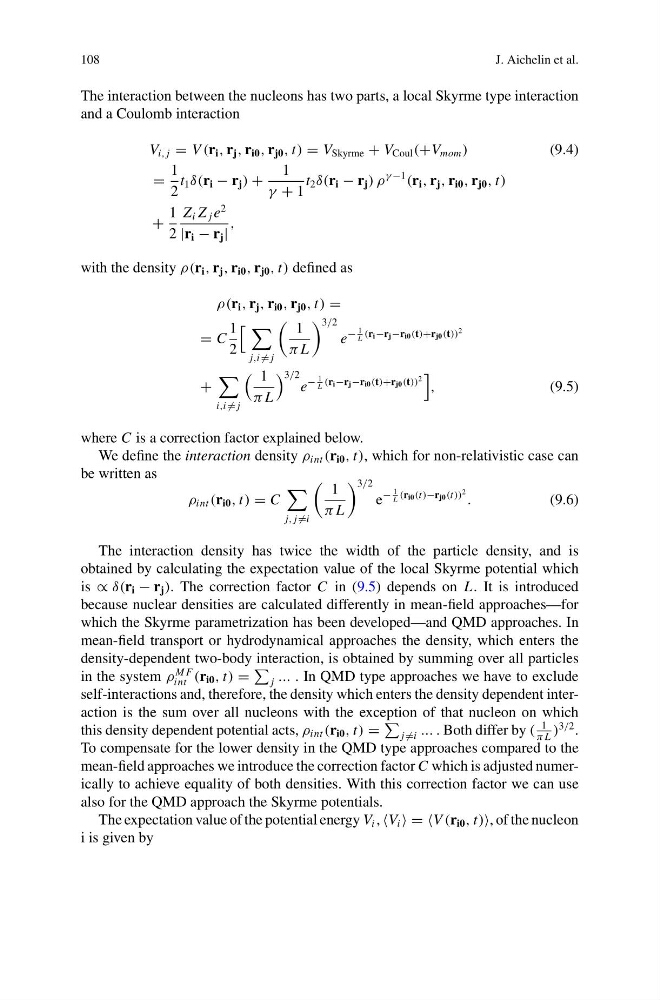
The interaction between the nucleons has two parts, a local Skyrme type interaction
and a Coulomb interaction
V i, j = V (r i , r j , r i0 , r j0 , t) = V Skyrme + V Coul (+V mom )
(9.4)
=
1
2
t 1 δ(r i − r j ) +
1
γ + 1
t 2 δ(r i − r j ) ρ
γ −1
(r i , r j , r i0 , r j0 , t)
+
1
2
Z i Z j e
2
|r i − r j |
,
with the density ρ(r i , r j , r i0 , r j0 , t) defined as
ρ(r i , r j , r i0 , r j0 , t) =
= C
1
2
j,i = j
1
π L
3/2
e
−
1
L (r i −r j −r i0 (t)+r j0 (t))
2
+
i,i = j
1
π L
3/2
e
−
1
L (r i −r j −r i0 (t)+r j0 (t))
2
,
(9.5)
where C is a correction factor explained below.
We define the interaction density ρ int (r i0 , t), which for non-relativistic case can
be written as
ρ int (r i0 , t) = C
j, j =i
1
π L
3/2
e
−
1
L (r i0 (t)−r j0 (t))
2 .
(9.6)
The interaction density has twice the width of the particle density, and is
obtained by calculating the expectation value of the local Skyrme potential which
is ∝ δ(r i − r j ). The correction factor C in (9.5) depends on L. It is introduced
because nuclear densities are calculated differently in mean-field approaches—for
which the Skyrme parametrization has been developed—and QMD approaches. In
mean-field transport or hydrodynamical approaches the density, which enters the
density-dependent two-body interaction, is obtained by summing over all particles
in the system ρ
M F
int (r i0 , t) =
j ... . In QMD type approaches we have to exclude
self-interactions and, therefore, the density which enters the density dependent interaction is the sum over all nucleons with the exception of that nucleon on which
this density dependent potential acts, ρ int (r i0 , t) =
j =i ... . Both differ by (
1
π L
)
3/2 .
To compensate for the lower density in the QMD type approaches compared to the
mean-field approaches we introduce the correction factor C which is adjusted numerically to achieve equality of both densities. With this correction factor we can use
also for the QMD approach the Skyrme potentials.
The expectation value of the potential energy V i , V i = =V (r i0 , t), of the nucleon
i is given by
J. Aichelin et al.
The interaction between the nucleons has two parts, a local Skyrme type interaction
and a Coulomb interaction
V i, j = V (r i , r j , r i0 , r j0 , t) = V Skyrme + V Coul (+V mom )
(9.4)
=
1
2
t 1 δ(r i − r j ) +
1
γ + 1
t 2 δ(r i − r j ) ρ
γ −1
(r i , r j , r i0 , r j0 , t)
+
1
2
Z i Z j e
2
|r i − r j |
,
with the density ρ(r i , r j , r i0 , r j0 , t) defined as
ρ(r i , r j , r i0 , r j0 , t) =
= C
1
2
j,i = j
1
π L
3/2
e
−
1
L (r i −r j −r i0 (t)+r j0 (t))
2
+
i,i = j
1
π L
3/2
e
−
1
L (r i −r j −r i0 (t)+r j0 (t))
2
,
(9.5)
where C is a correction factor explained below.
We define the interaction density ρ int (r i0 , t), which for non-relativistic case can
be written as
ρ int (r i0 , t) = C
j, j =i
1
π L
3/2
e
−
1
L (r i0 (t)−r j0 (t))
2 .
(9.6)
The interaction density has twice the width of the particle density, and is
obtained by calculating the expectation value of the local Skyrme potential which
is ∝ δ(r i − r j ). The correction factor C in (9.5) depends on L. It is introduced
because nuclear densities are calculated differently in mean-field approaches—for
which the Skyrme parametrization has been developed—and QMD approaches. In
mean-field transport or hydrodynamical approaches the density, which enters the
density-dependent two-body interaction, is obtained by summing over all particles
in the system ρ
M F
int (r i0 , t) =
j ... . In QMD type approaches we have to exclude
self-interactions and, therefore, the density which enters the density dependent interaction is the sum over all nucleons with the exception of that nucleon on which
this density dependent potential acts, ρ int (r i0 , t) =
j =i ... . Both differ by (
1
π L
)
3/2 .
To compensate for the lower density in the QMD type approaches compared to the
mean-field approaches we introduce the correction factor C which is adjusted numerically to achieve equality of both densities. With this correction factor we can use
also for the QMD approach the Skyrme potentials.
The expectation value of the potential energy V i , V i = =V (r i0 , t), of the nucleon
i is given by