

7 Role of Mass Asymmetry on the Energy of Peak …
89
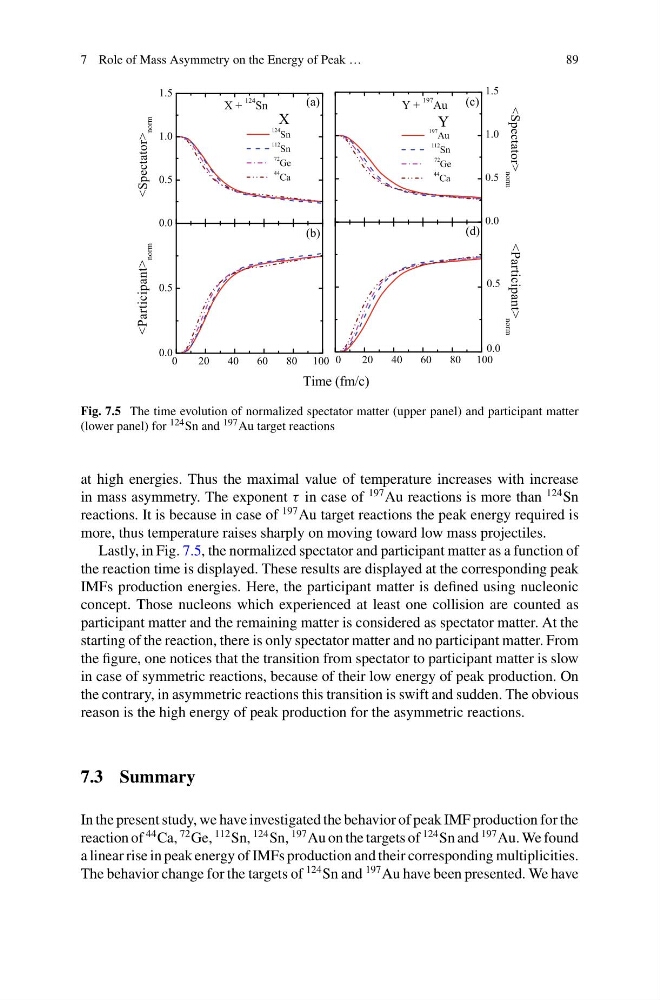
Fig. 7.5 The time evolution of normalized spectator matter (upper panel) and participant matter
(lower panel) for 124 Sn and 197 Au target reactions
at high energies. Thus the maximal value of temperature increases with increase
in mass asymmetry. The exponent τ in case of
197 Au reactions is more than
124 Sn
reactions. It is because in case of
197 Au target reactions the peak energy required is
more, thus temperature raises sharply on moving toward low mass projectiles.
Lastly, in Fig. 7.5, the normalized spectator and participant matter as a function of
the reaction time is displayed. These results are displayed at the corresponding peak
IMFs production energies. Here, the participant matter is defined using nucleonic
concept. Those nucleons which experienced at least one collision are counted as
participant matter and the remaining matter is considered as spectator matter. At the
starting of the reaction, there is only spectator matter and no participant matter. From
the figure, one notices that the transition from spectator to participant matter is slow
in case of symmetric reactions, because of their low energy of peak production. On
the contrary, in asymmetric reactions this transition is swift and sudden. The obvious
reason is the high energy of peak production for the asymmetric reactions.
7.3 Summary
In the present study, we have investigated the behavior of peak IMF production for the
reaction of
44 Ca,
72 Ge,
112 Sn,
124 Sn,
197 Au on the targets of
124 Sn and
197 Au. We found
a linear rise in peak energy of IMFs production and their corresponding multiplicities.
The behavior change for the targets of
124 Sn and
197 Au have been presented. We have
89
Fig. 7.5 The time evolution of normalized spectator matter (upper panel) and participant matter
(lower panel) for 124 Sn and 197 Au target reactions
at high energies. Thus the maximal value of temperature increases with increase
in mass asymmetry. The exponent τ in case of
197 Au reactions is more than
124 Sn
reactions. It is because in case of
197 Au target reactions the peak energy required is
more, thus temperature raises sharply on moving toward low mass projectiles.
Lastly, in Fig. 7.5, the normalized spectator and participant matter as a function of
the reaction time is displayed. These results are displayed at the corresponding peak
IMFs production energies. Here, the participant matter is defined using nucleonic
concept. Those nucleons which experienced at least one collision are counted as
participant matter and the remaining matter is considered as spectator matter. At the
starting of the reaction, there is only spectator matter and no participant matter. From
the figure, one notices that the transition from spectator to participant matter is slow
in case of symmetric reactions, because of their low energy of peak production. On
the contrary, in asymmetric reactions this transition is swift and sudden. The obvious
reason is the high energy of peak production for the asymmetric reactions.
7.3 Summary
In the present study, we have investigated the behavior of peak IMF production for the
reaction of
44 Ca,
72 Ge,
112 Sn,
124 Sn,
197 Au on the targets of
124 Sn and
197 Au. We found
a linear rise in peak energy of IMFs production and their corresponding multiplicities.
The behavior change for the targets of
124 Sn and
197 Au have been presented. We have