

3.3 Mission Analysis
71
spacecraft of the U.S. and Russia with power supply by RHU. Those spacecraft has
flown for 20 years and might continue to fly another 20 years.
The half life period of
238 Pu is 87.74 years. When
238 Pu is decaying, it will give
off alpha particles and gamma ray in 99.89 keV and 43.491 keV, whose intensity is
lower 2–3 order of magnitude than alpha particles. The major form of radioisotope
fuel is
238 Pu and PuO 2 in application, whose specific power is about 0.55 W/g and
density is 5.09 g/cm
3 .
The core of RHU was usually
238 PuO 2 in ceramics container. The advantages of
ceramics structure are high temperature resistant, high hardness, dust free and low
leach rate of radioisotope element. Therefore all space RTG was in such form. The
outer wall of RTG was made up of multiple materials and multilayered structure to
safeguard, seal and avoid leakage of radioactive materials. There were four layers
from inside to outer including: seal layer, high-strength protection layer, heat insulation layer and carbon fiber braided outer layer. The structure of RTG source was
compact with higher safety and reliability.
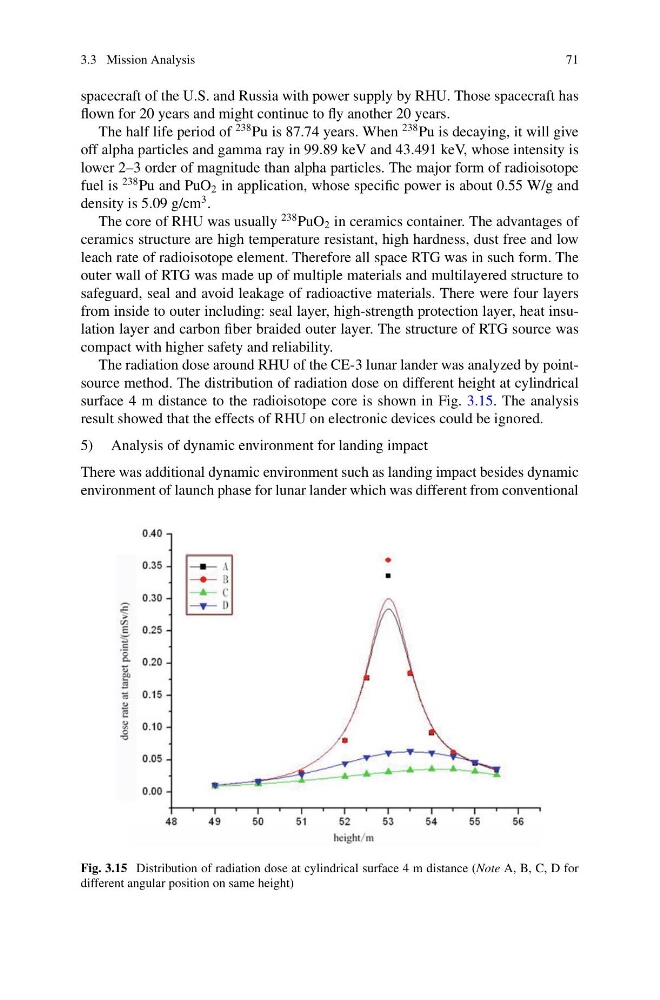
The radiation dose around RHU of the CE-3 lunar lander was analyzed by pointsource method. The distribution of radiation dose on different height at cylindrical
surface 4 m distance to the radioisotope core is shown in Fig. 3.15. The analysis
result showed that the effects of RHU on electronic devices could be ignored.
5) Analysis of dynamic environment for landing impact
There was additional dynamic environment such as landing impact besides dynamic
environment of launch phase for lunar lander which was different from conventional
Fig. 3.15 Distribution of radiation dose at cylindrical surface 4 m distance (Note A, B, C, D for
different angular position on same height)
71
spacecraft of the U.S. and Russia with power supply by RHU. Those spacecraft has
flown for 20 years and might continue to fly another 20 years.
The half life period of
238 Pu is 87.74 years. When
238 Pu is decaying, it will give
off alpha particles and gamma ray in 99.89 keV and 43.491 keV, whose intensity is
lower 2–3 order of magnitude than alpha particles. The major form of radioisotope
fuel is
238 Pu and PuO 2 in application, whose specific power is about 0.55 W/g and
density is 5.09 g/cm
3 .
The core of RHU was usually
238 PuO 2 in ceramics container. The advantages of
ceramics structure are high temperature resistant, high hardness, dust free and low
leach rate of radioisotope element. Therefore all space RTG was in such form. The
outer wall of RTG was made up of multiple materials and multilayered structure to
safeguard, seal and avoid leakage of radioactive materials. There were four layers
from inside to outer including: seal layer, high-strength protection layer, heat insulation layer and carbon fiber braided outer layer. The structure of RTG source was
compact with higher safety and reliability.
The radiation dose around RHU of the CE-3 lunar lander was analyzed by pointsource method. The distribution of radiation dose on different height at cylindrical
surface 4 m distance to the radioisotope core is shown in Fig. 3.15. The analysis
result showed that the effects of RHU on electronic devices could be ignored.
5) Analysis of dynamic environment for landing impact
There was additional dynamic environment such as landing impact besides dynamic
environment of launch phase for lunar lander which was different from conventional
Fig. 3.15 Distribution of radiation dose at cylindrical surface 4 m distance (Note A, B, C, D for
different angular position on same height)