

46
2 Environment Analysis of Lunar Soft Landing Exploration
friction and the vacuum discharge of electronic devices is similar to the design of
Earth spacecraft.
It is shown that the order of magnitude of the density of lunar atmosphere is
equivalent to that of Earth atmosphere with an altitude over 1500 km by comparison
of Tables 2.11 and 2.12. So, the atmospheric drag of the Moon is considered as the
same as that of the Earth with an altitude over 1500 km in the design of circumlunar
lunar orbit.
2.6.3 Illumination Environment on the Lunar Surface
Similar to Earth, the Sun rises from east and sets in west while viewing on lunar
surface due to rotation around its own axis. The rotation period of Moon is 1 month,
and one lunar day is approximately 28 Earth days. This period is the lunar cycle. It
is almost identical to the lunation in the traditional Chinese calendar.
Except the lunar night as long as 14 Earth days, short-time invisibility of Sun may
happen on the Moon due to the block of the Earth. It is the solar eclipse of the Moon.
The solar eclipse of the Moon is the lunar eclipse in the view of Earth. Since the
ecliptic (orbit of Earth) intersects the Moon’s path (orbit of Moon) with an incline
angle of about 5°, the Moon moves into the Earth shadow when the Sun approaches
closely to the two intersection points of these two orbital planes and the connection
line between Earth and Moon points to the Sun at the same time. Then the lunar
eclipse of the Earth, which is also the solar eclipse of the Moon, will happen. Earth
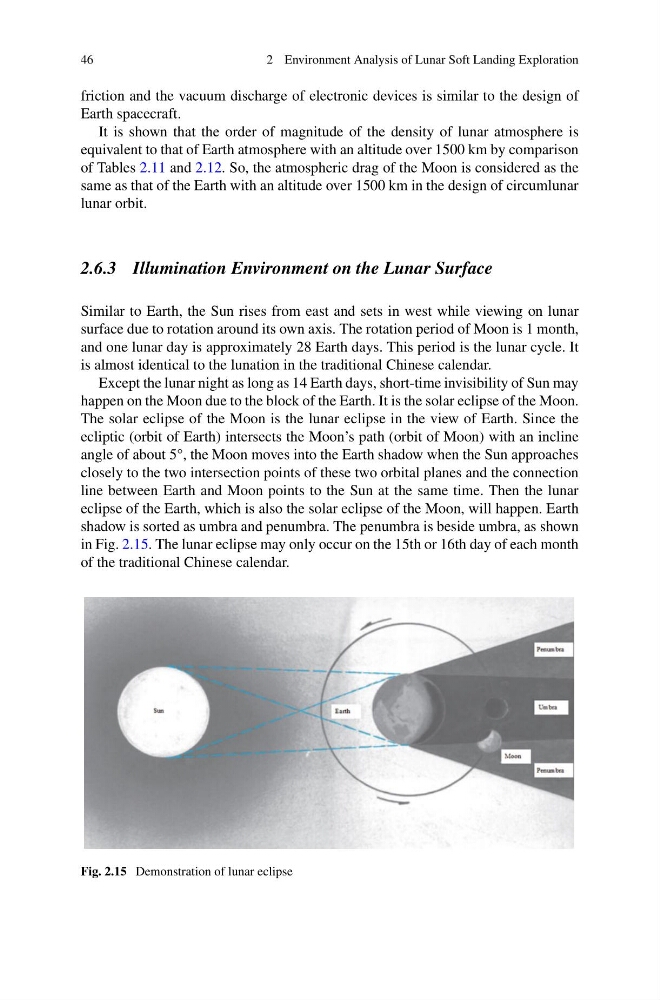
shadow is sorted as umbra and penumbra. The penumbra is beside umbra, as shown
in Fig. 2.15. The lunar eclipse may only occur on the 15th or 16th day of each month
of the traditional Chinese calendar.
Fig. 2.15 Demonstration of lunar eclipse
2 Environment Analysis of Lunar Soft Landing Exploration
friction and the vacuum discharge of electronic devices is similar to the design of
Earth spacecraft.
It is shown that the order of magnitude of the density of lunar atmosphere is
equivalent to that of Earth atmosphere with an altitude over 1500 km by comparison
of Tables 2.11 and 2.12. So, the atmospheric drag of the Moon is considered as the
same as that of the Earth with an altitude over 1500 km in the design of circumlunar
lunar orbit.
2.6.3 Illumination Environment on the Lunar Surface
Similar to Earth, the Sun rises from east and sets in west while viewing on lunar
surface due to rotation around its own axis. The rotation period of Moon is 1 month,
and one lunar day is approximately 28 Earth days. This period is the lunar cycle. It
is almost identical to the lunation in the traditional Chinese calendar.
Except the lunar night as long as 14 Earth days, short-time invisibility of Sun may
happen on the Moon due to the block of the Earth. It is the solar eclipse of the Moon.
The solar eclipse of the Moon is the lunar eclipse in the view of Earth. Since the
ecliptic (orbit of Earth) intersects the Moon’s path (orbit of Moon) with an incline
angle of about 5°, the Moon moves into the Earth shadow when the Sun approaches
closely to the two intersection points of these two orbital planes and the connection
line between Earth and Moon points to the Sun at the same time. Then the lunar
eclipse of the Earth, which is also the solar eclipse of the Moon, will happen. Earth
shadow is sorted as umbra and penumbra. The penumbra is beside umbra, as shown
in Fig. 2.15. The lunar eclipse may only occur on the 15th or 16th day of each month
of the traditional Chinese calendar.
Fig. 2.15 Demonstration of lunar eclipse