

32
2 Environment Analysis of Lunar Soft Landing Exploration
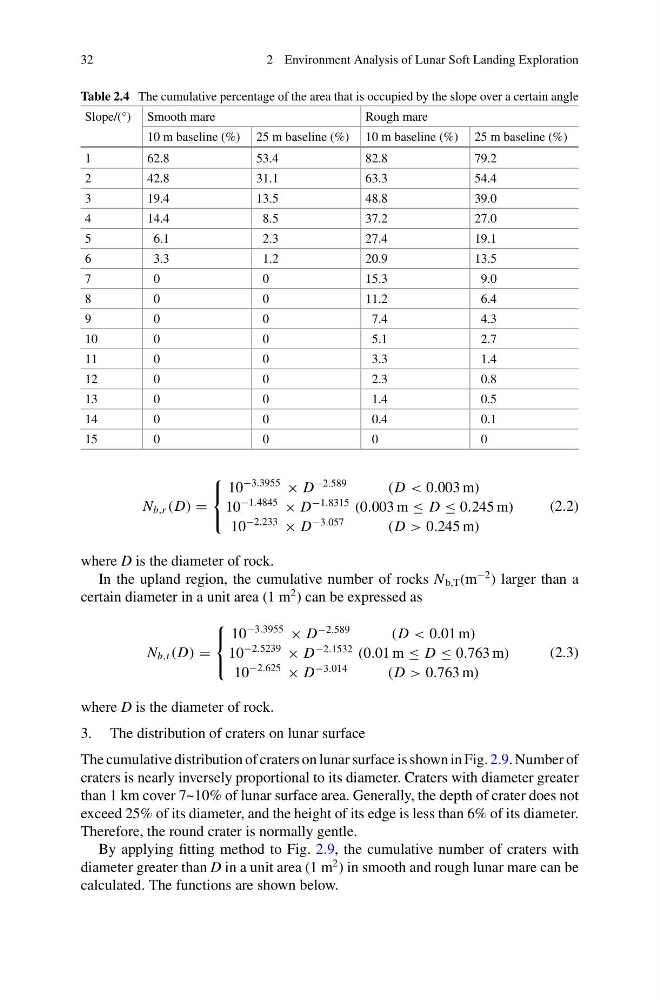
Table 2.4 The cumulative percentage of the area that is occupied by the slope over a certain angle
Slope/(°) Smooth mare
Rough mare
10 m baseline (%) 25 m baseline (%) 10 m baseline (%) 25 m baseline (%)
1
62.8
53.4
82.8
79.2
2
42.8
31.1
63.3
54.4
3
19.4
13.5
48.8
39.0
4
14.4
8.5
37.2
27.0
5
6.1
2.3
27.4
19.1
6
3.3
1.2
20.9
13.5
7
0
0
15.3
9.0
8
0
0
11.2
6.4
9
0
0
7.4
4.3
10
0
0
5.1
2.7
11
0
0
3.3
1.4
12
0
0
2.3
0.8
13
0
0
1.4
0.5
14
0
0
0.4
0.1
15
0
0
0
0
N b,r (D) =
⎧
⎨
⎩
10
−3.3955
× D
−2.589
(D < 0.003 m)
10
−1.4845
× D
−1.8315
(0.003 m ≤ D ≤ 0.245 m)
10
−2.233
× D
−3.057
(D > 0.245 m)
(2.2)
where D is the diameter of rock.
In the upland region, the cumulative number of rocks N b,T (m
−2 ) larger than a
certain diameter in a unit area (1 m
2 ) can be expressed as
N b,t (D) =
⎧
⎨
⎩
10
−3.3955
× D
−2.589
(D < 0.01 m)
10
−2.5239
× D
−2.1532
(0.01 m ≤ D ≤ 0.763 m)
10
−2.625
× D
−3.014
(D > 0.763 m)
(2.3)
where D is the diameter of rock.
3. The distribution of craters on lunar surface
The cumulative distribution of craters on lunar surface is shown in Fig. 2.9. Number of
craters is nearly inversely proportional to its diameter. Craters with diameter greater
than 1 km cover 7~10% of lunar surface area. Generally, the depth of crater does not
exceed 25% of its diameter, and the height of its edge is less than 6% of its diameter.
Therefore, the round crater is normally gentle.
By applying fitting method to Fig. 2.9, the cumulative number of craters with
diameter greater than D in a unit area (1 m
2 ) in smooth and rough lunar mare can be
calculated. The functions are shown below.
2 Environment Analysis of Lunar Soft Landing Exploration
Table 2.4 The cumulative percentage of the area that is occupied by the slope over a certain angle
Slope/(°) Smooth mare
Rough mare
10 m baseline (%) 25 m baseline (%) 10 m baseline (%) 25 m baseline (%)
1
62.8
53.4
82.8
79.2
2
42.8
31.1
63.3
54.4
3
19.4
13.5
48.8
39.0
4
14.4
8.5
37.2
27.0
5
6.1
2.3
27.4
19.1
6
3.3
1.2
20.9
13.5
7
0
0
15.3
9.0
8
0
0
11.2
6.4
9
0
0
7.4
4.3
10
0
0
5.1
2.7
11
0
0
3.3
1.4
12
0
0
2.3
0.8
13
0
0
1.4
0.5
14
0
0
0.4
0.1
15
0
0
0
0
N b,r (D) =
⎧
⎨
⎩
10
−3.3955
× D
−2.589
(D < 0.003 m)
10
−1.4845
× D
−1.8315
(0.003 m ≤ D ≤ 0.245 m)
10
−2.233
× D
−3.057
(D > 0.245 m)
(2.2)
where D is the diameter of rock.
In the upland region, the cumulative number of rocks N b,T (m
−2 ) larger than a
certain diameter in a unit area (1 m
2 ) can be expressed as
N b,t (D) =
⎧
⎨
⎩
10
−3.3955
× D
−2.589
(D < 0.01 m)
10
−2.5239
× D
−2.1532
(0.01 m ≤ D ≤ 0.763 m)
10
−2.625
× D
−3.014
(D > 0.763 m)
(2.3)
where D is the diameter of rock.
3. The distribution of craters on lunar surface
The cumulative distribution of craters on lunar surface is shown in Fig. 2.9. Number of
craters is nearly inversely proportional to its diameter. Craters with diameter greater
than 1 km cover 7~10% of lunar surface area. Generally, the depth of crater does not
exceed 25% of its diameter, and the height of its edge is less than 6% of its diameter.
Therefore, the round crater is normally gentle.
By applying fitting method to Fig. 2.9, the cumulative number of craters with
diameter greater than D in a unit area (1 m
2 ) in smooth and rough lunar mare can be
calculated. The functions are shown below.