

548
16 Scientific Instrument Technology of Lunar Lander
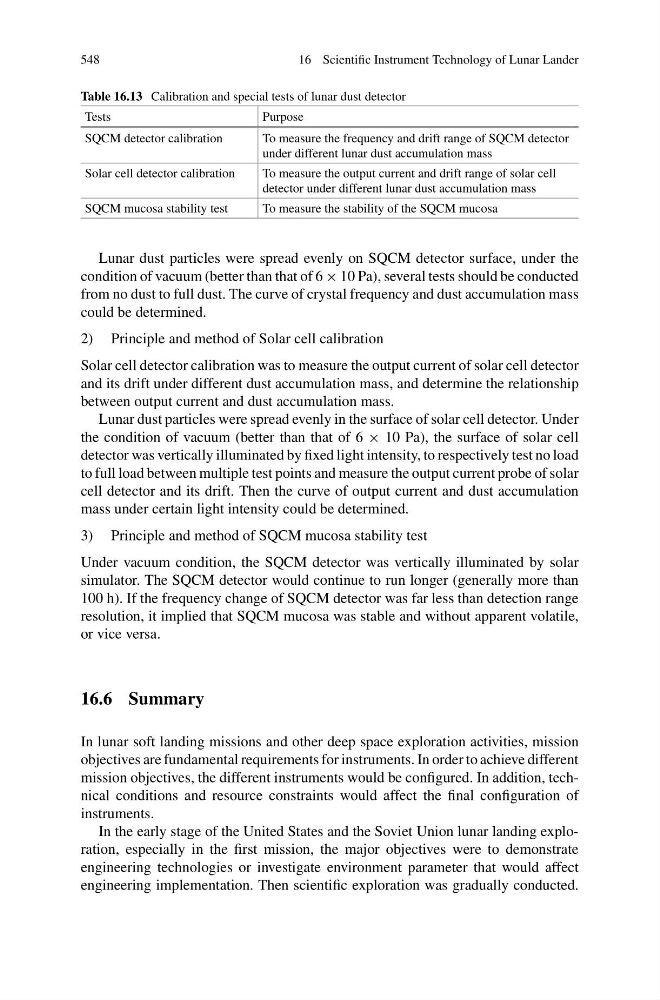
Table 16.13 Calibration and special tests of lunar dust detector
Tests
Purpose
SQCM detector calibration
To measure the frequency and drift range of SQCM detector
under different lunar dust accumulation mass
Solar cell detector calibration
To measure the output current and drift range of solar cell
detector under different lunar dust accumulation mass
SQCM mucosa stability test
To measure the stability of the SQCM mucosa
Lunar dust particles were spread evenly on SQCM detector surface, under the
condition of vacuum (better than that of 6 × 10 Pa), several tests should be conducted
from no dust to full dust. The curve of crystal frequency and dust accumulation mass
could be determined.
2) Principle and method of Solar cell calibration
Solar cell detector calibration was to measure the output current of solar cell detector
and its drift under different dust accumulation mass, and determine the relationship
between output current and dust accumulation mass.
Lunar dust particles were spread evenly in the surface of solar cell detector. Under
the condition of vacuum (better than that of 6 × 10 Pa), the surface of solar cell
detector was vertically illuminated by fixed light intensity, to respectively test no load
to full load between multiple test points and measure the output current probe of solar
cell detector and its drift. Then the curve of output current and dust accumulation
mass under certain light intensity could be determined.
3) Principle and method of SQCM mucosa stability test
Under vacuum condition, the SQCM detector was vertically illuminated by solar
simulator. The SQCM detector would continue to run longer (generally more than
100 h). If the frequency change of SQCM detector was far less than detection range
resolution, it implied that SQCM mucosa was stable and without apparent volatile,
or vice versa.
16.6 Summary
In lunar soft landing missions and other deep space exploration activities, mission
objectives are fundamental requirements for instruments. In order to achieve different
mission objectives, the different instruments would be configured. In addition, technical conditions and resource constraints would affect the final configuration of
instruments.
In the early stage of the United States and the Soviet Union lunar landing exploration, especially in the first mission, the major objectives were to demonstrate
engineering technologies or investigate environment parameter that would affect
engineering implementation. Then scientific exploration was gradually conducted.
16 Scientific Instrument Technology of Lunar Lander
Table 16.13 Calibration and special tests of lunar dust detector
Tests
Purpose
SQCM detector calibration
To measure the frequency and drift range of SQCM detector
under different lunar dust accumulation mass
Solar cell detector calibration
To measure the output current and drift range of solar cell
detector under different lunar dust accumulation mass
SQCM mucosa stability test
To measure the stability of the SQCM mucosa
Lunar dust particles were spread evenly on SQCM detector surface, under the
condition of vacuum (better than that of 6 × 10 Pa), several tests should be conducted
from no dust to full dust. The curve of crystal frequency and dust accumulation mass
could be determined.
2) Principle and method of Solar cell calibration
Solar cell detector calibration was to measure the output current of solar cell detector
and its drift under different dust accumulation mass, and determine the relationship
between output current and dust accumulation mass.
Lunar dust particles were spread evenly in the surface of solar cell detector. Under
the condition of vacuum (better than that of 6 × 10 Pa), the surface of solar cell
detector was vertically illuminated by fixed light intensity, to respectively test no load
to full load between multiple test points and measure the output current probe of solar
cell detector and its drift. Then the curve of output current and dust accumulation
mass under certain light intensity could be determined.
3) Principle and method of SQCM mucosa stability test
Under vacuum condition, the SQCM detector was vertically illuminated by solar
simulator. The SQCM detector would continue to run longer (generally more than
100 h). If the frequency change of SQCM detector was far less than detection range
resolution, it implied that SQCM mucosa was stable and without apparent volatile,
or vice versa.
16.6 Summary
In lunar soft landing missions and other deep space exploration activities, mission
objectives are fundamental requirements for instruments. In order to achieve different
mission objectives, the different instruments would be configured. In addition, technical conditions and resource constraints would affect the final configuration of
instruments.
In the early stage of the United States and the Soviet Union lunar landing exploration, especially in the first mission, the major objectives were to demonstrate
engineering technologies or investigate environment parameter that would affect
engineering implementation. Then scientific exploration was gradually conducted.