

496
15 System Testing and Validation Technology of Lunar Lander
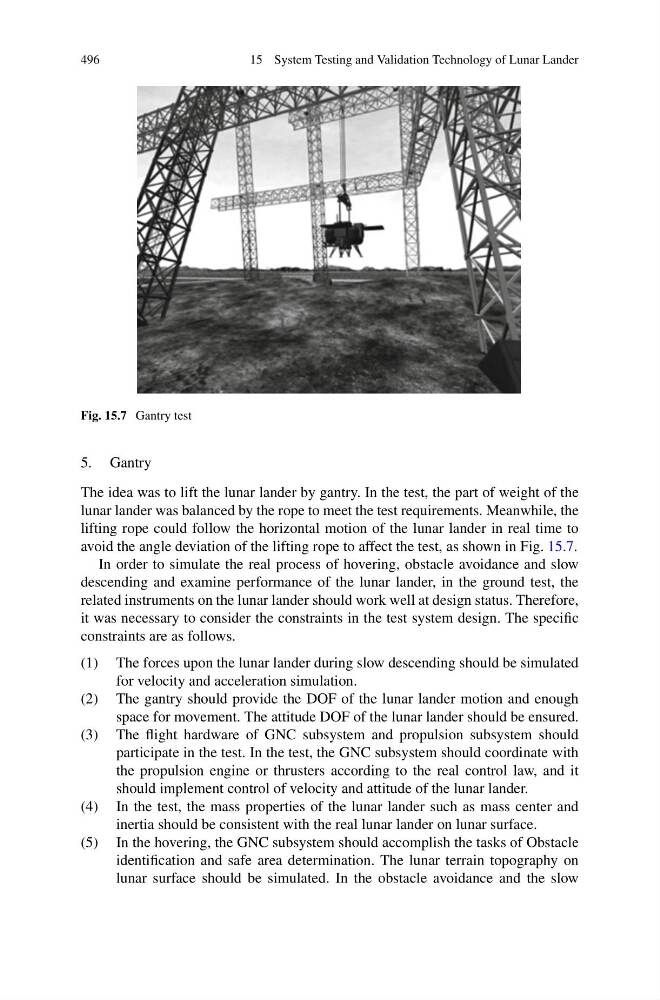
Fig. 15.7 Gantry test
5. Gantry
The idea was to lift the lunar lander by gantry. In the test, the part of weight of the
lunar lander was balanced by the rope to meet the test requirements. Meanwhile, the
lifting rope could follow the horizontal motion of the lunar lander in real time to
avoid the angle deviation of the lifting rope to affect the test, as shown in Fig. 15.7.
In order to simulate the real process of hovering, obstacle avoidance and slow
descending and examine performance of the lunar lander, in the ground test, the
related instruments on the lunar lander should work well at design status. Therefore,
it was necessary to consider the constraints in the test system design. The specific
constraints are as follows.
(1) The forces upon the lunar lander during slow descending should be simulated
for velocity and acceleration simulation.
(2) The gantry should provide the DOF of the lunar lander motion and enough
space for movement. The attitude DOF of the lunar lander should be ensured.
(3) The flight hardware of GNC subsystem and propulsion subsystem should
participate in the test. In the test, the GNC subsystem should coordinate with
the propulsion engine or thrusters according to the real control law, and it
should implement control of velocity and attitude of the lunar lander.
(4) In the test, the mass properties of the lunar lander such as mass center and
inertia should be consistent with the real lunar lander on lunar surface.
(5) In the hovering, the GNC subsystem should accomplish the tasks of Obstacle
identification and safe area determination. The lunar terrain topography on
lunar surface should be simulated. In the obstacle avoidance and the slow
15 System Testing and Validation Technology of Lunar Lander
Fig. 15.7 Gantry test
5. Gantry
The idea was to lift the lunar lander by gantry. In the test, the part of weight of the
lunar lander was balanced by the rope to meet the test requirements. Meanwhile, the
lifting rope could follow the horizontal motion of the lunar lander in real time to
avoid the angle deviation of the lifting rope to affect the test, as shown in Fig. 15.7.
In order to simulate the real process of hovering, obstacle avoidance and slow
descending and examine performance of the lunar lander, in the ground test, the
related instruments on the lunar lander should work well at design status. Therefore,
it was necessary to consider the constraints in the test system design. The specific
constraints are as follows.
(1) The forces upon the lunar lander during slow descending should be simulated
for velocity and acceleration simulation.
(2) The gantry should provide the DOF of the lunar lander motion and enough
space for movement. The attitude DOF of the lunar lander should be ensured.
(3) The flight hardware of GNC subsystem and propulsion subsystem should
participate in the test. In the test, the GNC subsystem should coordinate with
the propulsion engine or thrusters according to the real control law, and it
should implement control of velocity and attitude of the lunar lander.
(4) In the test, the mass properties of the lunar lander such as mass center and
inertia should be consistent with the real lunar lander on lunar surface.
(5) In the hovering, the GNC subsystem should accomplish the tasks of Obstacle
identification and safe area determination. The lunar terrain topography on
lunar surface should be simulated. In the obstacle avoidance and the slow