

492
15 System Testing and Validation Technology of Lunar Lander
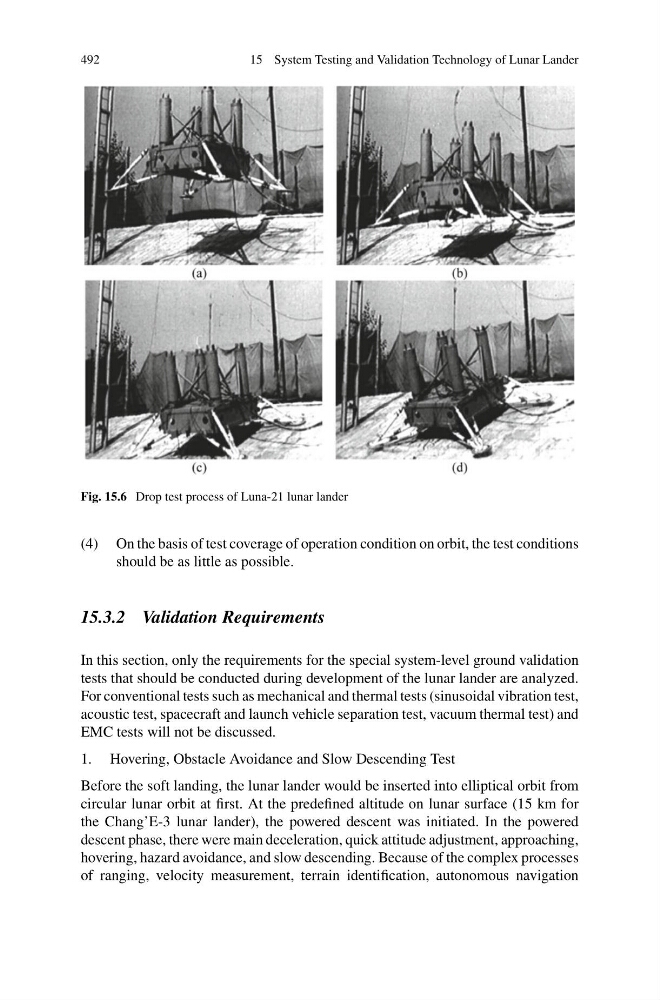
Fig. 15.6 Drop test process of Luna-21 lunar lander
(4) On the basis of test coverage of operation condition on orbit, the test conditions
should be as little as possible.
15.3.2 Validation Requirements
In this section, only the requirements for the special system-level ground validation
tests that should be conducted during development of the lunar lander are analyzed.
For conventional tests such as mechanical and thermal tests (sinusoidal vibration test,
acoustic test, spacecraft and launch vehicle separation test, vacuum thermal test) and
EMC tests will not be discussed.
1. Hovering, Obstacle Avoidance and Slow Descending Test
Before the soft landing, the lunar lander would be inserted into elliptical orbit from
circular lunar orbit at first. At the predefined altitude on lunar surface (15 km for
the Chang’E-3 lunar lander), the powered descent was initiated. In the powered
descent phase, there were main deceleration, quick attitude adjustment, approaching,
hovering, hazard avoidance, and slow descending. Because of the complex processes
of ranging, velocity measurement, terrain identification, autonomous navigation
15 System Testing and Validation Technology of Lunar Lander
Fig. 15.6 Drop test process of Luna-21 lunar lander
(4) On the basis of test coverage of operation condition on orbit, the test conditions
should be as little as possible.
15.3.2 Validation Requirements
In this section, only the requirements for the special system-level ground validation
tests that should be conducted during development of the lunar lander are analyzed.
For conventional tests such as mechanical and thermal tests (sinusoidal vibration test,
acoustic test, spacecraft and launch vehicle separation test, vacuum thermal test) and
EMC tests will not be discussed.
1. Hovering, Obstacle Avoidance and Slow Descending Test
Before the soft landing, the lunar lander would be inserted into elliptical orbit from
circular lunar orbit at first. At the predefined altitude on lunar surface (15 km for
the Chang’E-3 lunar lander), the powered descent was initiated. In the powered
descent phase, there were main deceleration, quick attitude adjustment, approaching,
hovering, hazard avoidance, and slow descending. Because of the complex processes
of ranging, velocity measurement, terrain identification, autonomous navigation