

9.4 Design Methodology
325
maintainability and inheritance of the operating system was fully considered, the
OBDH SMU software of the Chang’E-3 lunar lander applied ASOS as the central
computer operating system. The major software functions are as follows.
(1) To support multitasking.
(2) To support task scheduling mechanism based on priority preemption.
(3) To support the operation management and maintenance of ERC32 processor.
(4) To provide timers.
(5) To support synchronous and asynchronous interrupt management for ERC32
processors.
(6) To support multi-task communication.
(7) To support static memory allocation and management mechanism.
(8) To support management and maintenance of common serial port operations.
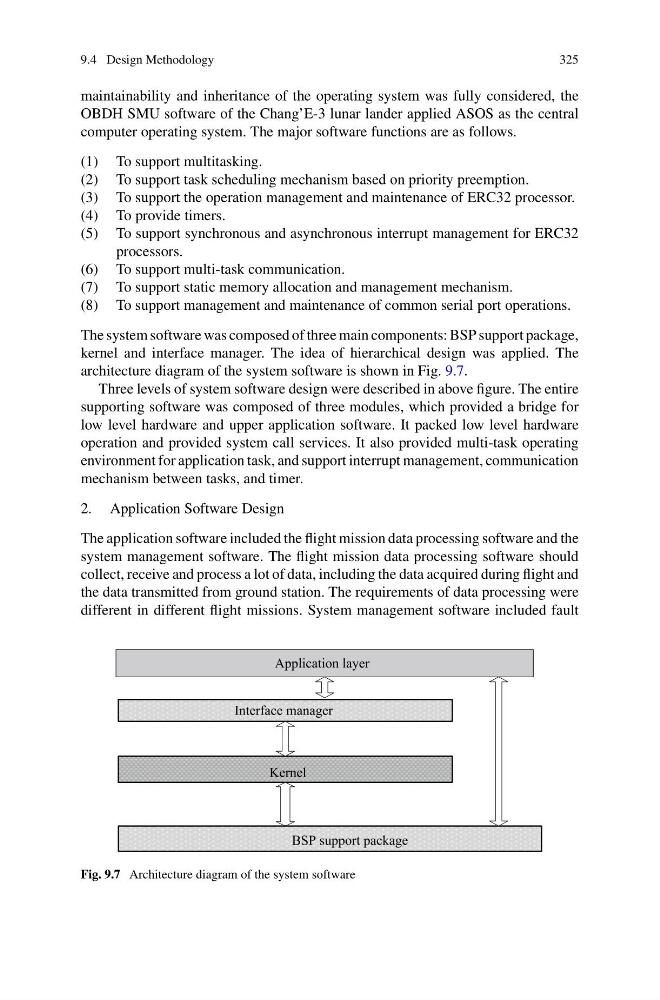
The system software was composed of three main components: BSP support package,
kernel and interface manager. The idea of hierarchical design was applied. The
architecture diagram of the system software is shown in Fig. 9.7.
Three levels of system software design were described in above figure. The entire
supporting software was composed of three modules, which provided a bridge for
low level hardware and upper application software. It packed low level hardware
operation and provided system call services. It also provided multi-task operating
environment for application task, and support interrupt management, communication
mechanism between tasks, and timer.
2. Application Software Design
The application software included the flight mission data processing software and the
system management software. The flight mission data processing software should
collect, receive and process a lot of data, including the data acquired during flight and
the data transmitted from ground station. The requirements of data processing were
different in different flight missions. System management software included fault
Fig. 9.7 Architecture diagram of the system software
325
maintainability and inheritance of the operating system was fully considered, the
OBDH SMU software of the Chang’E-3 lunar lander applied ASOS as the central
computer operating system. The major software functions are as follows.
(1) To support multitasking.
(2) To support task scheduling mechanism based on priority preemption.
(3) To support the operation management and maintenance of ERC32 processor.
(4) To provide timers.
(5) To support synchronous and asynchronous interrupt management for ERC32
processors.
(6) To support multi-task communication.
(7) To support static memory allocation and management mechanism.
(8) To support management and maintenance of common serial port operations.
The system software was composed of three main components: BSP support package,
kernel and interface manager. The idea of hierarchical design was applied. The
architecture diagram of the system software is shown in Fig. 9.7.
Three levels of system software design were described in above figure. The entire
supporting software was composed of three modules, which provided a bridge for
low level hardware and upper application software. It packed low level hardware
operation and provided system call services. It also provided multi-task operating
environment for application task, and support interrupt management, communication
mechanism between tasks, and timer.
2. Application Software Design
The application software included the flight mission data processing software and the
system management software. The flight mission data processing software should
collect, receive and process a lot of data, including the data acquired during flight and
the data transmitted from ground station. The requirements of data processing were
different in different flight missions. System management software included fault
Fig. 9.7 Architecture diagram of the system software