

296
8 Propulsion Technology of Lunar Lander
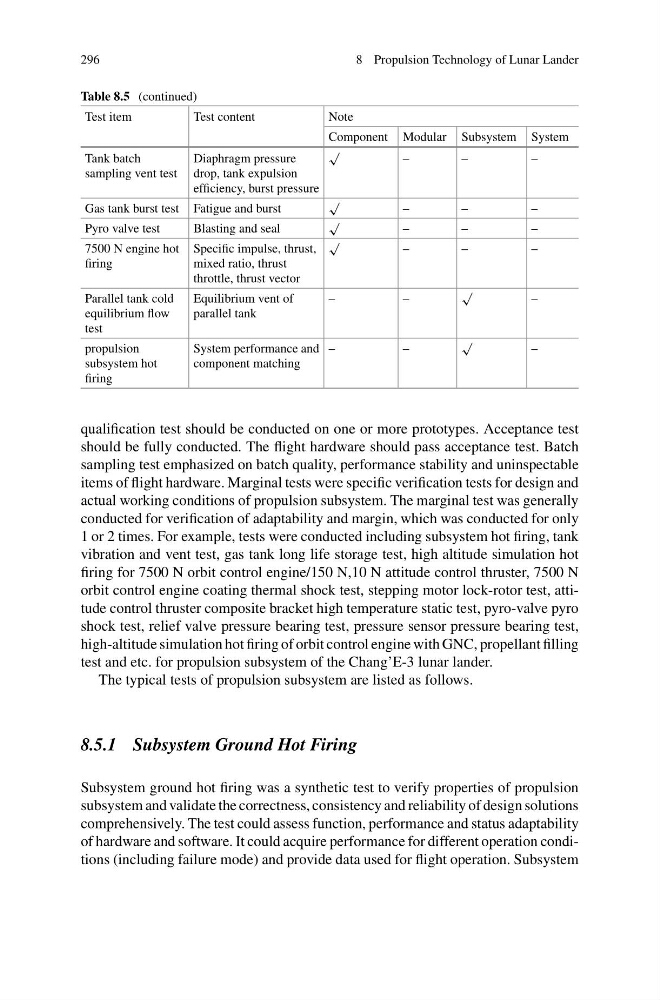
Table 8.5 (continued)
Test item
Test content
Note
Component Modular Subsystem System
Tank batch
sampling vent test
Diaphragm pressure
drop, tank expulsion
efficiency, burst pressure
√
–
–
–
Gas tank burst test Fatigue and burst
√
–
–
–
Pyro valve test
Blasting and seal
√
–
–
–
7500 N engine hot
firing
Specific impulse, thrust,
mixed ratio, thrust
throttle, thrust vector
√
–
–
–
Parallel tank cold
equilibrium flow
test
Equilibrium vent of
parallel tank
–
–
√
–
propulsion
subsystem hot
firing
System performance and
component matching
–
–
√
–
qualification test should be conducted on one or more prototypes. Acceptance test
should be fully conducted. The flight hardware should pass acceptance test. Batch
sampling test emphasized on batch quality, performance stability and uninspectable
items of flight hardware. Marginal tests were specific verification tests for design and
actual working conditions of propulsion subsystem. The marginal test was generally
conducted for verification of adaptability and margin, which was conducted for only
1 or 2 times. For example, tests were conducted including subsystem hot firing, tank
vibration and vent test, gas tank long life storage test, high altitude simulation hot
firing for 7500 N orbit control engine/150 N,10 N attitude control thruster, 7500 N
orbit control engine coating thermal shock test, stepping motor lock-rotor test, attitude control thruster composite bracket high temperature static test, pyro-valve pyro
shock test, relief valve pressure bearing test, pressure sensor pressure bearing test,
high-altitude simulation hot firing of orbit control engine with GNC, propellant filling
test and etc. for propulsion subsystem of the Chang’E-3 lunar lander.
The typical tests of propulsion subsystem are listed as follows.
8.5.1 Subsystem Ground Hot Firing
Subsystem ground hot firing was a synthetic test to verify properties of propulsion
subsystem and validate the correctness, consistency and reliability of design solutions
comprehensively. The test could assess function, performance and status adaptability
of hardware and software. It could acquire performance for different operation conditions (including failure mode) and provide data used for flight operation. Subsystem
8 Propulsion Technology of Lunar Lander
Table 8.5 (continued)
Test item
Test content
Note
Component Modular Subsystem System
Tank batch
sampling vent test
Diaphragm pressure
drop, tank expulsion
efficiency, burst pressure
√
–
–
–
Gas tank burst test Fatigue and burst
√
–
–
–
Pyro valve test
Blasting and seal
√
–
–
–
7500 N engine hot
firing
Specific impulse, thrust,
mixed ratio, thrust
throttle, thrust vector
√
–
–
–
Parallel tank cold
equilibrium flow
test
Equilibrium vent of
parallel tank
–
–
√
–
propulsion
subsystem hot
firing
System performance and
component matching
–
–
√
–
qualification test should be conducted on one or more prototypes. Acceptance test
should be fully conducted. The flight hardware should pass acceptance test. Batch
sampling test emphasized on batch quality, performance stability and uninspectable
items of flight hardware. Marginal tests were specific verification tests for design and
actual working conditions of propulsion subsystem. The marginal test was generally
conducted for verification of adaptability and margin, which was conducted for only
1 or 2 times. For example, tests were conducted including subsystem hot firing, tank
vibration and vent test, gas tank long life storage test, high altitude simulation hot
firing for 7500 N orbit control engine/150 N,10 N attitude control thruster, 7500 N
orbit control engine coating thermal shock test, stepping motor lock-rotor test, attitude control thruster composite bracket high temperature static test, pyro-valve pyro
shock test, relief valve pressure bearing test, pressure sensor pressure bearing test,
high-altitude simulation hot firing of orbit control engine with GNC, propellant filling
test and etc. for propulsion subsystem of the Chang’E-3 lunar lander.
The typical tests of propulsion subsystem are listed as follows.
8.5.1 Subsystem Ground Hot Firing
Subsystem ground hot firing was a synthetic test to verify properties of propulsion
subsystem and validate the correctness, consistency and reliability of design solutions
comprehensively. The test could assess function, performance and status adaptability
of hardware and software. It could acquire performance for different operation conditions (including failure mode) and provide data used for flight operation. Subsystem