

8.2 Development Status [2, 3]
273
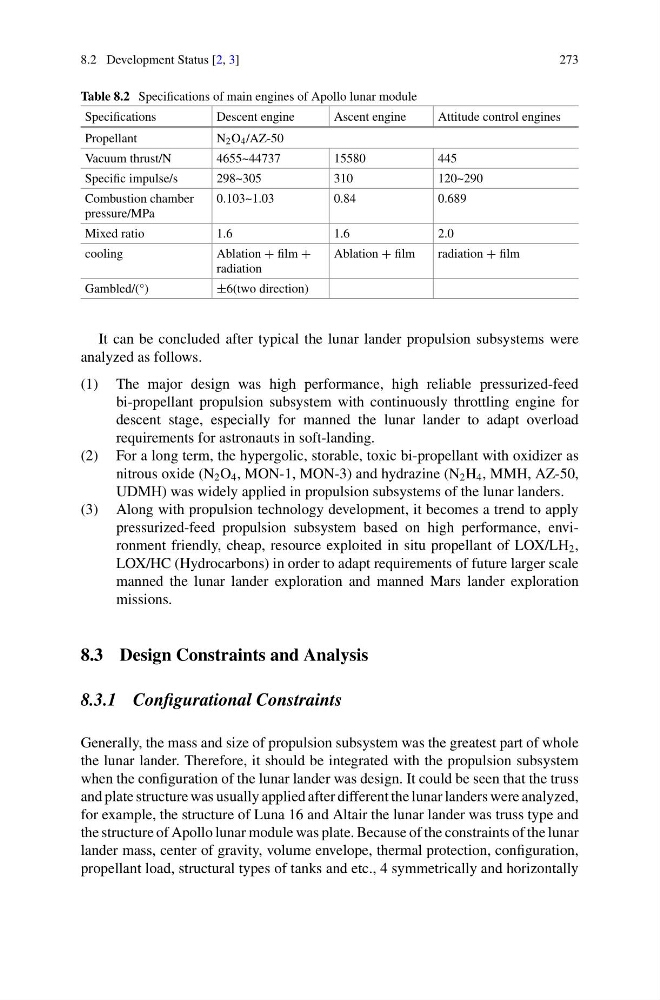
Table 8.2 Specifications of main engines of Apollo lunar module
Specifications
Descent engine
Ascent engine
Attitude control engines
Propellant
N 2 O 4 /AZ-50
Vacuum thrust/N
4655~44737
15580
445
Specific impulse/s
298~305
310
120~290
Combustion chamber
pressure/MPa
0.103~1.03
0.84
0.689
Mixed ratio
1.6
1.6
2.0
cooling
Ablation + film +
radiation
Ablation + film
radiation + film
Gambled/(°)
±6(two direction)
It can be concluded after typical the lunar lander propulsion subsystems were
analyzed as follows.
(1) The major design was high performance, high reliable pressurized-feed
bi-propellant propulsion subsystem with continuously throttling engine for
descent stage, especially for manned the lunar lander to adapt overload
requirements for astronauts in soft-landing.
(2) For a long term, the hypergolic, storable, toxic bi-propellant with oxidizer as
nitrous oxide (N 2 O 4 , MON-1, MON-3) and hydrazine (N 2 H 4 , MMH, AZ-50,
UDMH) was widely applied in propulsion subsystems of the lunar landers.
(3) Along with propulsion technology development, it becomes a trend to apply
pressurized-feed propulsion subsystem based on high performance, environment friendly, cheap, resource exploited in situ propellant of LOX/LH 2 ,
LOX/HC (Hydrocarbons) in order to adapt requirements of future larger scale
manned the lunar lander exploration and manned Mars lander exploration
missions.
8.3 Design Constraints and Analysis
8.3.1 Configurational Constraints
Generally, the mass and size of propulsion subsystem was the greatest part of whole
the lunar lander. Therefore, it should be integrated with the propulsion subsystem
when the configuration of the lunar lander was design. It could be seen that the truss
and plate structure was usually applied after different the lunar landers were analyzed,
for example, the structure of Luna 16 and Altair the lunar lander was truss type and
the structure of Apollo lunar module was plate. Because of the constraints of the lunar
lander mass, center of gravity, volume envelope, thermal protection, configuration,
propellant load, structural types of tanks and etc., 4 symmetrically and horizontally
273
Table 8.2 Specifications of main engines of Apollo lunar module
Specifications
Descent engine
Ascent engine
Attitude control engines
Propellant
N 2 O 4 /AZ-50
Vacuum thrust/N
4655~44737
15580
445
Specific impulse/s
298~305
310
120~290
Combustion chamber
pressure/MPa
0.103~1.03
0.84
0.689
Mixed ratio
1.6
1.6
2.0
cooling
Ablation + film +
radiation
Ablation + film
radiation + film
Gambled/(°)
±6(two direction)
It can be concluded after typical the lunar lander propulsion subsystems were
analyzed as follows.
(1) The major design was high performance, high reliable pressurized-feed
bi-propellant propulsion subsystem with continuously throttling engine for
descent stage, especially for manned the lunar lander to adapt overload
requirements for astronauts in soft-landing.
(2) For a long term, the hypergolic, storable, toxic bi-propellant with oxidizer as
nitrous oxide (N 2 O 4 , MON-1, MON-3) and hydrazine (N 2 H 4 , MMH, AZ-50,
UDMH) was widely applied in propulsion subsystems of the lunar landers.
(3) Along with propulsion technology development, it becomes a trend to apply
pressurized-feed propulsion subsystem based on high performance, environment friendly, cheap, resource exploited in situ propellant of LOX/LH 2 ,
LOX/HC (Hydrocarbons) in order to adapt requirements of future larger scale
manned the lunar lander exploration and manned Mars lander exploration
missions.
8.3 Design Constraints and Analysis
8.3.1 Configurational Constraints
Generally, the mass and size of propulsion subsystem was the greatest part of whole
the lunar lander. Therefore, it should be integrated with the propulsion subsystem
when the configuration of the lunar lander was design. It could be seen that the truss
and plate structure was usually applied after different the lunar landers were analyzed,
for example, the structure of Luna 16 and Altair the lunar lander was truss type and
the structure of Apollo lunar module was plate. Because of the constraints of the lunar
lander mass, center of gravity, volume envelope, thermal protection, configuration,
propellant load, structural types of tanks and etc., 4 symmetrically and horizontally