

7.5 Typical Technology
251
to identify and avoid obstacles; The formation of a well downward trajectory should
be considered so that the landing area could be observed when the guidance law was
designed for the phase. The guidance law for final descent phase was designed to
ensure that the lunar lander was landed on lunar surface smoothly. The design of the
guidance laws for the powered descent process of the Chang’E-3 lunar lander are as
follows.
1. Guidance Law for Main Deceleration
The main deceleration was the mission segment when the soft-landing process
took the longest and the propellant was consumed the most. The main task of this
phase was to eliminate the large initial horizontal velocity of the powered descent
process (about 1.7 km/s). Therefore, the optimization of propellant consumption
was the main design goal for guidance law of this phase. In addition, the autonomy
and engineering feasibility should be taken into consideration. The linear tangent
guidance law was close to fuel optimal, and the resulting attitude command was nearly
linear, and the change was more gradual, which was conducive to the realization of
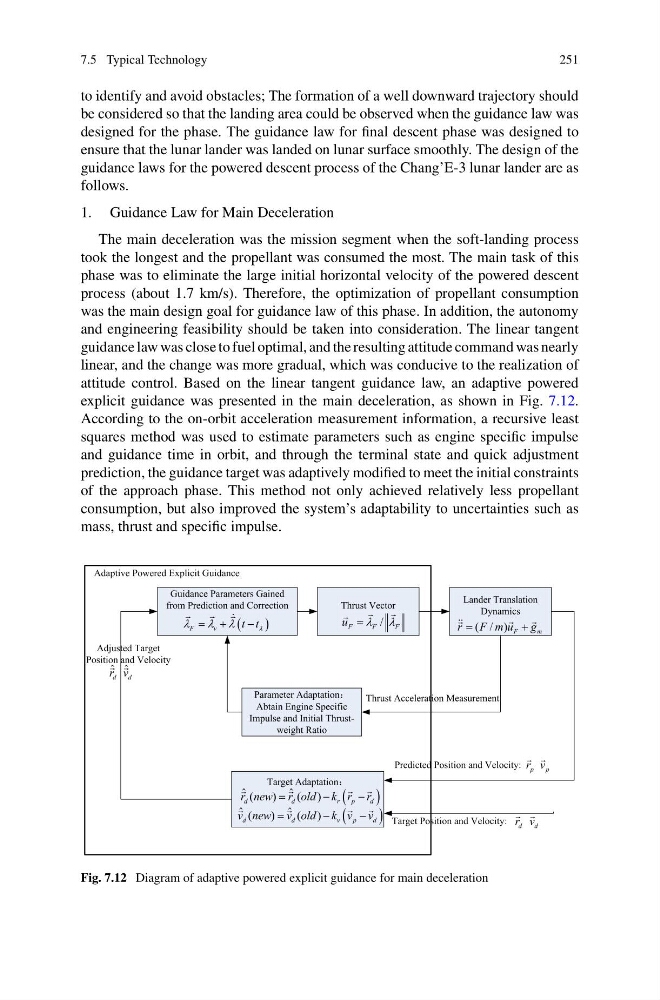
attitude control. Based on the linear tangent guidance law, an adaptive powered
explicit guidance was presented in the main deceleration, as shown in Fig. 7.12.
According to the on-orbit acceleration measurement information, a recursive least
squares method was used to estimate parameters such as engine specific impulse
and guidance time in orbit, and through the terminal state and quick adjustment
prediction, the guidance target was adaptively modified to meet the initial constraints
of the approach phase. This method not only achieved relatively less propellant
consumption, but also improved the system’s adaptability to uncertainties such as
mass, thrust and specific impulse.
Fig. 7.12 Diagram of adaptive powered explicit guidance for main deceleration
251
to identify and avoid obstacles; The formation of a well downward trajectory should
be considered so that the landing area could be observed when the guidance law was
designed for the phase. The guidance law for final descent phase was designed to
ensure that the lunar lander was landed on lunar surface smoothly. The design of the
guidance laws for the powered descent process of the Chang’E-3 lunar lander are as
follows.
1. Guidance Law for Main Deceleration
The main deceleration was the mission segment when the soft-landing process
took the longest and the propellant was consumed the most. The main task of this
phase was to eliminate the large initial horizontal velocity of the powered descent
process (about 1.7 km/s). Therefore, the optimization of propellant consumption
was the main design goal for guidance law of this phase. In addition, the autonomy
and engineering feasibility should be taken into consideration. The linear tangent
guidance law was close to fuel optimal, and the resulting attitude command was nearly
linear, and the change was more gradual, which was conducive to the realization of
attitude control. Based on the linear tangent guidance law, an adaptive powered
explicit guidance was presented in the main deceleration, as shown in Fig. 7.12.
According to the on-orbit acceleration measurement information, a recursive least
squares method was used to estimate parameters such as engine specific impulse
and guidance time in orbit, and through the terminal state and quick adjustment
prediction, the guidance target was adaptively modified to meet the initial constraints
of the approach phase. This method not only achieved relatively less propellant
consumption, but also improved the system’s adaptability to uncertainties such as
mass, thrust and specific impulse.
Fig. 7.12 Diagram of adaptive powered explicit guidance for main deceleration