

6.3 Mission Requirements and Characteristics
205
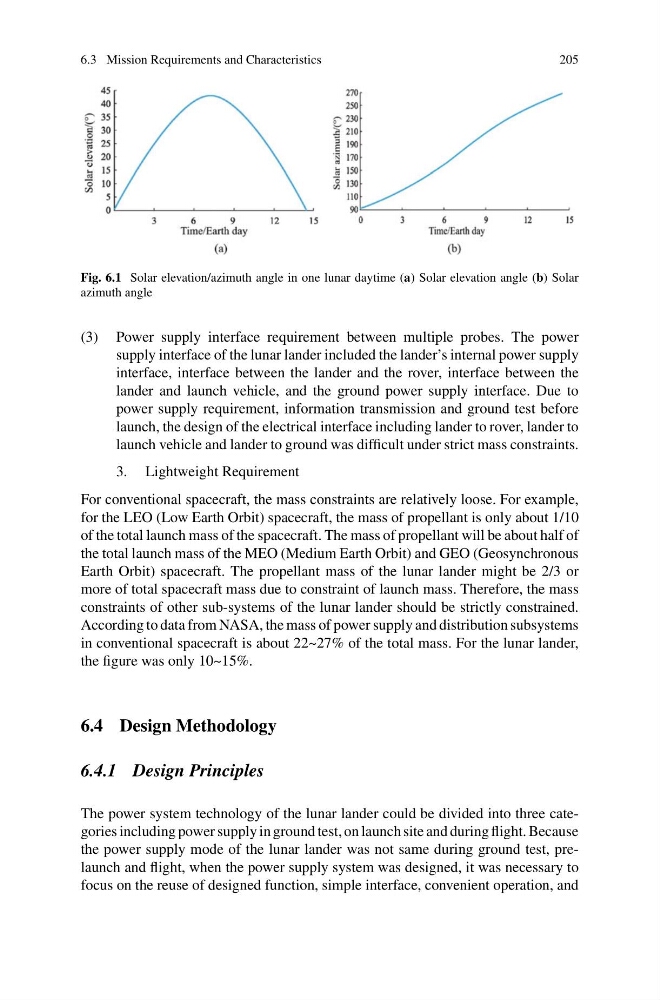
Fig. 6.1 Solar elevation/azimuth angle in one lunar daytime (a) Solar elevation angle (b) Solar
azimuth angle
(3) Power supply interface requirement between multiple probes. The power
supply interface of the lunar lander included the lander’s internal power supply
interface, interface between the lander and the rover, interface between the
lander and launch vehicle, and the ground power supply interface. Due to
power supply requirement, information transmission and ground test before
launch, the design of the electrical interface including lander to rover, lander to
launch vehicle and lander to ground was difficult under strict mass constraints.
3. Lightweight Requirement
For conventional spacecraft, the mass constraints are relatively loose. For example,
for the LEO (Low Earth Orbit) spacecraft, the mass of propellant is only about 1/10
of the total launch mass of the spacecraft. The mass of propellant will be about half of
the total launch mass of the MEO (Medium Earth Orbit) and GEO (Geosynchronous
Earth Orbit) spacecraft. The propellant mass of the lunar lander might be 2/3 or
more of total spacecraft mass due to constraint of launch mass. Therefore, the mass
constraints of other sub-systems of the lunar lander should be strictly constrained.
According to data from NASA, the mass of power supply and distribution subsystems
in conventional spacecraft is about 22~27% of the total mass. For the lunar lander,
the figure was only 10~15%.
6.4 Design Methodology
6.4.1 Design Principles
The power system technology of the lunar lander could be divided into three categories including power supply in ground test, on launch site and during flight. Because
the power supply mode of the lunar lander was not same during ground test, prelaunch and flight, when the power supply system was designed, it was necessary to
focus on the reuse of designed function, simple interface, convenient operation, and
205
Fig. 6.1 Solar elevation/azimuth angle in one lunar daytime (a) Solar elevation angle (b) Solar
azimuth angle
(3) Power supply interface requirement between multiple probes. The power
supply interface of the lunar lander included the lander’s internal power supply
interface, interface between the lander and the rover, interface between the
lander and launch vehicle, and the ground power supply interface. Due to
power supply requirement, information transmission and ground test before
launch, the design of the electrical interface including lander to rover, lander to
launch vehicle and lander to ground was difficult under strict mass constraints.
3. Lightweight Requirement
For conventional spacecraft, the mass constraints are relatively loose. For example,
for the LEO (Low Earth Orbit) spacecraft, the mass of propellant is only about 1/10
of the total launch mass of the spacecraft. The mass of propellant will be about half of
the total launch mass of the MEO (Medium Earth Orbit) and GEO (Geosynchronous
Earth Orbit) spacecraft. The propellant mass of the lunar lander might be 2/3 or
more of total spacecraft mass due to constraint of launch mass. Therefore, the mass
constraints of other sub-systems of the lunar lander should be strictly constrained.
According to data from NASA, the mass of power supply and distribution subsystems
in conventional spacecraft is about 22~27% of the total mass. For the lunar lander,
the figure was only 10~15%.
6.4 Design Methodology
6.4.1 Design Principles
The power system technology of the lunar lander could be divided into three categories including power supply in ground test, on launch site and during flight. Because
the power supply mode of the lunar lander was not same during ground test, prelaunch and flight, when the power supply system was designed, it was necessary to
focus on the reuse of designed function, simple interface, convenient operation, and