

5.2 Current Status of Thermal Control Technology
153
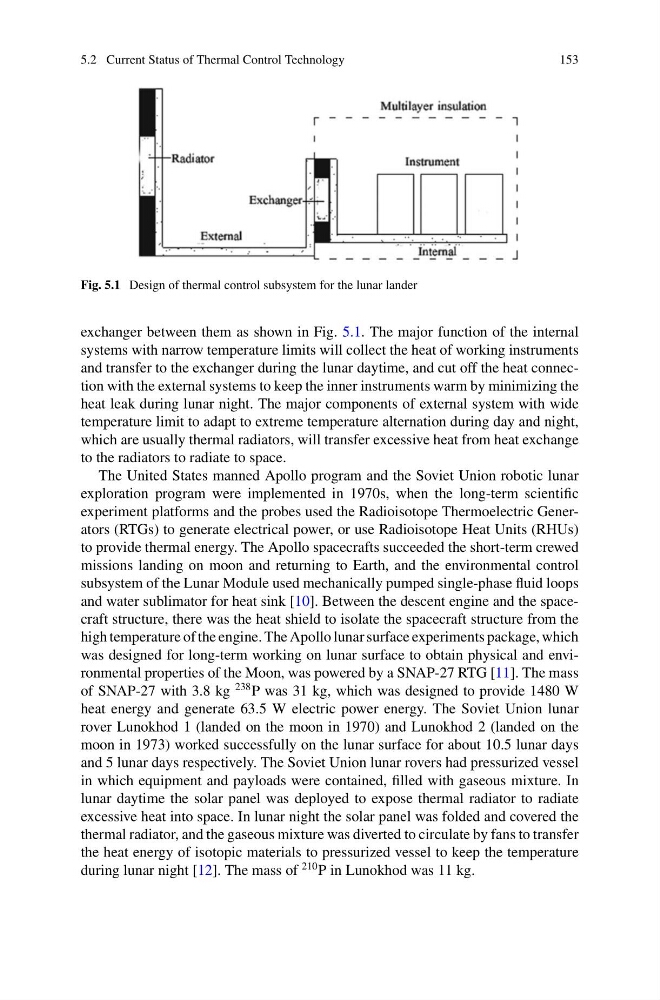
Fig. 5.1 Design of thermal control subsystem for the lunar lander
exchanger between them as shown in Fig. 5.1. The major function of the internal
systems with narrow temperature limits will collect the heat of working instruments
and transfer to the exchanger during the lunar daytime, and cut off the heat connection with the external systems to keep the inner instruments warm by minimizing the
heat leak during lunar night. The major components of external system with wide
temperature limit to adapt to extreme temperature alternation during day and night,
which are usually thermal radiators, will transfer excessive heat from heat exchange
to the radiators to radiate to space.
The United States manned Apollo program and the Soviet Union robotic lunar
exploration program were implemented in 1970s, when the long-term scientific
experiment platforms and the probes used the Radioisotope Thermoelectric Generators (RTGs) to generate electrical power, or use Radioisotope Heat Units (RHUs)
to provide thermal energy. The Apollo spacecrafts succeeded the short-term crewed
missions landing on moon and returning to Earth, and the environmental control
subsystem of the Lunar Module used mechanically pumped single-phase fluid loops
and water sublimator for heat sink [10]. Between the descent engine and the spacecraft structure, there was the heat shield to isolate the spacecraft structure from the
high temperature of the engine. The Apollo lunar surface experiments package, which
was designed for long-term working on lunar surface to obtain physical and environmental properties of the Moon, was powered by a SNAP-27 RTG [11]. The mass
of SNAP-27 with 3.8 kg
238 P was 31 kg, which was designed to provide 1480 W
heat energy and generate 63.5 W electric power energy. The Soviet Union lunar
rover Lunokhod 1 (landed on the moon in 1970) and Lunokhod 2 (landed on the
moon in 1973) worked successfully on the lunar surface for about 10.5 lunar days
and 5 lunar days respectively. The Soviet Union lunar rovers had pressurized vessel
in which equipment and payloads were contained, filled with gaseous mixture. In
lunar daytime the solar panel was deployed to expose thermal radiator to radiate
excessive heat into space. In lunar night the solar panel was folded and covered the
thermal radiator, and the gaseous mixture was diverted to circulate by fans to transfer
the heat energy of isotopic materials to pressurized vessel to keep the temperature
during lunar night [12]. The mass of
210 P in Lunokhod was 11 kg.
153
Fig. 5.1 Design of thermal control subsystem for the lunar lander
exchanger between them as shown in Fig. 5.1. The major function of the internal
systems with narrow temperature limits will collect the heat of working instruments
and transfer to the exchanger during the lunar daytime, and cut off the heat connection with the external systems to keep the inner instruments warm by minimizing the
heat leak during lunar night. The major components of external system with wide
temperature limit to adapt to extreme temperature alternation during day and night,
which are usually thermal radiators, will transfer excessive heat from heat exchange
to the radiators to radiate to space.
The United States manned Apollo program and the Soviet Union robotic lunar
exploration program were implemented in 1970s, when the long-term scientific
experiment platforms and the probes used the Radioisotope Thermoelectric Generators (RTGs) to generate electrical power, or use Radioisotope Heat Units (RHUs)
to provide thermal energy. The Apollo spacecrafts succeeded the short-term crewed
missions landing on moon and returning to Earth, and the environmental control
subsystem of the Lunar Module used mechanically pumped single-phase fluid loops
and water sublimator for heat sink [10]. Between the descent engine and the spacecraft structure, there was the heat shield to isolate the spacecraft structure from the
high temperature of the engine. The Apollo lunar surface experiments package, which
was designed for long-term working on lunar surface to obtain physical and environmental properties of the Moon, was powered by a SNAP-27 RTG [11]. The mass
of SNAP-27 with 3.8 kg
238 P was 31 kg, which was designed to provide 1480 W
heat energy and generate 63.5 W electric power energy. The Soviet Union lunar
rover Lunokhod 1 (landed on the moon in 1970) and Lunokhod 2 (landed on the
moon in 1973) worked successfully on the lunar surface for about 10.5 lunar days
and 5 lunar days respectively. The Soviet Union lunar rovers had pressurized vessel
in which equipment and payloads were contained, filled with gaseous mixture. In
lunar daytime the solar panel was deployed to expose thermal radiator to radiate
excessive heat into space. In lunar night the solar panel was folded and covered the
thermal radiator, and the gaseous mixture was diverted to circulate by fans to transfer
the heat energy of isotopic materials to pressurized vessel to keep the temperature
during lunar night [12]. The mass of
210 P in Lunokhod was 11 kg.