

128
4 Structure and Mechanism Technology of Lunar Lander
(2) The solar panel mechanism had sufficient capability of driving and position
maintenance with load under mechanical and thermal environmental conditions
during flight and operation on lunar surface to ensure normal unfolding and
folding.
3. Configuration, Components and Operation Mode of Solar Panels.
The installation position and basic configuration of the solar panels on the lunar lander
should be determined according to the factors such as orbit, plume, and occultation.
The configuration of the solar panel mechanism was designed to meet the requirements of strength, stiffness, and deployed position in all mission profile. The main
design contents included: strength of solar panels substrate, stiffness, hold down and
release mechanism (including the number and location of hold down points), driving
mechanism of solar panels deployment, and etc.
In initial stage of the configuration design of solar panel mechanism, multiple
concepts should be compared to determine final configuration through comparison
of functions and performances.
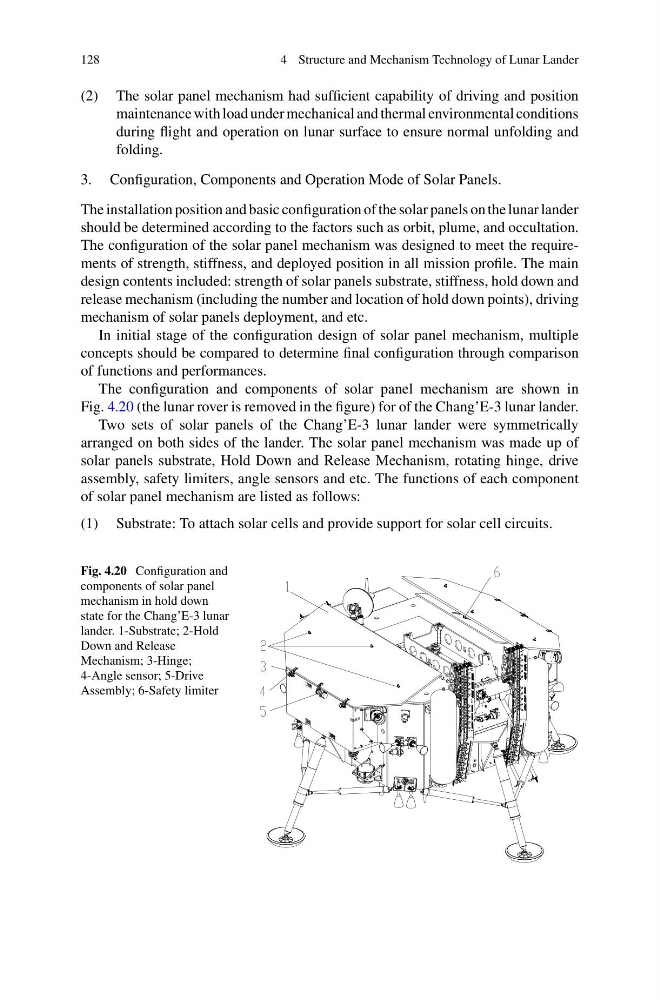
The configuration and components of solar panel mechanism are shown in
Fig. 4.20 (the lunar rover is removed in the figure) for of the Chang’E-3 lunar lander.
Two sets of solar panels of the Chang’E-3 lunar lander were symmetrically
arranged on both sides of the lander. The solar panel mechanism was made up of
solar panels substrate, Hold Down and Release Mechanism, rotating hinge, drive
assembly, safety limiters, angle sensors and etc. The functions of each component
of solar panel mechanism are listed as follows:
(1) Substrate: To attach solar cells and provide support for solar cell circuits.
Fig. 4.20 Configuration and
components of solar panel
mechanism in hold down
state for the Chang’E-3 lunar
lander. 1-Substrate; 2-Hold
Down and Release
Mechanism; 3-Hinge;
4-Angle sensor; 5-Drive
Assembly; 6-Safety limiter
4 Structure and Mechanism Technology of Lunar Lander
(2) The solar panel mechanism had sufficient capability of driving and position
maintenance with load under mechanical and thermal environmental conditions
during flight and operation on lunar surface to ensure normal unfolding and
folding.
3. Configuration, Components and Operation Mode of Solar Panels.
The installation position and basic configuration of the solar panels on the lunar lander
should be determined according to the factors such as orbit, plume, and occultation.
The configuration of the solar panel mechanism was designed to meet the requirements of strength, stiffness, and deployed position in all mission profile. The main
design contents included: strength of solar panels substrate, stiffness, hold down and
release mechanism (including the number and location of hold down points), driving
mechanism of solar panels deployment, and etc.
In initial stage of the configuration design of solar panel mechanism, multiple
concepts should be compared to determine final configuration through comparison
of functions and performances.
The configuration and components of solar panel mechanism are shown in
Fig. 4.20 (the lunar rover is removed in the figure) for of the Chang’E-3 lunar lander.
Two sets of solar panels of the Chang’E-3 lunar lander were symmetrically
arranged on both sides of the lander. The solar panel mechanism was made up of
solar panels substrate, Hold Down and Release Mechanism, rotating hinge, drive
assembly, safety limiters, angle sensors and etc. The functions of each component
of solar panel mechanism are listed as follows:
(1) Substrate: To attach solar cells and provide support for solar cell circuits.
Fig. 4.20 Configuration and
components of solar panel
mechanism in hold down
state for the Chang’E-3 lunar
lander. 1-Substrate; 2-Hold
Down and Release
Mechanism; 3-Hinge;
4-Angle sensor; 5-Drive
Assembly; 6-Safety limiter