

120
4 Structure and Mechanism Technology of Lunar Lander
1. Static Test
The static test is a test method to study the mechanical behavior of the spacecraft
structure under static or quasi-static conditions, and to solve the static strength,
stiffness and stability of the structure. As the content of static analysis, it’s justa
different research method. For the lunar lander, the quasi-static load in launch process
and landing impact load were still static test loads.
The static test of the lunar lander structure mainly included static tests of primary
structure in launch state and landing state.
1) Static test of the primary structure in launching state
The static load of launching state was inertia load. For practical loading, it was
necessary to simplify the actual load in static test. In addition to ensuring the effective
verification of the structure, the simplification of the load should also be taken into
account the feasibility and operability of the test plan, as well as the actual conditions
of the test site and equipment. The simplified load and the actual load should be
equivalent in macro sense, and the simplification of load shall meet the purpose of
the experiment.
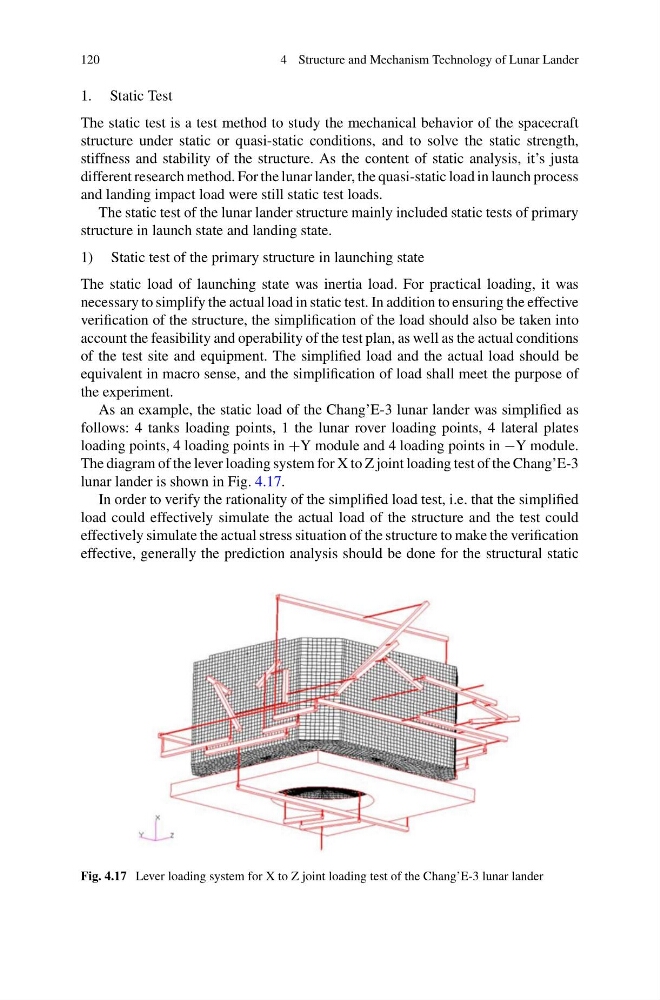
As an example, the static load of the Chang’E-3 lunar lander was simplified as
follows: 4 tanks loading points, 1 the lunar rover loading points, 4 lateral plates
loading points, 4 loading points in +Y module and 4 loading points in −Y module.
The diagram of the lever loading system for X to Z joint loading test of the Chang’E-3
lunar lander is shown in Fig. 4.17.
In order to verify the rationality of the simplified load test, i.e. that the simplified
load could effectively simulate the actual load of the structure and the test could
effectively simulate the actual stress situation of the structure to make the verification
effective, generally the prediction analysis should be done for the structural static
Fig. 4.17 Lever loading system for X to Z joint loading test of the Chang’E-3 lunar lander
4 Structure and Mechanism Technology of Lunar Lander
1. Static Test
The static test is a test method to study the mechanical behavior of the spacecraft
structure under static or quasi-static conditions, and to solve the static strength,
stiffness and stability of the structure. As the content of static analysis, it’s justa
different research method. For the lunar lander, the quasi-static load in launch process
and landing impact load were still static test loads.
The static test of the lunar lander structure mainly included static tests of primary
structure in launch state and landing state.
1) Static test of the primary structure in launching state
The static load of launching state was inertia load. For practical loading, it was
necessary to simplify the actual load in static test. In addition to ensuring the effective
verification of the structure, the simplification of the load should also be taken into
account the feasibility and operability of the test plan, as well as the actual conditions
of the test site and equipment. The simplified load and the actual load should be
equivalent in macro sense, and the simplification of load shall meet the purpose of
the experiment.
As an example, the static load of the Chang’E-3 lunar lander was simplified as
follows: 4 tanks loading points, 1 the lunar rover loading points, 4 lateral plates
loading points, 4 loading points in +Y module and 4 loading points in −Y module.
The diagram of the lever loading system for X to Z joint loading test of the Chang’E-3
lunar lander is shown in Fig. 4.17.
In order to verify the rationality of the simplified load test, i.e. that the simplified
load could effectively simulate the actual load of the structure and the test could
effectively simulate the actual stress situation of the structure to make the verification
effective, generally the prediction analysis should be done for the structural static
Fig. 4.17 Lever loading system for X to Z joint loading test of the Chang’E-3 lunar lander