

4.3 Design and Verification of Lunar Lander Structure
109
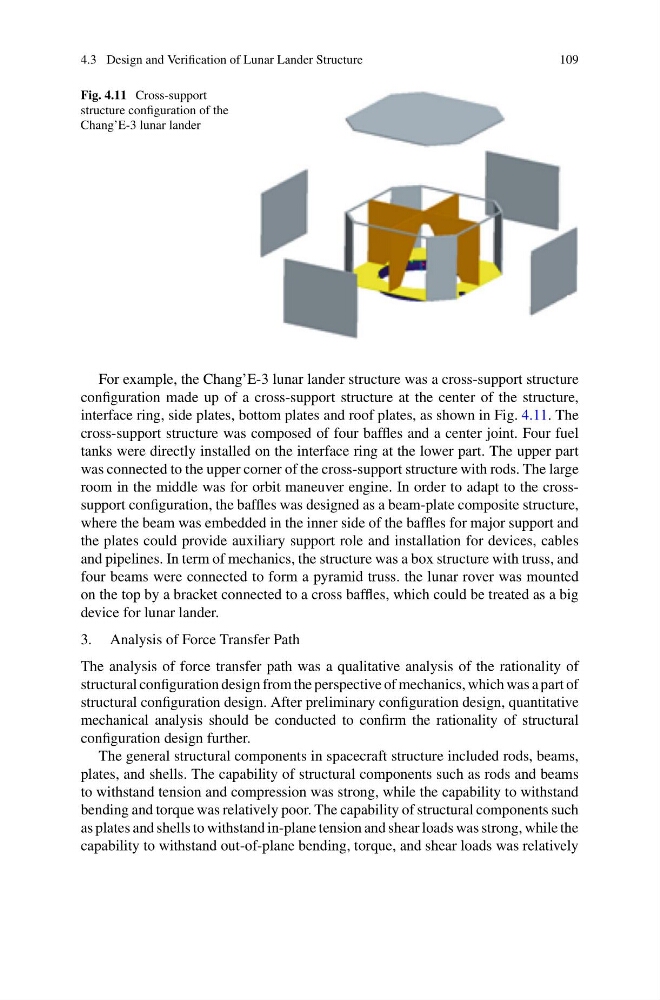
Fig. 4.11 Cross-support
structure configuration of the
Chang’E-3 lunar lander
For example, the Chang’E-3 lunar lander structure was a cross-support structure
configuration made up of a cross-support structure at the center of the structure,
interface ring, side plates, bottom plates and roof plates, as shown in Fig. 4.11. The
cross-support structure was composed of four baffles and a center joint. Four fuel
tanks were directly installed on the interface ring at the lower part. The upper part
was connected to the upper corner of the cross-support structure with rods. The large
room in the middle was for orbit maneuver engine. In order to adapt to the crosssupport configuration, the baffles was designed as a beam-plate composite structure,
where the beam was embedded in the inner side of the baffles for major support and
the plates could provide auxiliary support role and installation for devices, cables
and pipelines. In term of mechanics, the structure was a box structure with truss, and
four beams were connected to form a pyramid truss. the lunar rover was mounted
on the top by a bracket connected to a cross baffles, which could be treated as a big
device for lunar lander.
3. Analysis of Force Transfer Path
The analysis of force transfer path was a qualitative analysis of the rationality of
structural configuration design from the perspective of mechanics, which was a part of
structural configuration design. After preliminary configuration design, quantitative
mechanical analysis should be conducted to confirm the rationality of structural
configuration design further.
The general structural components in spacecraft structure included rods, beams,
plates, and shells. The capability of structural components such as rods and beams
to withstand tension and compression was strong, while the capability to withstand
bending and torque was relatively poor. The capability of structural components such
as plates and shells to withstand in-plane tension and shear loads was strong, while the
capability to withstand out-of-plane bending, torque, and shear loads was relatively
109
Fig. 4.11 Cross-support
structure configuration of the
Chang’E-3 lunar lander
For example, the Chang’E-3 lunar lander structure was a cross-support structure
configuration made up of a cross-support structure at the center of the structure,
interface ring, side plates, bottom plates and roof plates, as shown in Fig. 4.11. The
cross-support structure was composed of four baffles and a center joint. Four fuel
tanks were directly installed on the interface ring at the lower part. The upper part
was connected to the upper corner of the cross-support structure with rods. The large
room in the middle was for orbit maneuver engine. In order to adapt to the crosssupport configuration, the baffles was designed as a beam-plate composite structure,
where the beam was embedded in the inner side of the baffles for major support and
the plates could provide auxiliary support role and installation for devices, cables
and pipelines. In term of mechanics, the structure was a box structure with truss, and
four beams were connected to form a pyramid truss. the lunar rover was mounted
on the top by a bracket connected to a cross baffles, which could be treated as a big
device for lunar lander.
3. Analysis of Force Transfer Path
The analysis of force transfer path was a qualitative analysis of the rationality of
structural configuration design from the perspective of mechanics, which was a part of
structural configuration design. After preliminary configuration design, quantitative
mechanical analysis should be conducted to confirm the rationality of structural
configuration design further.
The general structural components in spacecraft structure included rods, beams,
plates, and shells. The capability of structural components such as rods and beams
to withstand tension and compression was strong, while the capability to withstand
bending and torque was relatively poor. The capability of structural components such
as plates and shells to withstand in-plane tension and shear loads was strong, while the
capability to withstand out-of-plane bending, torque, and shear loads was relatively