

4.3 Design and Verification of Lunar Lander Structure
107
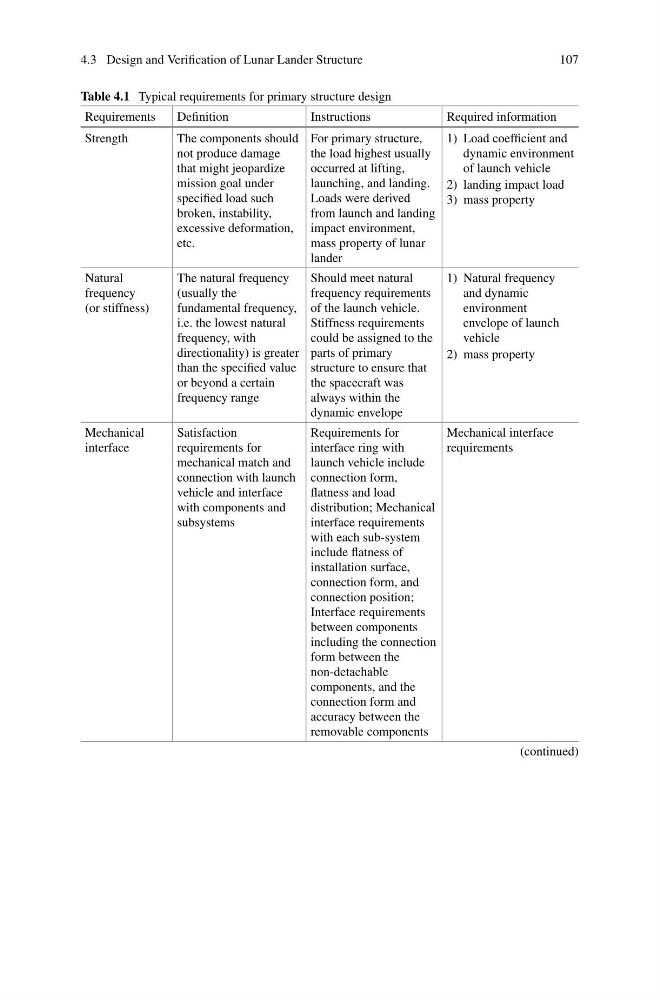
Table 4.1 Typical requirements for primary structure design
Requirements
Definition
Instructions
Required information
Strength
The components should
not produce damage
that might jeopardize
mission goal under
specified load such
broken, instability,
excessive deformation,
etc.
For primary structure,
the load highest usually
occurred at lifting,
launching, and landing.
Loads were derived
from launch and landing
impact environment,
mass property of lunar
lander
1) Load coefficient and
dynamic environment
of launch vehicle
2) landing impact load
3) mass property
Natural
frequency
(or stiffness)
The natural frequency
(usually the
fundamental frequency,
i.e. the lowest natural
frequency, with
directionality) is greater
than the specified value
or beyond a certain
frequency range
Should meet natural
frequency requirements
of the launch vehicle.
Stiffness requirements
could be assigned to the
parts of primary
structure to ensure that
the spacecraft was
always within the
dynamic envelope
1) Natural frequency
and dynamic
environment
envelope of launch
vehicle
2) mass property
Mechanical
interface
Satisfaction
requirements for
mechanical match and
connection with launch
vehicle and interface
with components and
subsystems
Requirements for
interface ring with
launch vehicle include
connection form,
flatness and load
distribution; Mechanical
interface requirements
with each sub-system
include flatness of
installation surface,
connection form, and
connection position;
Interface requirements
between components
including the connection
form between the
non-detachable
components, and the
connection form and
accuracy between the
removable components
Mechanical interface
requirements
(continued)
107
Table 4.1 Typical requirements for primary structure design
Requirements
Definition
Instructions
Required information
Strength
The components should
not produce damage
that might jeopardize
mission goal under
specified load such
broken, instability,
excessive deformation,
etc.
For primary structure,
the load highest usually
occurred at lifting,
launching, and landing.
Loads were derived
from launch and landing
impact environment,
mass property of lunar
lander
1) Load coefficient and
dynamic environment
of launch vehicle
2) landing impact load
3) mass property
Natural
frequency
(or stiffness)
The natural frequency
(usually the
fundamental frequency,
i.e. the lowest natural
frequency, with
directionality) is greater
than the specified value
or beyond a certain
frequency range
Should meet natural
frequency requirements
of the launch vehicle.
Stiffness requirements
could be assigned to the
parts of primary
structure to ensure that
the spacecraft was
always within the
dynamic envelope
1) Natural frequency
and dynamic
environment
envelope of launch
vehicle
2) mass property
Mechanical
interface
Satisfaction
requirements for
mechanical match and
connection with launch
vehicle and interface
with components and
subsystems
Requirements for
interface ring with
launch vehicle include
connection form,
flatness and load
distribution; Mechanical
interface requirements
with each sub-system
include flatness of
installation surface,
connection form, and
connection position;
Interface requirements
between components
including the connection
form between the
non-detachable
components, and the
connection form and
accuracy between the
removable components
Mechanical interface
requirements
(continued)