

4.2 Structural and Mechanism Features of Lunar Lander
105
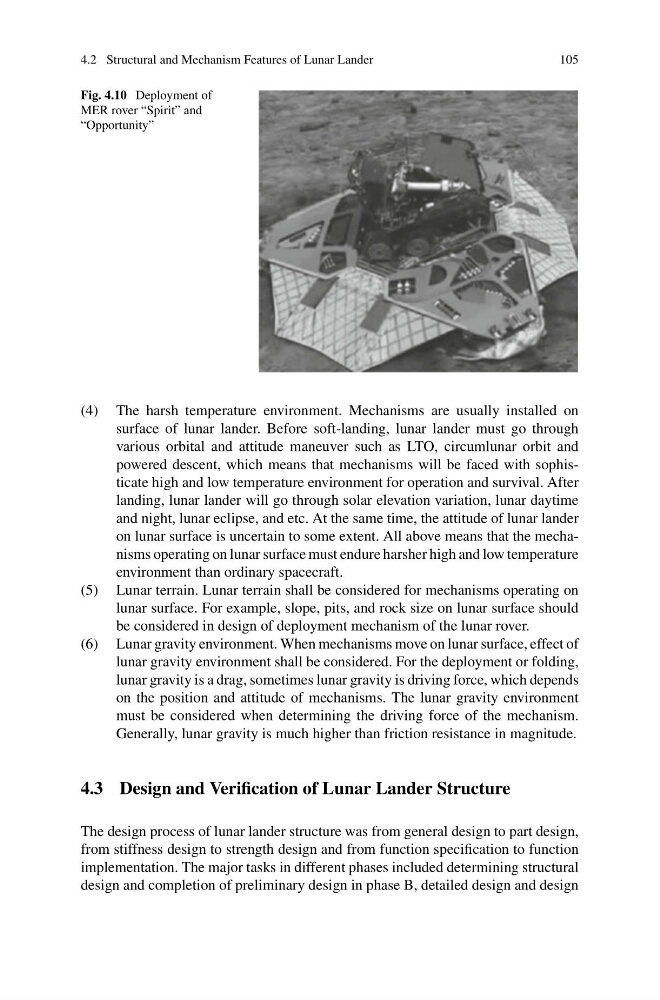
Fig. 4.10 Deployment of
MER rover “Spirit” and
“Opportunity”
(4) The harsh temperature environment. Mechanisms are usually installed on
surface of lunar lander. Before soft-landing, lunar lander must go through
various orbital and attitude maneuver such as LTO, circumlunar orbit and
powered descent, which means that mechanisms will be faced with sophisticate high and low temperature environment for operation and survival. After
landing, lunar lander will go through solar elevation variation, lunar daytime
and night, lunar eclipse, and etc. At the same time, the attitude of lunar lander
on lunar surface is uncertain to some extent. All above means that the mechanisms operating on lunar surface must endure harsher high and low temperature
environment than ordinary spacecraft.
(5) Lunar terrain. Lunar terrain shall be considered for mechanisms operating on
lunar surface. For example, slope, pits, and rock size on lunar surface should
be considered in design of deployment mechanism of the lunar rover.
(6) Lunar gravity environment. When mechanisms move on lunar surface, effect of
lunar gravity environment shall be considered. For the deployment or folding,
lunar gravity is a drag, sometimes lunar gravity is driving force, which depends
on the position and attitude of mechanisms. The lunar gravity environment
must be considered when determining the driving force of the mechanism.
Generally, lunar gravity is much higher than friction resistance in magnitude.
4.3 Design and Verification of Lunar Lander Structure
The design process of lunar lander structure was from general design to part design,
from stiffness design to strength design and from function specification to function
implementation. The major tasks in different phases included determining structural
design and completion of preliminary design in phase B, detailed design and design
105
Fig. 4.10 Deployment of
MER rover “Spirit” and
“Opportunity”
(4) The harsh temperature environment. Mechanisms are usually installed on
surface of lunar lander. Before soft-landing, lunar lander must go through
various orbital and attitude maneuver such as LTO, circumlunar orbit and
powered descent, which means that mechanisms will be faced with sophisticate high and low temperature environment for operation and survival. After
landing, lunar lander will go through solar elevation variation, lunar daytime
and night, lunar eclipse, and etc. At the same time, the attitude of lunar lander
on lunar surface is uncertain to some extent. All above means that the mechanisms operating on lunar surface must endure harsher high and low temperature
environment than ordinary spacecraft.
(5) Lunar terrain. Lunar terrain shall be considered for mechanisms operating on
lunar surface. For example, slope, pits, and rock size on lunar surface should
be considered in design of deployment mechanism of the lunar rover.
(6) Lunar gravity environment. When mechanisms move on lunar surface, effect of
lunar gravity environment shall be considered. For the deployment or folding,
lunar gravity is a drag, sometimes lunar gravity is driving force, which depends
on the position and attitude of mechanisms. The lunar gravity environment
must be considered when determining the driving force of the mechanism.
Generally, lunar gravity is much higher than friction resistance in magnitude.
4.3 Design and Verification of Lunar Lander Structure
The design process of lunar lander structure was from general design to part design,
from stiffness design to strength design and from function specification to function
implementation. The major tasks in different phases included determining structural
design and completion of preliminary design in phase B, detailed design and design