

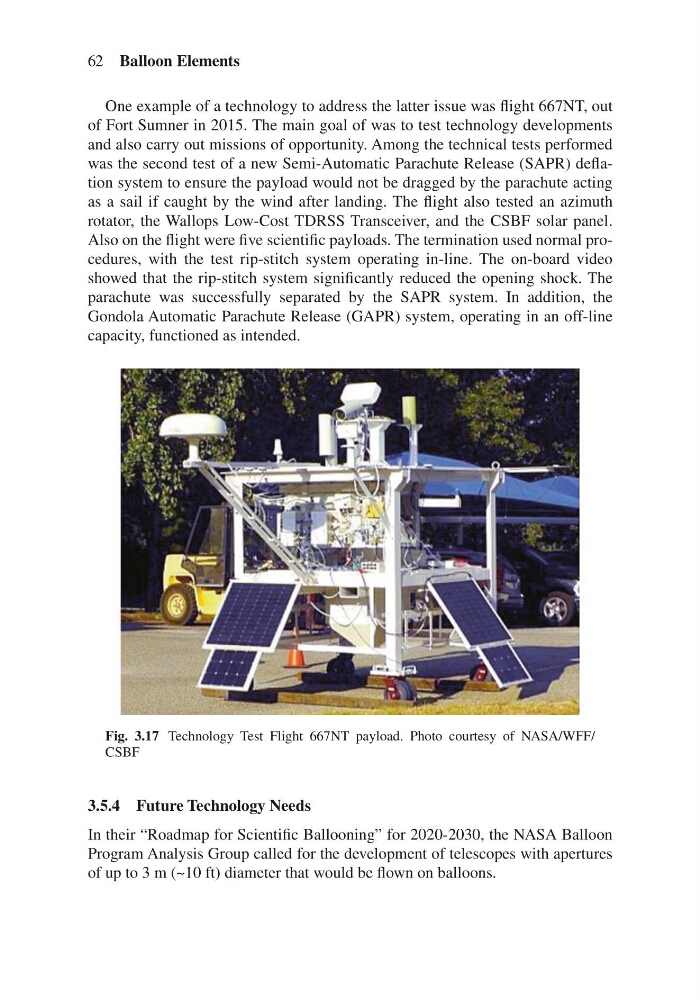
One example of a technology to address the latter issue was flight 667NT, out
of Fort Sumner in 2015. The main goal of was to test technology developments
and also carry out missions of opportunity. Among the technical tests performed
was the second test of a new Semi-Automatic Parachute Release (SAPR) deflation system to ensure the payload would not be dragged by the parachute acting
as a sail if caught by the wind after landing. The flight also tested an azimuth
rotator, the Wallops Low-Cost TDRSS Transceiver, and the CSBF solar panel.
Also on the flight were five scientific payloads. The termination used normal procedures, with the test rip-stitch system operating in-line. The on-board video
showed that the rip-stitch system significantly reduced the opening shock. The
parachute was successfully separated by the SAPR system. In addition, the
Gondola Automatic Parachute Release (GAPR) system, operating in an off-line
capacity, functioned as intended.
3.5.4 Future Technology Needs
In their “Roadmap for Scientific Ballooning” for 2020-2030, the NASA Balloon
Program Analysis Group called for the development of telescopes with apertures
of up to 3 m (~10 ft) diameter that would be flown on balloons.
Fig. 3.17 Technology Test Flight 667NT payload. Photo courtesy of NASA/WFF/
CSBF
62 Balloon Elements
of Fort Sumner in 2015. The main goal of was to test technology developments
and also carry out missions of opportunity. Among the technical tests performed
was the second test of a new Semi-Automatic Parachute Release (SAPR) deflation system to ensure the payload would not be dragged by the parachute acting
as a sail if caught by the wind after landing. The flight also tested an azimuth
rotator, the Wallops Low-Cost TDRSS Transceiver, and the CSBF solar panel.
Also on the flight were five scientific payloads. The termination used normal procedures, with the test rip-stitch system operating in-line. The on-board video
showed that the rip-stitch system significantly reduced the opening shock. The
parachute was successfully separated by the SAPR system. In addition, the
Gondola Automatic Parachute Release (GAPR) system, operating in an off-line
capacity, functioned as intended.
3.5.4 Future Technology Needs
In their “Roadmap for Scientific Ballooning” for 2020-2030, the NASA Balloon
Program Analysis Group called for the development of telescopes with apertures
of up to 3 m (~10 ft) diameter that would be flown on balloons.
Fig. 3.17 Technology Test Flight 667NT payload. Photo courtesy of NASA/WFF/
CSBF
62 Balloon Elements