

analysis evaluates DayStar’s ability to centroid stars, match stars between frames,
and use a series of images to track the orientation. This links the precision of star
centroiding algorithms with the pointing acuity for both day and night conditions.
The results will be used to validate the performance model and examine DayStar
as a potential star tracker for high altitude balloon observatories.
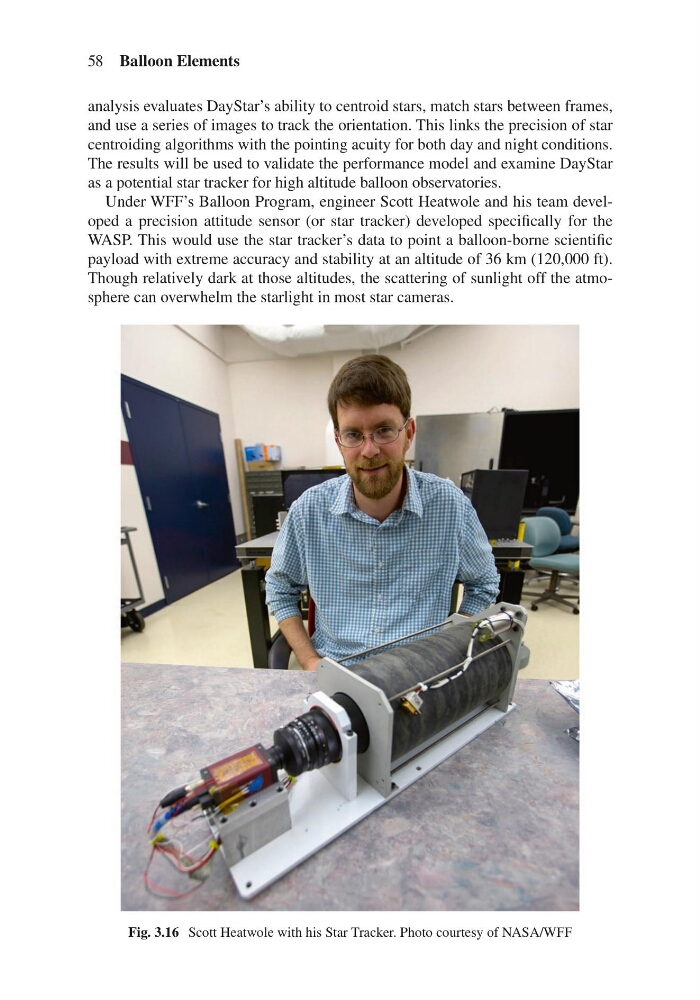
Under WFF’s Balloon Program, engineer Scott Heatwole and his team developed a precision attitude sensor (or star tracker) developed specifically for the
WASP. This would use the star tracker’s data to point a balloon-borne scientific
payload with extreme accuracy and stability at an altitude of 36 km (120,000 ft).
Though relatively dark at those altitudes, the scattering of sunlight off the atmosphere can overwhelm the starlight in most star cameras.
Fig. 3.16 Scott Heatwole with his Star Tracker. Photo courtesy of NASA/WFF
58 Balloon Elements
and use a series of images to track the orientation. This links the precision of star
centroiding algorithms with the pointing acuity for both day and night conditions.
The results will be used to validate the performance model and examine DayStar
as a potential star tracker for high altitude balloon observatories.
Under WFF’s Balloon Program, engineer Scott Heatwole and his team developed a precision attitude sensor (or star tracker) developed specifically for the
WASP. This would use the star tracker’s data to point a balloon-borne scientific
payload with extreme accuracy and stability at an altitude of 36 km (120,000 ft).
Though relatively dark at those altitudes, the scattering of sunlight off the atmosphere can overwhelm the starlight in most star cameras.
Fig. 3.16 Scott Heatwole with his Star Tracker. Photo courtesy of NASA/WFF
58 Balloon Elements