

can optionally record science data onto its flight computer hard drives when using
the omni antenna. These hard drives are only recovered at the end of the flight. The
OCC in Palestine is the only location from which TDRSS science data and commanding is accessed during flight. Support is available in the field to verify TDRSS
return and forward telemetry using a special test set. After launch, and while the balloon is still visible, an L-Band or S-Band telemetry transmitter can be made available
for the science team to monitor data. See the OCC/ROCC discussion above.
Wallops Arc Second Pointer
The Wallops Arc Second Pointer (WASP) System is a NASA provided support
system that can point telescopes on balloon gondolas at inertial targets with arcsecond accuracy. WASP is intended to be a flexible system that can be used to
support a variety of science-provided instruments and sensors to meet specific
mission performance requirements. Its major components are reusable and this
reduces the overall costs to the Balloon Program Office and to users.
During tests in 2011-2012, WASP successfully demonstrated positional stability at sub-arc-second levels in flight. In September 2013 it supported its first
pointed science instrument, the HyperSpectral Imager for Climate Science
(HySICS) that was created by the Laboratory for Atmospheric and Space Physics
(LASP) of the University of Colorado at Boulder. The mission was launched from
Fort Sumner, NM.
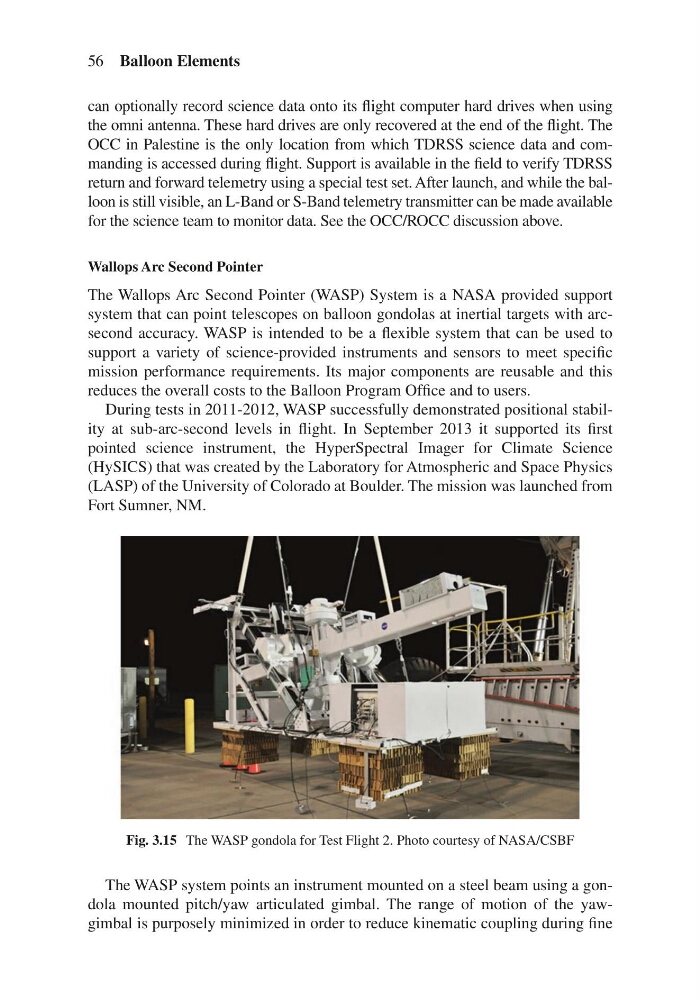
The WASP system points an instrument mounted on a steel beam using a gondola mounted pitch/yaw articulated gimbal. The range of motion of the yawgimbal is purposely minimized in order to reduce kinematic coupling during fine
Fig. 3.15 The WASP gondola for Test Flight 2. Photo courtesy of NASA/CSBF
56 Balloon Elements
the omni antenna. These hard drives are only recovered at the end of the flight. The
OCC in Palestine is the only location from which TDRSS science data and commanding is accessed during flight. Support is available in the field to verify TDRSS
return and forward telemetry using a special test set. After launch, and while the balloon is still visible, an L-Band or S-Band telemetry transmitter can be made available
for the science team to monitor data. See the OCC/ROCC discussion above.
Wallops Arc Second Pointer
The Wallops Arc Second Pointer (WASP) System is a NASA provided support
system that can point telescopes on balloon gondolas at inertial targets with arcsecond accuracy. WASP is intended to be a flexible system that can be used to
support a variety of science-provided instruments and sensors to meet specific
mission performance requirements. Its major components are reusable and this
reduces the overall costs to the Balloon Program Office and to users.
During tests in 2011-2012, WASP successfully demonstrated positional stability at sub-arc-second levels in flight. In September 2013 it supported its first
pointed science instrument, the HyperSpectral Imager for Climate Science
(HySICS) that was created by the Laboratory for Atmospheric and Space Physics
(LASP) of the University of Colorado at Boulder. The mission was launched from
Fort Sumner, NM.
The WASP system points an instrument mounted on a steel beam using a gondola mounted pitch/yaw articulated gimbal. The range of motion of the yawgimbal is purposely minimized in order to reduce kinematic coupling during fine
Fig. 3.15 The WASP gondola for Test Flight 2. Photo courtesy of NASA/CSBF
56 Balloon Elements