

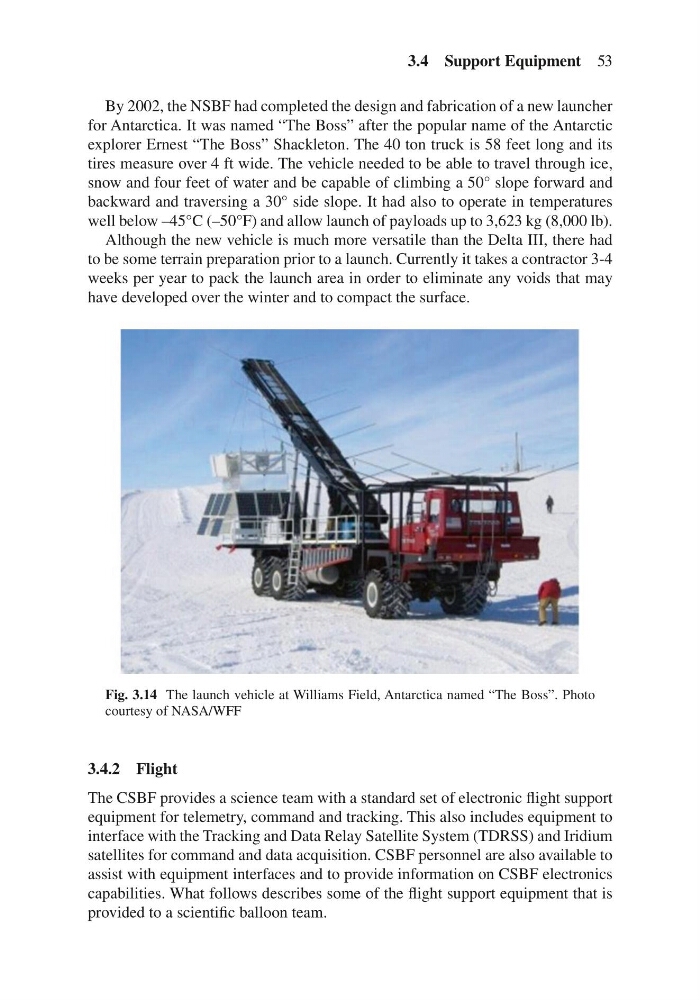
By 2002, the NSBF had completed the design and fabrication of a new launcher
for Antarctica. It was named “The Boss” after the popular name of the Antarctic
explorer Ernest “The Boss” Shackleton. The 40 ton truck is 58 feet long and its
tires measure over 4 ft wide. The vehicle needed to be able to travel through ice,
snow and four feet of water and be capable of climbing a 50° slope forward and
backward and traversing a 30° side slope. It had also to operate in temperatures
well below –45°C (–50°F) and allow launch of payloads up to 3,623 kg (8,000 lb).
Although the new vehicle is much more versatile than the Delta III, there had
to be some terrain preparation prior to a launch. Currently it takes a contractor 3-4
weeks per year to pack the launch area in order to eliminate any voids that may
have developed over the winter and to compact the surface.
3.4.2 Flight
The CSBF provides a science team with a standard set of electronic flight support
equipment for telemetry, command and tracking. This also includes equipment to
interface with the Tracking and Data Relay Satellite System (TDRSS) and Iridium
satellites for command and data acquisition. CSBF personnel are also available to
assist with equipment interfaces and to provide information on CSBF electronics
capabilities. What follows describes some of the flight support equipment that is
provided to a scientific balloon team.
Fig. 3.14 The launch vehicle at Williams Field, Antarctica named “The Boss”. Photo
courtesy of NASA/WFF
3.4 Support Equipment 53
for Antarctica. It was named “The Boss” after the popular name of the Antarctic
explorer Ernest “The Boss” Shackleton. The 40 ton truck is 58 feet long and its
tires measure over 4 ft wide. The vehicle needed to be able to travel through ice,
snow and four feet of water and be capable of climbing a 50° slope forward and
backward and traversing a 30° side slope. It had also to operate in temperatures
well below –45°C (–50°F) and allow launch of payloads up to 3,623 kg (8,000 lb).
Although the new vehicle is much more versatile than the Delta III, there had
to be some terrain preparation prior to a launch. Currently it takes a contractor 3-4
weeks per year to pack the launch area in order to eliminate any voids that may
have developed over the winter and to compact the surface.
3.4.2 Flight
The CSBF provides a science team with a standard set of electronic flight support
equipment for telemetry, command and tracking. This also includes equipment to
interface with the Tracking and Data Relay Satellite System (TDRSS) and Iridium
satellites for command and data acquisition. CSBF personnel are also available to
assist with equipment interfaces and to provide information on CSBF electronics
capabilities. What follows describes some of the flight support equipment that is
provided to a scientific balloon team.
Fig. 3.14 The launch vehicle at Williams Field, Antarctica named “The Boss”. Photo
courtesy of NASA/WFF
3.4 Support Equipment 53