

Demonstration Flights
Recent demonstration flights achieved several significant accomplishments that
can feed forward to a GHAPS gondola project. Science results included the first
ever Earth-based measurements for CO 2 in a comet, first measurements for CO 2
and H 2 O in an Oort Cloud comet, and the first measurement of the dwarf planet 1
Ceres at 2.73 micrometers to refine the profile of the infrared water absorption
feature. The performance of the Fine Steering Mirror was also successfully demonstrated. The BOPPS platform can continue to be leveraged on future flights
even as GHAPS is being developed. The study affirmed the planetary decadal
recommendations that a number of Top Priority science questions could be
addressed in this manner. A combination GHAPS and BOPPS would provide the
best value for the Planetary Science Division for realizing that science.
Planetary Ballooning
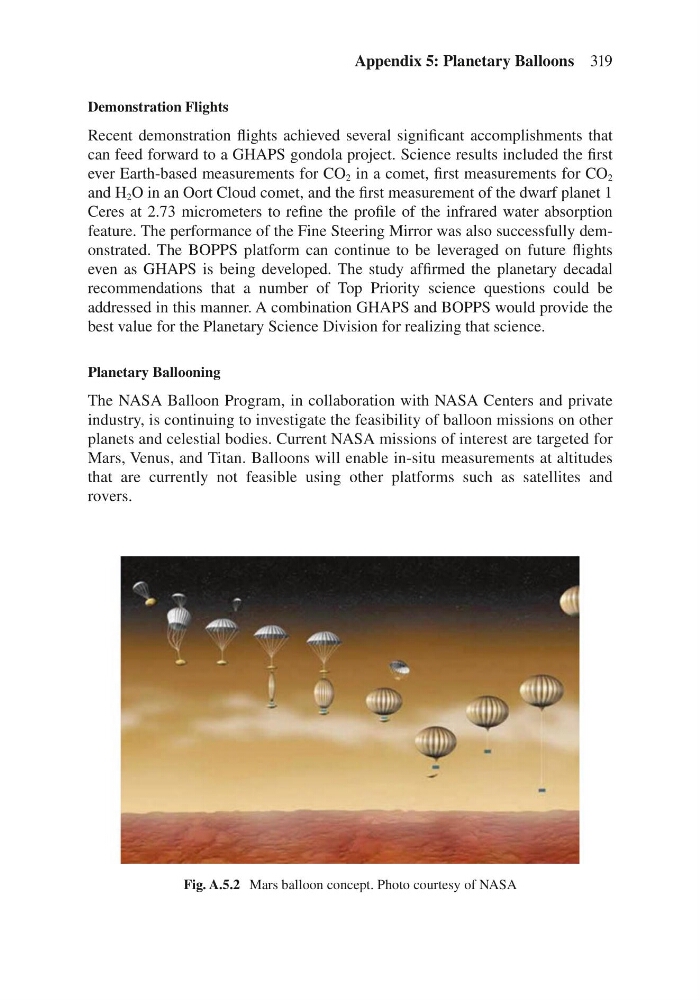
The NASA Balloon Program, in collaboration with NASA Centers and private
industry, is continuing to investigate the feasibility of balloon missions on other
planets and celestial bodies. Current NASA missions of interest are targeted for
Mars, Venus, and Titan. Balloons will enable in-situ measurements at altitudes
that are currently not feasible using other platforms such as satellites and
rovers.
Fig. A.5.2 Mars balloon concept. Photo courtesy of NASA
Appendix 5: Planetary Balloons 319
Recent demonstration flights achieved several significant accomplishments that
can feed forward to a GHAPS gondola project. Science results included the first
ever Earth-based measurements for CO 2 in a comet, first measurements for CO 2
and H 2 O in an Oort Cloud comet, and the first measurement of the dwarf planet 1
Ceres at 2.73 micrometers to refine the profile of the infrared water absorption
feature. The performance of the Fine Steering Mirror was also successfully demonstrated. The BOPPS platform can continue to be leveraged on future flights
even as GHAPS is being developed. The study affirmed the planetary decadal
recommendations that a number of Top Priority science questions could be
addressed in this manner. A combination GHAPS and BOPPS would provide the
best value for the Planetary Science Division for realizing that science.
Planetary Ballooning
The NASA Balloon Program, in collaboration with NASA Centers and private
industry, is continuing to investigate the feasibility of balloon missions on other
planets and celestial bodies. Current NASA missions of interest are targeted for
Mars, Venus, and Titan. Balloons will enable in-situ measurements at altitudes
that are currently not feasible using other platforms such as satellites and
rovers.
Fig. A.5.2 Mars balloon concept. Photo courtesy of NASA
Appendix 5: Planetary Balloons 319