

Weather balloons, as compared to scientific stratospheric balloons, are usually
made of a highly flexible latex material, though chloroprene (a synthetic rubber)
may also be used. They are generally filled with hydrogen, but occasionally the
more expensive helium. When released, the balloon is about 1.5 m (~5 feet) in
diameter and gradually expands as it rises owing to the decrease in air pressure.
When the balloon achieves a diameter of 6 to 8 m (20 to 25 feet) in diameter it
bursts. A small, orange colored parachute slows the descent of the radiosonde,
minimizing the danger to lives and property.
Weather balloons typically fly to ~35 km (~115,000 feet) but they can achieve
~40 km (~131,000 ft) or more. The altitude is limited by diminishing pressures
causing the balloon to expand to such a degree that it disintegrates. Above that
altitude, sounding rockets are used. For even higher altitudes, it is necessary to
launch satellites. In 2002 one weather balloon set an altitude record of 52.7 km
(173,000 ft). See Chapter 9 for details of the National Weather Service.
While weather balloons are about the size of a man, a scientific stratospheric
balloon can be the size of a football stadium. They are of a fantastic size, but provide fantastic science and real-world applications. In the U.S., they are the responsibility of the NASA Balloon Program Office (BPO) at the Wallops Flight Facility
(WFF) of Goddard Space Flight Center, which supports numerous space and Earth
science research missions. There are different balloons to meet various scientific
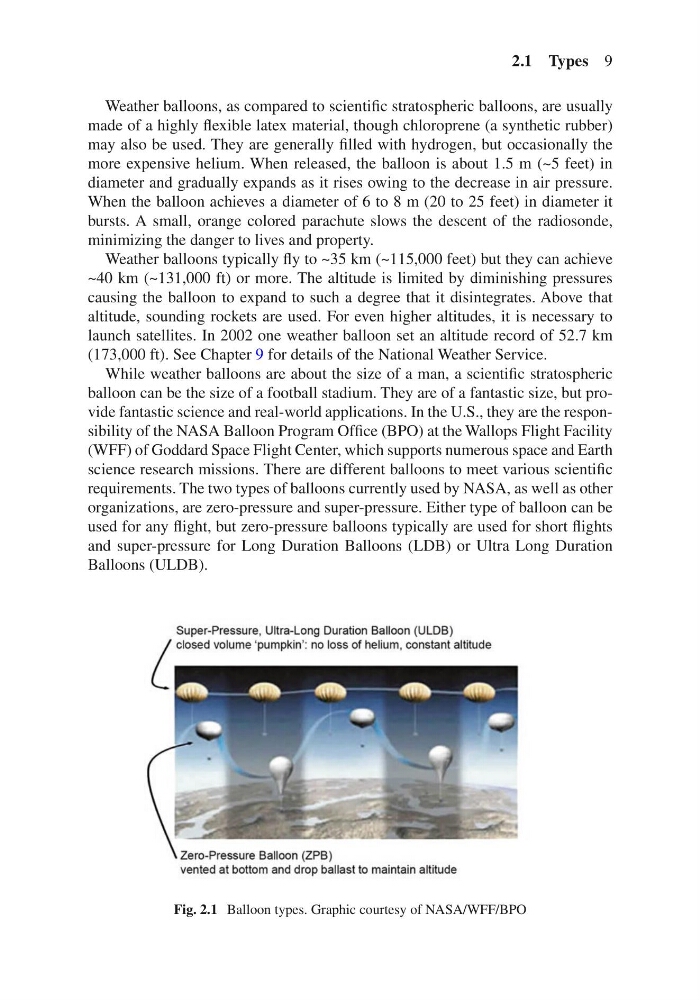
requirements. The two types of balloons currently used by NASA, as well as other
organizations, are zero-pressure and super-pressure. Either type of balloon can be
used for any flight, but zero-pressure balloons typically are used for short flights
and super-pressure for Long Duration Balloons (LDB) or Ultra Long Duration
Balloons (ULDB).
Fig. 2.1 Balloon types. Graphic courtesy of NASA/WFF/BPO
2.1 Types 9
made of a highly flexible latex material, though chloroprene (a synthetic rubber)
may also be used. They are generally filled with hydrogen, but occasionally the
more expensive helium. When released, the balloon is about 1.5 m (~5 feet) in
diameter and gradually expands as it rises owing to the decrease in air pressure.
When the balloon achieves a diameter of 6 to 8 m (20 to 25 feet) in diameter it
bursts. A small, orange colored parachute slows the descent of the radiosonde,
minimizing the danger to lives and property.
Weather balloons typically fly to ~35 km (~115,000 feet) but they can achieve
~40 km (~131,000 ft) or more. The altitude is limited by diminishing pressures
causing the balloon to expand to such a degree that it disintegrates. Above that
altitude, sounding rockets are used. For even higher altitudes, it is necessary to
launch satellites. In 2002 one weather balloon set an altitude record of 52.7 km
(173,000 ft). See Chapter 9 for details of the National Weather Service.
While weather balloons are about the size of a man, a scientific stratospheric
balloon can be the size of a football stadium. They are of a fantastic size, but provide fantastic science and real-world applications. In the U.S., they are the responsibility of the NASA Balloon Program Office (BPO) at the Wallops Flight Facility
(WFF) of Goddard Space Flight Center, which supports numerous space and Earth
science research missions. There are different balloons to meet various scientific
requirements. The two types of balloons currently used by NASA, as well as other
organizations, are zero-pressure and super-pressure. Either type of balloon can be
used for any flight, but zero-pressure balloons typically are used for short flights
and super-pressure for Long Duration Balloons (LDB) or Ultra Long Duration
Balloons (ULDB).
Fig. 2.1 Balloon types. Graphic courtesy of NASA/WFF/BPO
2.1 Types 9