

employees, he started to lose control of the business. Coupled with an unhappy
marriage, he became depressed and, in 1979, the great innovator of the plastic balloon revolution committed suicide.
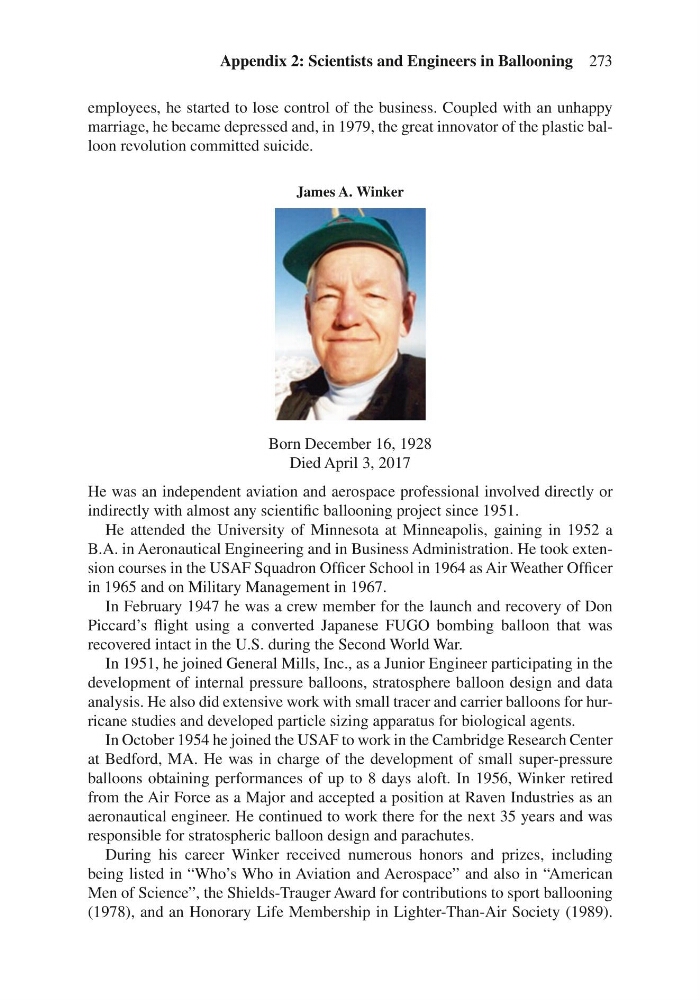
James A. Winker
Born December 16, 1928
Died April 3, 2017
He was an independent aviation and aerospace professional involved directly or
indirectly with almost any scientific ballooning project since 1951.
He attended the University of Minnesota at Minneapolis, gaining in 1952 a
B.A. in Aeronautical Engineering and in Business Administration. He took extension courses in the USAF Squadron Officer School in 1964 as Air Weather Officer
in 1965 and on Military Management in 1967.
In February 1947 he was a crew member for the launch and recovery of Don
Piccard’s flight using a converted Japanese FUGO bombing balloon that was
recovered intact in the U.S. during the Second World War.
In 1951, he joined General Mills, Inc., as a Junior Engineer participating in the
development of internal pressure balloons, stratosphere balloon design and data
analysis. He also did extensive work with small tracer and carrier balloons for hurricane studies and developed particle sizing apparatus for biological agents.
In October 1954 he joined the USAF to work in the Cambridge Research Center
at Bedford, MA. He was in charge of the development of small super-pressure
balloons obtaining performances of up to 8 days aloft. In 1956, Winker retired
from the Air Force as a Major and accepted a position at Raven Industries as an
aeronautical engineer. He continued to work there for the next 35 years and was
responsible for stratospheric balloon design and parachutes.
During his career Winker received numerous honors and prizes, including
being listed in “Who’s Who in Aviation and Aerospace” and also in “American
Men of Science”, the Shields-Trauger Award for contributions to sport ballooning
(1978), and an Honorary Life Membership in Lighter-Than-Air Society (1989).
Appendix 2: Scientists and Engineers in Ballooning 273
marriage, he became depressed and, in 1979, the great innovator of the plastic balloon revolution committed suicide.
James A. Winker
Born December 16, 1928
Died April 3, 2017
He was an independent aviation and aerospace professional involved directly or
indirectly with almost any scientific ballooning project since 1951.
He attended the University of Minnesota at Minneapolis, gaining in 1952 a
B.A. in Aeronautical Engineering and in Business Administration. He took extension courses in the USAF Squadron Officer School in 1964 as Air Weather Officer
in 1965 and on Military Management in 1967.
In February 1947 he was a crew member for the launch and recovery of Don
Piccard’s flight using a converted Japanese FUGO bombing balloon that was
recovered intact in the U.S. during the Second World War.
In 1951, he joined General Mills, Inc., as a Junior Engineer participating in the
development of internal pressure balloons, stratosphere balloon design and data
analysis. He also did extensive work with small tracer and carrier balloons for hurricane studies and developed particle sizing apparatus for biological agents.
In October 1954 he joined the USAF to work in the Cambridge Research Center
at Bedford, MA. He was in charge of the development of small super-pressure
balloons obtaining performances of up to 8 days aloft. In 1956, Winker retired
from the Air Force as a Major and accepted a position at Raven Industries as an
aeronautical engineer. He continued to work there for the next 35 years and was
responsible for stratospheric balloon design and parachutes.
During his career Winker received numerous honors and prizes, including
being listed in “Who’s Who in Aviation and Aerospace” and also in “American
Men of Science”, the Shields-Trauger Award for contributions to sport ballooning
(1978), and an Honorary Life Membership in Lighter-Than-Air Society (1989).
Appendix 2: Scientists and Engineers in Ballooning 273