

Peterzen’s passion for stratospheric ballooning dates back to his work with
the University of Alaska Fairbanks in Greenland in the early 1990’s. Extracting
ice cores for atmospheric investigations gave him the opportunity to participate
in a stratospheric balloon campaign for Harvard University and NASA. He has
been involved in ballooning ever since. “Balloons are a magical event. Watching
one climb to altitude excites the little kid inside of you. Balloons are a cheap
seat to space!”
The large balloons Peterzen works with at ISTAR can ascend to 45 km (150,000
ft). They provide access to near space at a fraction of the cost of a rocket launch,
opening up new opportunities for stratospheric research. The balloons can carry a
payload of cameras, sensors and other equipment to study atmospheric conditions
in the stratosphere, get an unobstructed view of space from above the atmosphere,
and peer down at the Earth. They also carry materials, equipment and even living
organisms (such as seeds, plants, bacteria, yeasts and fungi) into near space to see
how they respond to low temperatures and pressures, intense ultraviolet radiation
and low levels of oxygen and other atmospheric gases.
The balloons that students work with at Sisters High School are much smaller
and therefore can carry a lighter payload than the ones used by NASA and other
space organizations. And since the students’ balloons are not vented, they can only
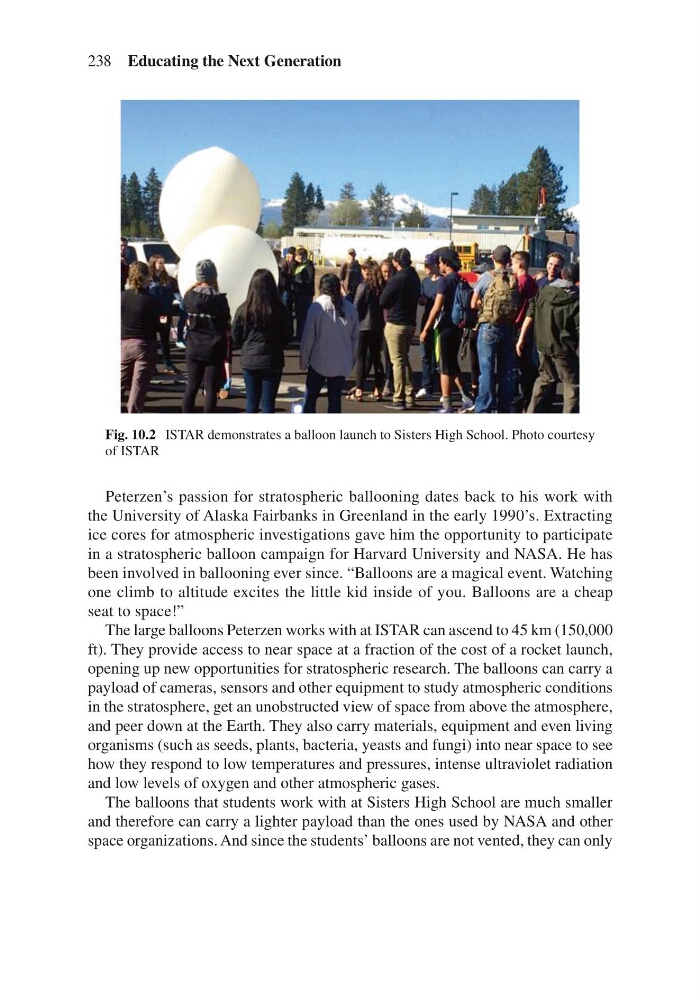
Fig. 10.2 ISTAR demonstrates a balloon launch to Sisters High School. Photo courtesy
of ISTAR
238 Educating the Next Generation
the University of Alaska Fairbanks in Greenland in the early 1990’s. Extracting
ice cores for atmospheric investigations gave him the opportunity to participate
in a stratospheric balloon campaign for Harvard University and NASA. He has
been involved in ballooning ever since. “Balloons are a magical event. Watching
one climb to altitude excites the little kid inside of you. Balloons are a cheap
seat to space!”
The large balloons Peterzen works with at ISTAR can ascend to 45 km (150,000
ft). They provide access to near space at a fraction of the cost of a rocket launch,
opening up new opportunities for stratospheric research. The balloons can carry a
payload of cameras, sensors and other equipment to study atmospheric conditions
in the stratosphere, get an unobstructed view of space from above the atmosphere,
and peer down at the Earth. They also carry materials, equipment and even living
organisms (such as seeds, plants, bacteria, yeasts and fungi) into near space to see
how they respond to low temperatures and pressures, intense ultraviolet radiation
and low levels of oxygen and other atmospheric gases.
The balloons that students work with at Sisters High School are much smaller
and therefore can carry a lighter payload than the ones used by NASA and other
space organizations. And since the students’ balloons are not vented, they can only
Fig. 10.2 ISTAR demonstrates a balloon launch to Sisters High School. Photo courtesy
of ISTAR
238 Educating the Next Generation