

graduates and postgraduates. While not HASP flights, they are representative of
major scientific instruments and missions.
• University of Arizona: Galactic/Extragalactic ULDB Spectroscopic
Terahertz Observatory (GUSTO) infrared telescope to investigate the interstellar medium for launch in December 2021 from Antarctica. It exploits
experience gained from precursor missions: the Stratospheric Terahertz
Observatory (STO) of 2012 and STO-2 of 2016. The other participants are
Massachusetts Institute of Technology, Arizona State University, SRON
Netherlands Institute for Space Research, Virginia Diodes, Ball Aerospace,
and the Applied Physics Laboratory of Johns Hopkins University.
• University of Maryland: Boron and Carbon Cosmic rays in the Upper
Stratosphere (BACCUS).
• University of Hawaii: Antarctic Impulsive Transient Antenna (ANITA).
• Washington University in St. Louis: Super Trans Iron Galactic Element
Recorder (SuperTIGER).
• University of Wyoming, Purdue University and University of Colorado supported the joint French-United States initiative that flew atmospheric payloads with the Concordiasi project.
• Arizona State University and the University of Miami are involved with the
Astrophysics Stratospheric Telescope for High Spectral Resolution
Observations at Submillimeter-wavelengths (ASTHROS) mission that is
managed by NASA-JPL and scheduled to launch from NSF’s McMurdo
Station in 2023. Johns Hopkins Applied Physics Laboratory is supplying
the gondola and pointing systems; the 2.5 m antenna unit is being built by
Media Lario S.r.l. in Lecco, Italy; the payload cryocooler was developed by
Lockheed Martin; the Columbia Science Balloon Facility will provide the
balloon and launch services.
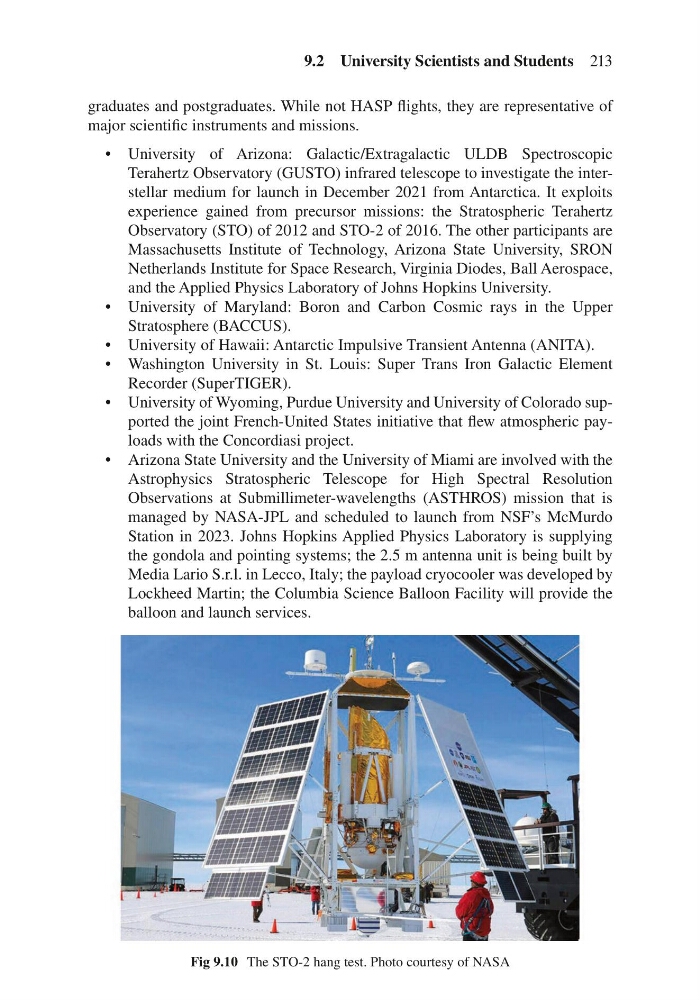
Fig 9.10 The STO-2 hang test. Photo courtesy of NASA
9.2 University Scientists and Students 213
major scientific instruments and missions.
• University of Arizona: Galactic/Extragalactic ULDB Spectroscopic
Terahertz Observatory (GUSTO) infrared telescope to investigate the interstellar medium for launch in December 2021 from Antarctica. It exploits
experience gained from precursor missions: the Stratospheric Terahertz
Observatory (STO) of 2012 and STO-2 of 2016. The other participants are
Massachusetts Institute of Technology, Arizona State University, SRON
Netherlands Institute for Space Research, Virginia Diodes, Ball Aerospace,
and the Applied Physics Laboratory of Johns Hopkins University.
• University of Maryland: Boron and Carbon Cosmic rays in the Upper
Stratosphere (BACCUS).
• University of Hawaii: Antarctic Impulsive Transient Antenna (ANITA).
• Washington University in St. Louis: Super Trans Iron Galactic Element
Recorder (SuperTIGER).
• University of Wyoming, Purdue University and University of Colorado supported the joint French-United States initiative that flew atmospheric payloads with the Concordiasi project.
• Arizona State University and the University of Miami are involved with the
Astrophysics Stratospheric Telescope for High Spectral Resolution
Observations at Submillimeter-wavelengths (ASTHROS) mission that is
managed by NASA-JPL and scheduled to launch from NSF’s McMurdo
Station in 2023. Johns Hopkins Applied Physics Laboratory is supplying
the gondola and pointing systems; the 2.5 m antenna unit is being built by
Media Lario S.r.l. in Lecco, Italy; the payload cryocooler was developed by
Lockheed Martin; the Columbia Science Balloon Facility will provide the
balloon and launch services.
Fig 9.10 The STO-2 hang test. Photo courtesy of NASA
9.2 University Scientists and Students 213