

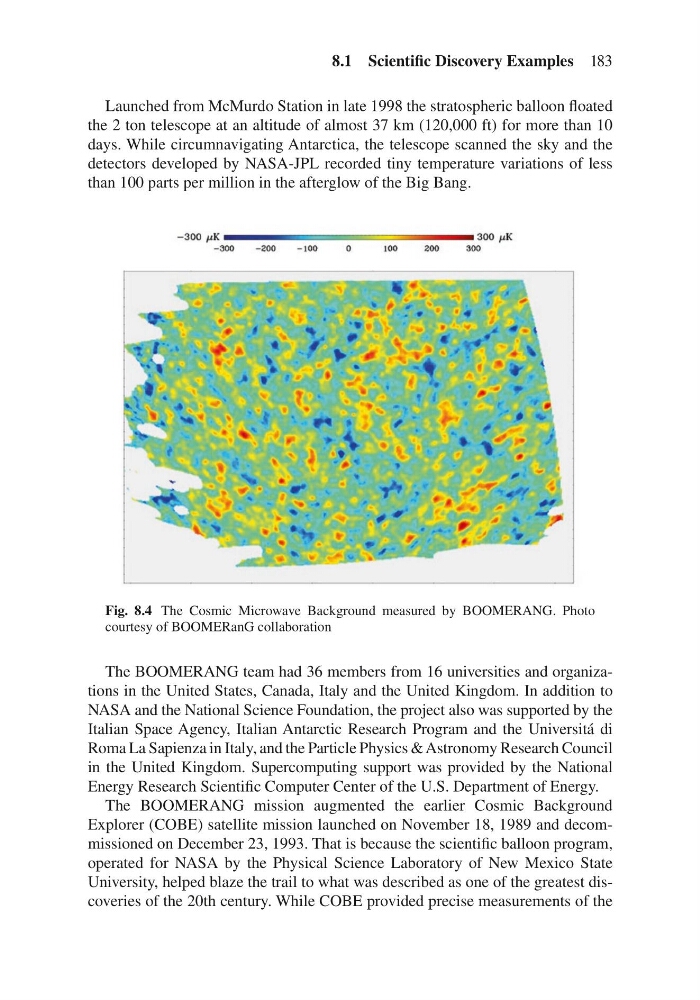
Launched from McMurdo Station in late 1998 the stratospheric balloon floated
the 2 ton telescope at an altitude of almost 37 km (120,000 ft) for more than 10
days. While circumnavigating Antarctica, the telescope scanned the sky and the
detectors developed by NASA-JPL recorded tiny temperature variations of less
than 100 parts per million in the afterglow of the Big Bang.
The BOOMERANG team had 36 members from 16 universities and organizations in the United States, Canada, Italy and the United Kingdom. In addition to
NASA and the National Science Foundation, the project also was supported by the
Italian Space Agency, Italian Antarctic Research Program and the Universitá di
Roma La Sapienza in Italy, and the Particle Physics & Astronomy Research Council
in the United Kingdom. Supercomputing support was provided by the National
Energy Research Scientific Computer Center of the U.S. Department of Energy.
The BOOMERANG mission augmented the earlier Cosmic Background
Explorer (COBE) satellite mission launched on November 18, 1989 and decommissioned on December 23, 1993. That is because the scientific balloon program,
operated for NASA by the Physical Science Laboratory of New Mexico State
University, helped blaze the trail to what was described as one of the greatest discoveries of the 20th century. While COBE provided precise measurements of the
Fig. 8.4 The Cosmic Microwave Background measured by BOOMERANG. Photo
courtesy of BOOMERanG collaboration
8.1 Scientific Discovery Examples 183
the 2 ton telescope at an altitude of almost 37 km (120,000 ft) for more than 10
days. While circumnavigating Antarctica, the telescope scanned the sky and the
detectors developed by NASA-JPL recorded tiny temperature variations of less
than 100 parts per million in the afterglow of the Big Bang.
The BOOMERANG team had 36 members from 16 universities and organizations in the United States, Canada, Italy and the United Kingdom. In addition to
NASA and the National Science Foundation, the project also was supported by the
Italian Space Agency, Italian Antarctic Research Program and the Universitá di
Roma La Sapienza in Italy, and the Particle Physics & Astronomy Research Council
in the United Kingdom. Supercomputing support was provided by the National
Energy Research Scientific Computer Center of the U.S. Department of Energy.
The BOOMERANG mission augmented the earlier Cosmic Background
Explorer (COBE) satellite mission launched on November 18, 1989 and decommissioned on December 23, 1993. That is because the scientific balloon program,
operated for NASA by the Physical Science Laboratory of New Mexico State
University, helped blaze the trail to what was described as one of the greatest discoveries of the 20th century. While COBE provided precise measurements of the
Fig. 8.4 The Cosmic Microwave Background measured by BOOMERANG. Photo
courtesy of BOOMERanG collaboration
8.1 Scientific Discovery Examples 183