

7.4.2 Balloon-borne Cryogenic Telescope Testbed (BOBCAT)
A good example of technology development is the effort to cool the telescopes
carried by balloons to eliminate the foreground emissions and boost the overall
sensitivity. The issue is that the heat generated by the telescope and light emitted
by the atmosphere overwhelm the weak far-infrared signal that the instrument is
to collect. Hence these facilities, like their counterparts in space, must be cooled
to just 21 K (–442°F).
Obtaining far-infrared light, especially on a balloon with a telescope which has
a large light-collecting mirror, is not as simple as it might seem. Scientists achieve
super-cold temperatures by placing the telescope inside a dewar and cooling that
with cryogenic fluids such as nitrogen and helium. But a conventional dewar of
sufficient size to accommodate a large primary mirror such as that of the Hubble
Space Telescope would weigh too much for the balloon to get off the ground. On
the other hand, an ultra-lightweight dewar with very thin vacuum walls cannot
withstand atmospheric pressure at sea level.
Dr. Alan J. Kogut conceived a way to do Hubble Space Telescope-class science
using a relatively inexpensive scientific balloon, and with support from GSFC’s
Internal Research and Development Program set out to prove the concept. This
Balloon-borne Cryogenic Telescope Testbed (BOBCAT) offers the potential to
revolutionize how astronomers collect far-infrared light in order to observe the
very distant universe and study its formation and evolution. At this wavelength
scientists can detect 98% of all photons emitted after the Big Bang.
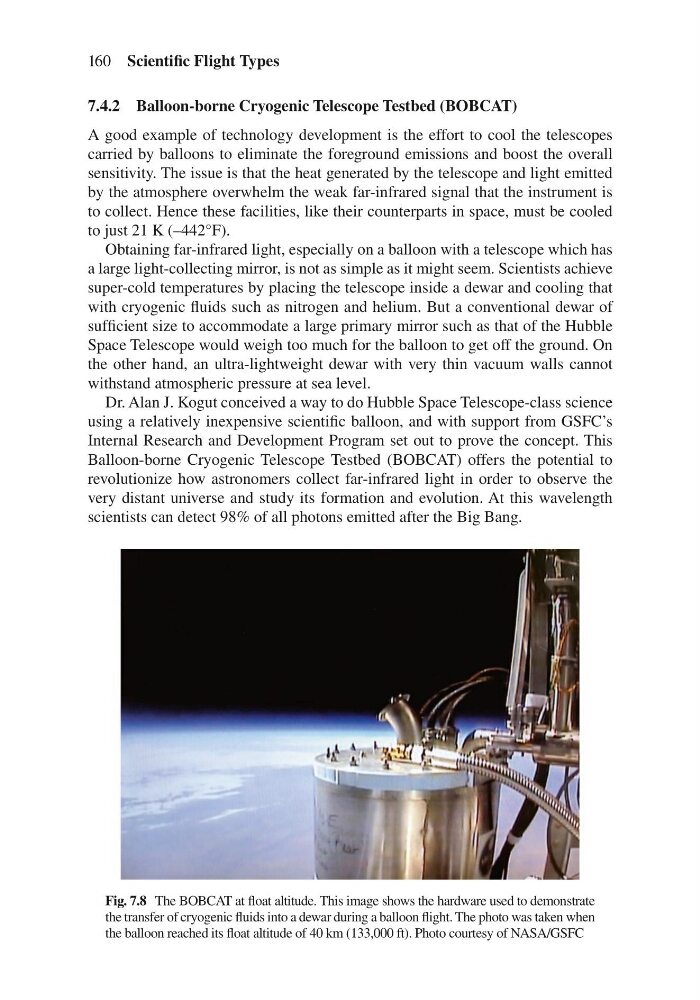
Fig. 7.8 The BOBCAT at float altitude. This image shows the hardware used to demonstrate
the transfer of cryogenic fluids into a dewar during a balloon flight. The photo was taken when
the balloon reached its float altitude of 40 km (133,000 ft). Photo courtesy of NASA/GSFC
160 Scientific Flight Types
A good example of technology development is the effort to cool the telescopes
carried by balloons to eliminate the foreground emissions and boost the overall
sensitivity. The issue is that the heat generated by the telescope and light emitted
by the atmosphere overwhelm the weak far-infrared signal that the instrument is
to collect. Hence these facilities, like their counterparts in space, must be cooled
to just 21 K (–442°F).
Obtaining far-infrared light, especially on a balloon with a telescope which has
a large light-collecting mirror, is not as simple as it might seem. Scientists achieve
super-cold temperatures by placing the telescope inside a dewar and cooling that
with cryogenic fluids such as nitrogen and helium. But a conventional dewar of
sufficient size to accommodate a large primary mirror such as that of the Hubble
Space Telescope would weigh too much for the balloon to get off the ground. On
the other hand, an ultra-lightweight dewar with very thin vacuum walls cannot
withstand atmospheric pressure at sea level.
Dr. Alan J. Kogut conceived a way to do Hubble Space Telescope-class science
using a relatively inexpensive scientific balloon, and with support from GSFC’s
Internal Research and Development Program set out to prove the concept. This
Balloon-borne Cryogenic Telescope Testbed (BOBCAT) offers the potential to
revolutionize how astronomers collect far-infrared light in order to observe the
very distant universe and study its formation and evolution. At this wavelength
scientists can detect 98% of all photons emitted after the Big Bang.
Fig. 7.8 The BOBCAT at float altitude. This image shows the hardware used to demonstrate
the transfer of cryogenic fluids into a dewar during a balloon flight. The photo was taken when
the balloon reached its float altitude of 40 km (133,000 ft). Photo courtesy of NASA/GSFC
160 Scientific Flight Types