

7.3.3 SuperTIGER
Super Trans-Iron Galactic Element Recorder (SuperTIGER) is an instrument to
measure the elemental composition of ultra-heavy galactic cosmic rays, whose
origin is one of the enduring mysteries in astrophysics. It was collaboration by
Washington University in St. Louis, NASA Goddard Space Flight Center, JPL,
California Institute of Technology, and University of Minnesota. As the name suggests, the instrument was an updated version of the TIGER experiment that was
flown in Antarctica twice in 2001 and 2003.
Flight 637N was a Raven Aerostar ZPB with a volume of 1.13 million m
3
(40
million ft
3
). It was launched on December 15, 2012 and flew for 55 days, in the
process setting a record for the longest flight of any heavy-lift scientific balloon.
It performed 2.7 revolutions around the South Pole. It performed well, returning
data on over 50 million cosmic ray nuclei. Owing to logistics complications and
the cancellation of the balloon launch campaign in 2014, the payload was left in
the ice for two years before being recovered in early 2015. After sixteen attempts
to launch SuperTIGER between December 8, 2017 and January 14, 2018, it was
decided to cancel the campaign for the season. Instead of returning it to the U.S.,
the payload was placed in special storage at McMurdo Station over the Antarctic
winter to await the next campaign. After many failed attempts, flight 706N was
successfully launched on December 16, 2019 and landed 32 days later.
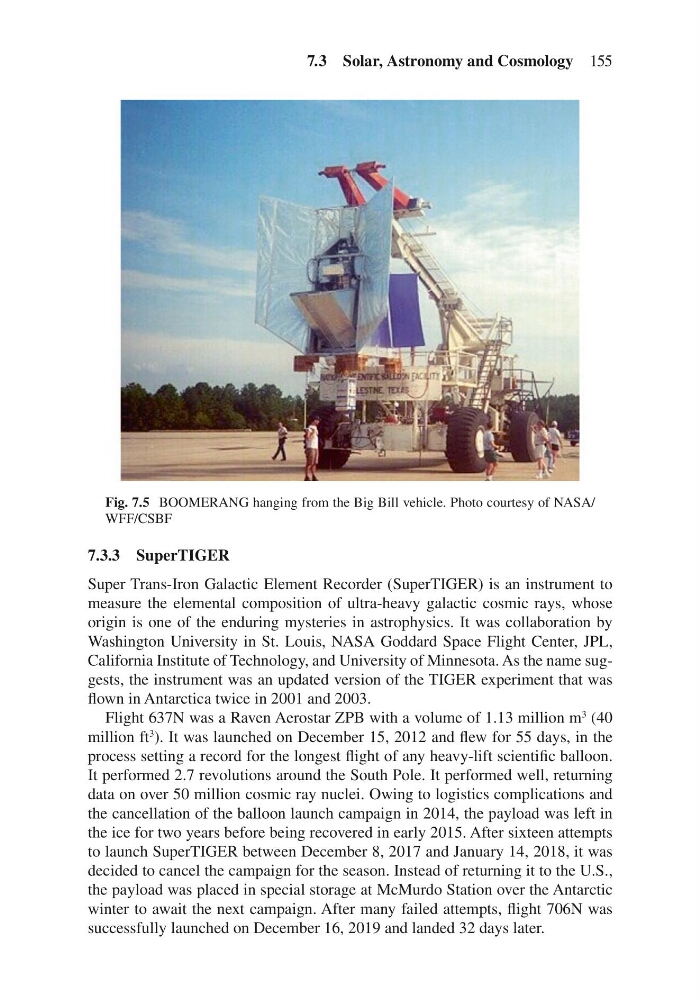
Fig. 7.5 BOOMERANG hanging from the Big Bill vehicle. Photo courtesy of NASA/
WFF/CSBF
7.3 Solar, Astronomy and Cosmology 155
Super Trans-Iron Galactic Element Recorder (SuperTIGER) is an instrument to
measure the elemental composition of ultra-heavy galactic cosmic rays, whose
origin is one of the enduring mysteries in astrophysics. It was collaboration by
Washington University in St. Louis, NASA Goddard Space Flight Center, JPL,
California Institute of Technology, and University of Minnesota. As the name suggests, the instrument was an updated version of the TIGER experiment that was
flown in Antarctica twice in 2001 and 2003.
Flight 637N was a Raven Aerostar ZPB with a volume of 1.13 million m
3
(40
million ft
3
). It was launched on December 15, 2012 and flew for 55 days, in the
process setting a record for the longest flight of any heavy-lift scientific balloon.
It performed 2.7 revolutions around the South Pole. It performed well, returning
data on over 50 million cosmic ray nuclei. Owing to logistics complications and
the cancellation of the balloon launch campaign in 2014, the payload was left in
the ice for two years before being recovered in early 2015. After sixteen attempts
to launch SuperTIGER between December 8, 2017 and January 14, 2018, it was
decided to cancel the campaign for the season. Instead of returning it to the U.S.,
the payload was placed in special storage at McMurdo Station over the Antarctic
winter to await the next campaign. After many failed attempts, flight 706N was
successfully launched on December 16, 2019 and landed 32 days later.
Fig. 7.5 BOOMERANG hanging from the Big Bill vehicle. Photo courtesy of NASA/
WFF/CSBF
7.3 Solar, Astronomy and Cosmology 155