

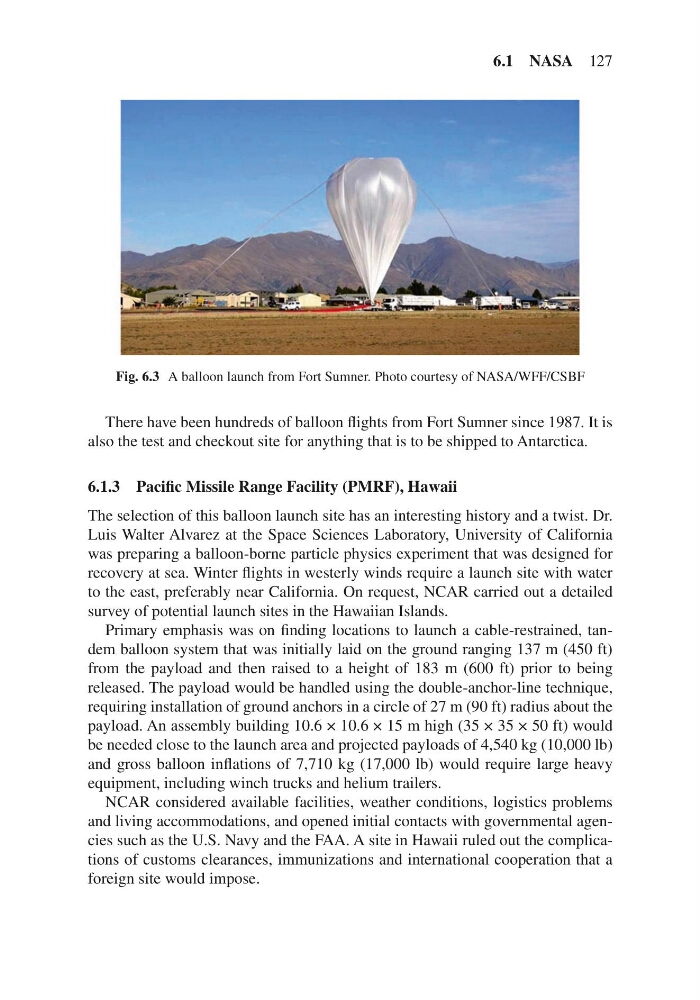
There have been hundreds of balloon flights from Fort Sumner since 1987. It is
also the test and checkout site for anything that is to be shipped to Antarctica.
6.1.3 Pacific Missile Range Facility (PMRF), Hawaii
The selection of this balloon launch site has an interesting history and a twist. Dr.
Luis Walter Alvarez at the Space Sciences Laboratory, University of California
was preparing a balloon-borne particle physics experiment that was designed for
recovery at sea. Winter flights in westerly winds require a launch site with water
to the east, preferably near California. On request, NCAR carried out a detailed
survey of potential launch sites in the Hawaiian Islands.
Primary emphasis was on finding locations to launch a cable-restrained, tandem balloon system that was initially laid on the ground ranging 137 m (450 ft)
from the payload and then raised to a height of 183 m (600 ft) prior to being
released. The payload would be handled using the double-anchor-line technique,
requiring installation of ground anchors in a circle of 27 m (90 ft) radius about the
payload. An assembly building 10.6 × 10.6 × 15 m high (35 × 35 × 50 ft) would
be needed close to the launch area and projected payloads of 4,540 kg (10,000 lb)
and gross balloon inflations of 7,710 kg (17,000 lb) would require large heavy
equipment, including winch trucks and helium trailers.
NCAR considered available facilities, weather conditions, logistics problems
and living accommodations, and opened initial contacts with governmental agencies such as the U.S. Navy and the FAA. A site in Hawaii ruled out the complications of customs clearances, immunizations and international cooperation that a
foreign site would impose.
Fig. 6.3 A balloon launch from Fort Sumner. Photo courtesy of NASA/WFF/CSBF
6.1 NASA 127
also the test and checkout site for anything that is to be shipped to Antarctica.
6.1.3 Pacific Missile Range Facility (PMRF), Hawaii
The selection of this balloon launch site has an interesting history and a twist. Dr.
Luis Walter Alvarez at the Space Sciences Laboratory, University of California
was preparing a balloon-borne particle physics experiment that was designed for
recovery at sea. Winter flights in westerly winds require a launch site with water
to the east, preferably near California. On request, NCAR carried out a detailed
survey of potential launch sites in the Hawaiian Islands.
Primary emphasis was on finding locations to launch a cable-restrained, tandem balloon system that was initially laid on the ground ranging 137 m (450 ft)
from the payload and then raised to a height of 183 m (600 ft) prior to being
released. The payload would be handled using the double-anchor-line technique,
requiring installation of ground anchors in a circle of 27 m (90 ft) radius about the
payload. An assembly building 10.6 × 10.6 × 15 m high (35 × 35 × 50 ft) would
be needed close to the launch area and projected payloads of 4,540 kg (10,000 lb)
and gross balloon inflations of 7,710 kg (17,000 lb) would require large heavy
equipment, including winch trucks and helium trailers.
NCAR considered available facilities, weather conditions, logistics problems
and living accommodations, and opened initial contacts with governmental agencies such as the U.S. Navy and the FAA. A site in Hawaii ruled out the complications of customs clearances, immunizations and international cooperation that a
foreign site would impose.
Fig. 6.3 A balloon launch from Fort Sumner. Photo courtesy of NASA/WFF/CSBF
6.1 NASA 127