

more flights during that first year of operations, including the Stratoscope II
telescope.
By 1964, the base had a paved launch area that had sections oriented in different
directions to cater for a variety of wind directions when extending the flight train.
Also that year there was a major improvement in the telemetry capability when a
digital command control system was installed. Also, a pair of movable telemetry
stations were added to the station setup to extend the range of the flying balloons.
In the 1970’s annual campaigns began, one between April and May and the
other between September and October. During these periods scientists and technicians arrived from around the world, providing a real stimulus for the local economy. It soon was apparent that a larger pad would be needed to handle larger
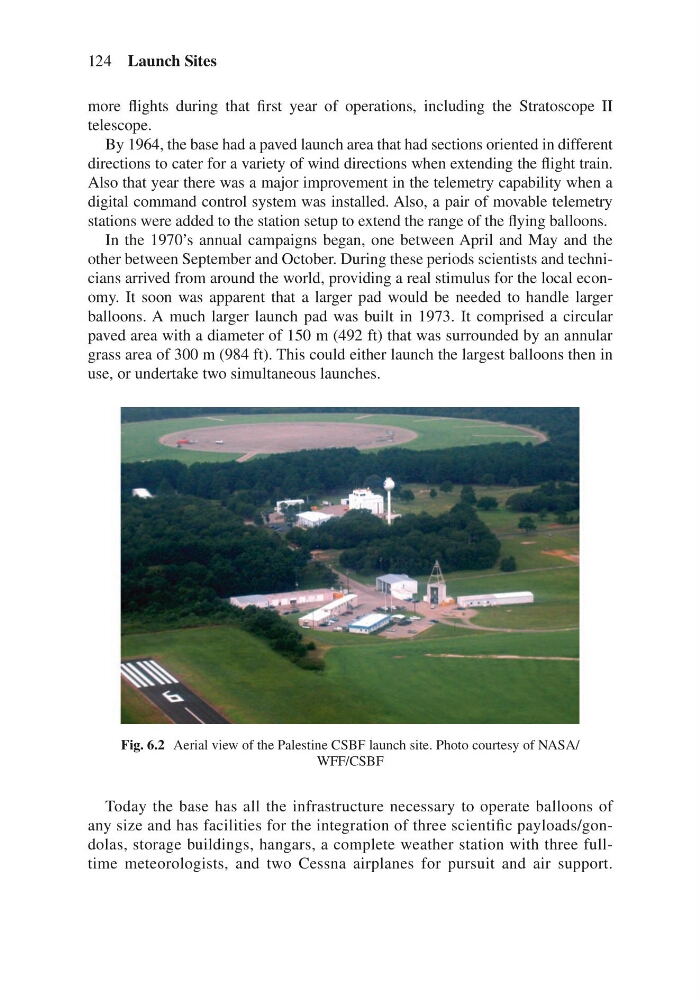
balloons. A much larger launch pad was built in 1973. It comprised a circular
paved area with a diameter of 150 m (492 ft) that was surrounded by an annular
grass area of 300 m (984 ft). This could either launch the largest balloons then in
use, or undertake two simultaneous launches.
Today the base has all the infrastructure necessary to operate balloons of
any size and has facilities for the integration of three scientific payloads/gondolas, storage buildings, hangars, a complete weather station with three fulltime meteorologists, and two Cessna airplanes for pursuit and air support.
Fig. 6.2 Aerial view of the Palestine CSBF launch site. Photo courtesy of NASA/
WFF/CSBF
124 Launch Sites
telescope.
By 1964, the base had a paved launch area that had sections oriented in different
directions to cater for a variety of wind directions when extending the flight train.
Also that year there was a major improvement in the telemetry capability when a
digital command control system was installed. Also, a pair of movable telemetry
stations were added to the station setup to extend the range of the flying balloons.
In the 1970’s annual campaigns began, one between April and May and the
other between September and October. During these periods scientists and technicians arrived from around the world, providing a real stimulus for the local economy. It soon was apparent that a larger pad would be needed to handle larger
balloons. A much larger launch pad was built in 1973. It comprised a circular
paved area with a diameter of 150 m (492 ft) that was surrounded by an annular
grass area of 300 m (984 ft). This could either launch the largest balloons then in
use, or undertake two simultaneous launches.
Today the base has all the infrastructure necessary to operate balloons of
any size and has facilities for the integration of three scientific payloads/gondolas, storage buildings, hangars, a complete weather station with three fulltime meteorologists, and two Cessna airplanes for pursuit and air support.
Fig. 6.2 Aerial view of the Palestine CSBF launch site. Photo courtesy of NASA/
WFF/CSBF
124 Launch Sites