

xii
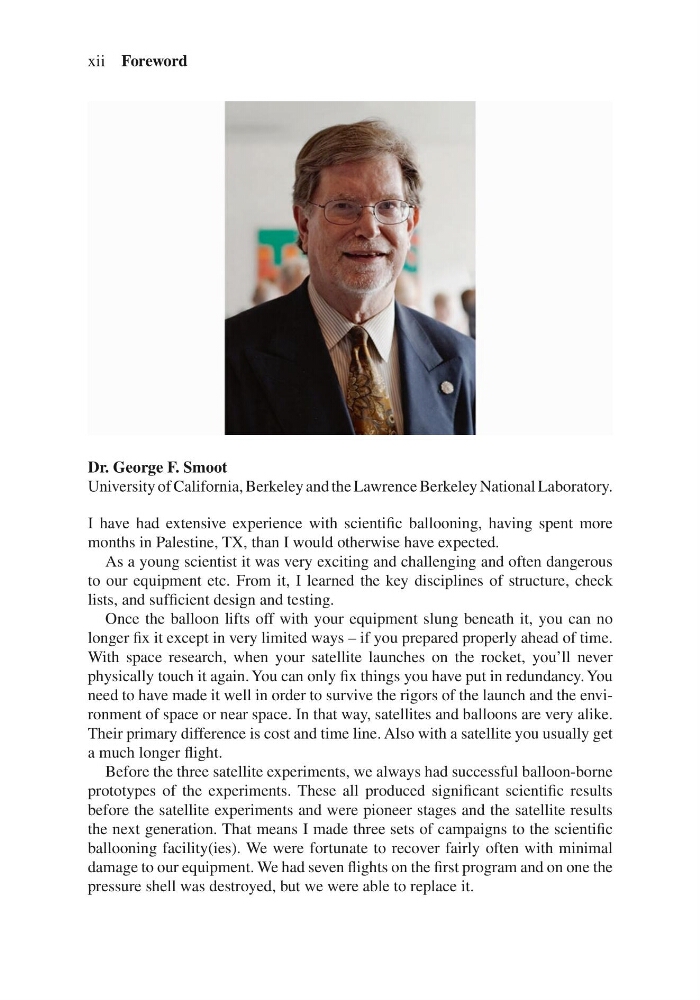
Dr. George F. Smoot
University of California, Berkeley and the Lawrence Berkeley National Laboratory.
I have had extensive experience with scientific ballooning, having spent more
months in Palestine, TX, than I would otherwise have expected.
As a young scientist it was very exciting and challenging and often dangerous
to our equipment etc. From it, I learned the key disciplines of structure, check
lists, and sufficient design and testing.
Once the balloon lifts off with your equipment slung beneath it, you can no
longer fix it except in very limited ways – if you prepared properly ahead of time.
With space research, when your satellite launches on the rocket, you’ll never
physically touch it again. You can only fix things you have put in redundancy. You
need to have made it well in order to survive the rigors of the launch and the environment of space or near space. In that way, satellites and balloons are very alike.
Their primary difference is cost and time line. Also with a satellite you usually get
a much longer flight.
Before the three satellite experiments, we always had successful balloon-borne
prototypes of the experiments. These all produced significant scientific results
before the satellite experiments and were pioneer stages and the satellite results
the next generation. That means I made three sets of campaigns to the scientific
ballooning facility(ies). We were fortunate to recover fairly often with minimal
damage to our equipment. We had seven flights on the first program and on one the
pressure shell was destroyed, but we were able to replace it.
Foreword
Dr. George F. Smoot
University of California, Berkeley and the Lawrence Berkeley National Laboratory.
I have had extensive experience with scientific ballooning, having spent more
months in Palestine, TX, than I would otherwise have expected.
As a young scientist it was very exciting and challenging and often dangerous
to our equipment etc. From it, I learned the key disciplines of structure, check
lists, and sufficient design and testing.
Once the balloon lifts off with your equipment slung beneath it, you can no
longer fix it except in very limited ways – if you prepared properly ahead of time.
With space research, when your satellite launches on the rocket, you’ll never
physically touch it again. You can only fix things you have put in redundancy. You
need to have made it well in order to survive the rigors of the launch and the environment of space or near space. In that way, satellites and balloons are very alike.
Their primary difference is cost and time line. Also with a satellite you usually get
a much longer flight.
Before the three satellite experiments, we always had successful balloon-borne
prototypes of the experiments. These all produced significant scientific results
before the satellite experiments and were pioneer stages and the satellite results
the next generation. That means I made three sets of campaigns to the scientific
ballooning facility(ies). We were fortunate to recover fairly often with minimal
damage to our equipment. We had seven flights on the first program and on one the
pressure shell was destroyed, but we were able to replace it.
Foreword