

Another attraction is the ability of a Stratollite to stay relatively in place, despite
variable high altitude winds. This is achieved by having real-time knowledge of
area meteorology and winds at various altitudes, and sophisticated algorithms to
managed the system to remain within a given range of the target with the sensors
onboard. On one flight, a Stratollite stayed within an area that was about 120 km
(75 mi) square for a period of 8 days, and zeroed in on a much smaller target just
10 km (six mi) wide for a total of 6.5 hours.
5.2.2 Stratocraft
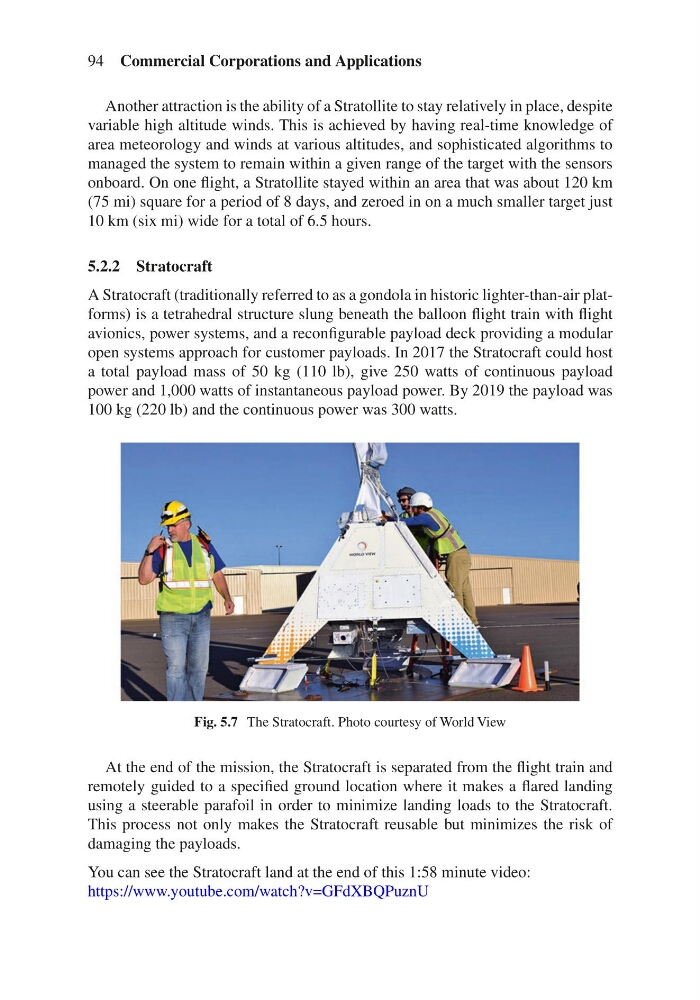
A Stratocraft (traditionally referred to as a gondola in historic lighter-than-air platforms) is a tetrahedral structure slung beneath the balloon flight train with flight
avionics, power systems, and a reconfigurable payload deck providing a modular
open systems approach for customer payloads. In 2017 the Stratocraft could host
a total payload mass of 50 kg (110 lb), give 250 watts of continuous payload
power and 1,000 watts of instantaneous payload power. By 2019 the payload was
100 kg (220 lb) and the continuous power was 300 watts.
At the end of the mission, the Stratocraft is separated from the flight train and
remotely guided to a specified ground location where it makes a flared landing
using a steerable parafoil in order to minimize landing loads to the Stratocraft.
This process not only makes the Stratocraft reusable but minimizes the risk of
damaging the payloads.
You can see the Stratocraft land at the end of this 1:58 minute video:
https://www.youtube.com/watch?v=GFdXBQPuznU
Fig. 5.7 The Stratocraft. Photo courtesy of World View
94 Commercial Corporations and Applications
variable high altitude winds. This is achieved by having real-time knowledge of
area meteorology and winds at various altitudes, and sophisticated algorithms to
managed the system to remain within a given range of the target with the sensors
onboard. On one flight, a Stratollite stayed within an area that was about 120 km
(75 mi) square for a period of 8 days, and zeroed in on a much smaller target just
10 km (six mi) wide for a total of 6.5 hours.
5.2.2 Stratocraft
A Stratocraft (traditionally referred to as a gondola in historic lighter-than-air platforms) is a tetrahedral structure slung beneath the balloon flight train with flight
avionics, power systems, and a reconfigurable payload deck providing a modular
open systems approach for customer payloads. In 2017 the Stratocraft could host
a total payload mass of 50 kg (110 lb), give 250 watts of continuous payload
power and 1,000 watts of instantaneous payload power. By 2019 the payload was
100 kg (220 lb) and the continuous power was 300 watts.
At the end of the mission, the Stratocraft is separated from the flight train and
remotely guided to a specified ground location where it makes a flared landing
using a steerable parafoil in order to minimize landing loads to the Stratocraft.
This process not only makes the Stratocraft reusable but minimizes the risk of
damaging the payloads.
You can see the Stratocraft land at the end of this 1:58 minute video:
https://www.youtube.com/watch?v=GFdXBQPuznU
Fig. 5.7 The Stratocraft. Photo courtesy of World View
94 Commercial Corporations and Applications