

84
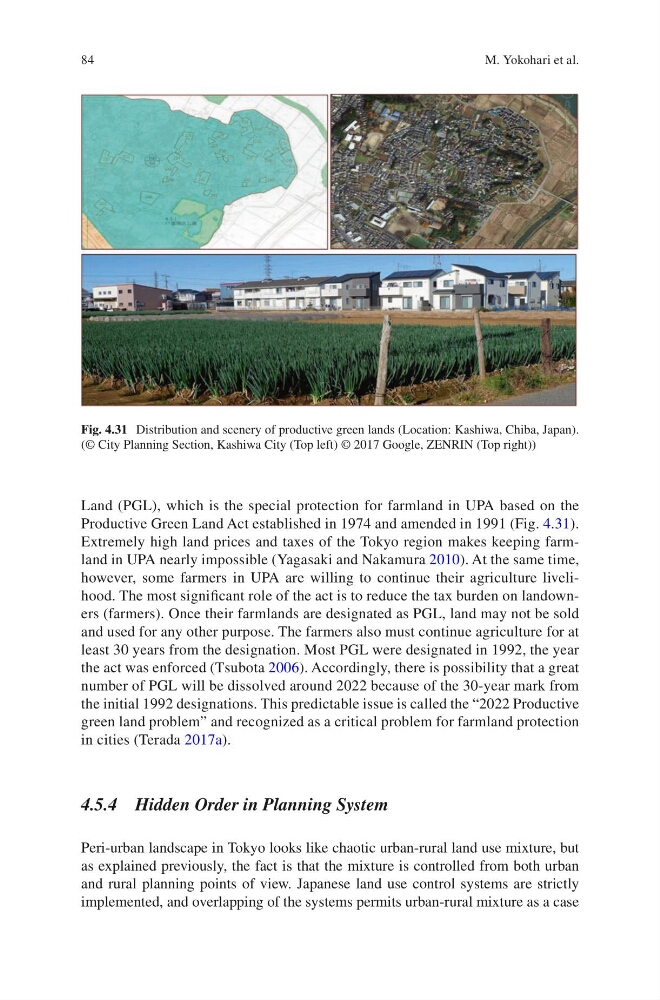
Land (PGL), which is the special protection for farmland in UPA based on the
Productive Green Land Act established in 1974 and amended in 1991 (Fig. 4.31).
Extremely high land prices and taxes of the Tokyo region makes keeping farmland in UPA nearly impossible (Yagasaki and Nakamura 2010). At the same time,
however, some farmers in UPA are willing to continue their agriculture livelihood. The most significant role of the act is to reduce the tax burden on landowners (farmers). Once their farmlands are designated as PGL, land may not be sold
and used for any other purpose. The farmers also must continue agriculture for at
least 30 years from the designation. Most PGL were designated in 1992, the year
the act was enforced (Tsubota 2006). Accordingly, there is possibility that a great
number of PGL will be dissolved around 2022 because of the 30-year mark from
the initial 1992 designations. This predictable issue is called the “2022 Productive
green land problem” and recognized as a critical problem for farmland protection
in cities (Terada 2017a).
4.5.4 Hidden Order in Planning System
Peri-urban landscape in Tokyo looks like chaotic urban-rural land use mixture, but
as explained previously, the fact is that the mixture is controlled from both urban
and rural planning points of view. Japanese land use control systems are strictly
implemented, and overlapping of the systems permits urban-rural mixture as a case
Fig. 4.31 Distribution and scenery of productive green lands (Location: Kashiwa, Chiba, Japan).
(© City Planning Section, Kashiwa City (Top left) © 2017 Google, ZENRIN (Top right))
M. Yokohari et al.
Land (PGL), which is the special protection for farmland in UPA based on the
Productive Green Land Act established in 1974 and amended in 1991 (Fig. 4.31).
Extremely high land prices and taxes of the Tokyo region makes keeping farmland in UPA nearly impossible (Yagasaki and Nakamura 2010). At the same time,
however, some farmers in UPA are willing to continue their agriculture livelihood. The most significant role of the act is to reduce the tax burden on landowners (farmers). Once their farmlands are designated as PGL, land may not be sold
and used for any other purpose. The farmers also must continue agriculture for at
least 30 years from the designation. Most PGL were designated in 1992, the year
the act was enforced (Tsubota 2006). Accordingly, there is possibility that a great
number of PGL will be dissolved around 2022 because of the 30-year mark from
the initial 1992 designations. This predictable issue is called the “2022 Productive
green land problem” and recognized as a critical problem for farmland protection
in cities (Terada 2017a).
4.5.4 Hidden Order in Planning System
Peri-urban landscape in Tokyo looks like chaotic urban-rural land use mixture, but
as explained previously, the fact is that the mixture is controlled from both urban
and rural planning points of view. Japanese land use control systems are strictly
implemented, and overlapping of the systems permits urban-rural mixture as a case
Fig. 4.31 Distribution and scenery of productive green lands (Location: Kashiwa, Chiba, Japan).
(© City Planning Section, Kashiwa City (Top left) © 2017 Google, ZENRIN (Top right))
M. Yokohari et al.