

65
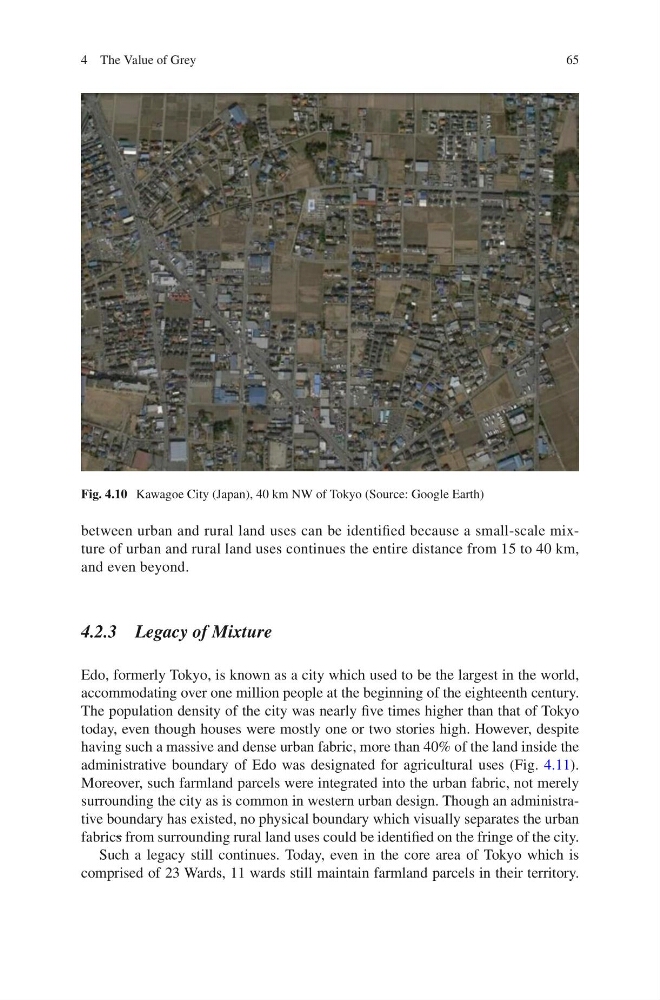
between urban and rural land uses can be identified because a small-scale mixture of urban and rural land uses continues the entire distance from 15 to 40 km,
and even beyond.
4.2.3 Legacy of Mixture
Edo, formerly Tokyo, is known as a city which used to be the largest in the world,
accommodating over one million people at the beginning of the eighteenth century.
The population density of the city was nearly five times higher than that of Tokyo
today, even though houses were mostly one or two stories high. However, despite
having such a massive and dense urban fabric, more than 40% of the land inside the
administrative boundary of Edo was designated for agricultural uses (Fig. 4.11).
Moreover, such farmland parcels were integrated into the urban fabric, not merely
surrounding the city as is common in western urban design. Though an administrative boundary has existed, no physical boundary which visually separates the urban
fabrics from surrounding rural land uses could be identified on the fringe of the city.
Such a legacy still continues. Today, even in the core area of Tokyo which is
comprised of 23 Wards, 11 wards still maintain farmland parcels in their territory.
Fig. 4.10 Kawagoe City (Japan), 40 km NW of Tokyo (Source: Google Earth)
4 The Value of Grey
between urban and rural land uses can be identified because a small-scale mixture of urban and rural land uses continues the entire distance from 15 to 40 km,
and even beyond.
4.2.3 Legacy of Mixture
Edo, formerly Tokyo, is known as a city which used to be the largest in the world,
accommodating over one million people at the beginning of the eighteenth century.
The population density of the city was nearly five times higher than that of Tokyo
today, even though houses were mostly one or two stories high. However, despite
having such a massive and dense urban fabric, more than 40% of the land inside the
administrative boundary of Edo was designated for agricultural uses (Fig. 4.11).
Moreover, such farmland parcels were integrated into the urban fabric, not merely
surrounding the city as is common in western urban design. Though an administrative boundary has existed, no physical boundary which visually separates the urban
fabrics from surrounding rural land uses could be identified on the fringe of the city.
Such a legacy still continues. Today, even in the core area of Tokyo which is
comprised of 23 Wards, 11 wards still maintain farmland parcels in their territory.
Fig. 4.10 Kawagoe City (Japan), 40 km NW of Tokyo (Source: Google Earth)
4 The Value of Grey