

59
4.2 Layer Model
4.2.1 Dichotomy Versus Grey
Dichotomy is probably one of easiest approaches to understand and plan complicated issues. When faced with complexity, people usually try to understand the
issue by locating it in a very simple dichotomous structure: yes or no, black or
white, right or wrong, ad infinitum. Such a dichotomous concept has been applied
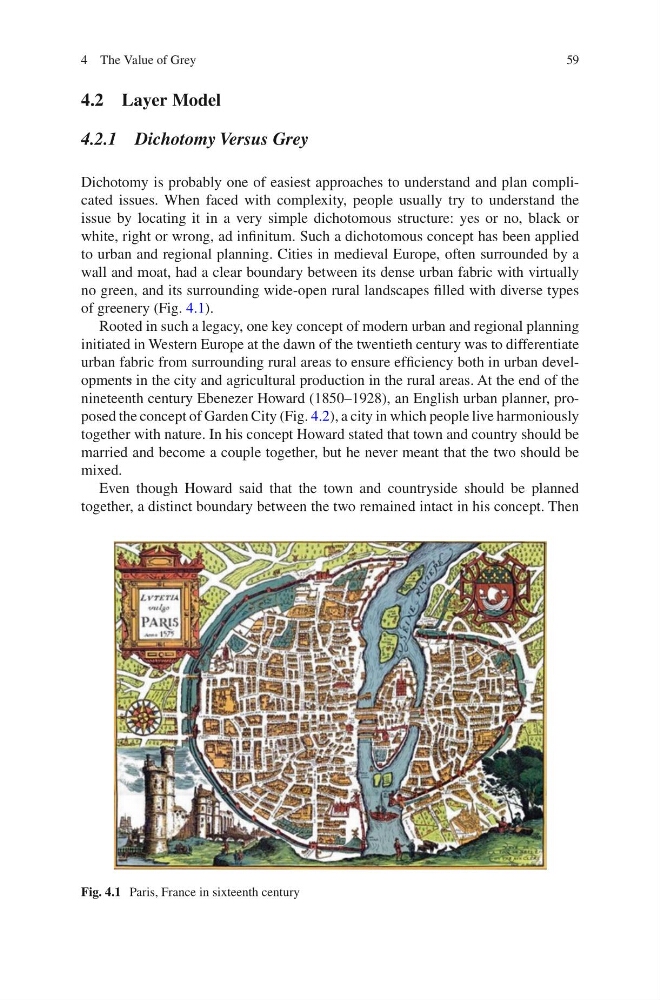
to urban and regional planning. Cities in medieval Europe, often surrounded by a
wall and moat, had a clear boundary between its dense urban fabric with virtually
no green, and its surrounding wide-open rural landscapes filled with diverse types
of greenery (Fig. 4.1).
Rooted in such a legacy, one key concept of modern urban and regional planning
initiated in Western Europe at the dawn of the twentieth century was to differentiate
urban fabric from surrounding rural areas to ensure efficiency both in urban developments in the city and agricultural production in the rural areas. At the end of the
nineteenth century Ebenezer Howard (1850–1928), an English urban planner, proposed the concept of Garden City (Fig. 4.2), a city in which people live harmoniously
together with nature. In his concept Howard stated that town and country should be
married and become a couple together, but he never meant that the two should be
mixed.
Even though Howard said that the town and countryside should be planned
together, a distinct boundary between the two remained intact in his concept. Then
Fig. 4.1 Paris, France in sixteenth century
4 The Value of Grey
4.2 Layer Model
4.2.1 Dichotomy Versus Grey
Dichotomy is probably one of easiest approaches to understand and plan complicated issues. When faced with complexity, people usually try to understand the
issue by locating it in a very simple dichotomous structure: yes or no, black or
white, right or wrong, ad infinitum. Such a dichotomous concept has been applied
to urban and regional planning. Cities in medieval Europe, often surrounded by a
wall and moat, had a clear boundary between its dense urban fabric with virtually
no green, and its surrounding wide-open rural landscapes filled with diverse types
of greenery (Fig. 4.1).
Rooted in such a legacy, one key concept of modern urban and regional planning
initiated in Western Europe at the dawn of the twentieth century was to differentiate
urban fabric from surrounding rural areas to ensure efficiency both in urban developments in the city and agricultural production in the rural areas. At the end of the
nineteenth century Ebenezer Howard (1850–1928), an English urban planner, proposed the concept of Garden City (Fig. 4.2), a city in which people live harmoniously
together with nature. In his concept Howard stated that town and country should be
married and become a couple together, but he never meant that the two should be
mixed.
Even though Howard said that the town and countryside should be planned
together, a distinct boundary between the two remained intact in his concept. Then
Fig. 4.1 Paris, France in sixteenth century
4 The Value of Grey