

45
process of change where the fundamental character of society—or a sub-system of
society—transforms (Rotmans et al. 2001). The field has extended to sustainability
over the past decade-plus with a number of “experiments,” especially in urban areas
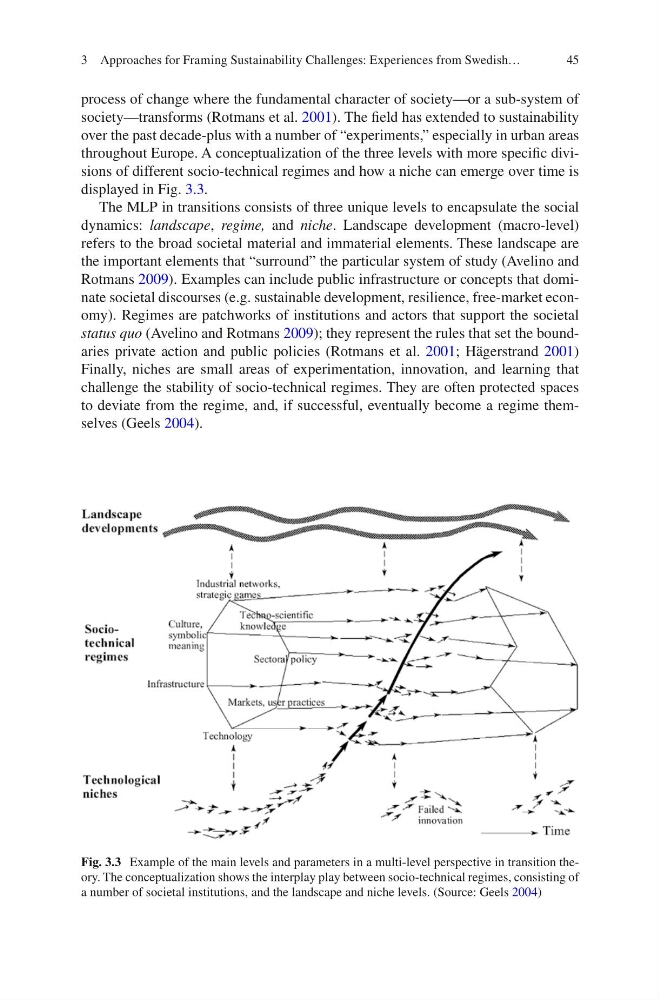
throughout Europe. A conceptualization of the three levels with more specific divisions of different socio-technical regimes and how a niche can emerge over time is
displayed in Fig. 3.3.
The MLP in transitions consists of three unique levels to encapsulate the social
dynamics: landscape, regime, and niche. Landscape development (macro-level)
refers to the broad societal material and immaterial elements. These landscape are
the important elements that “surround” the particular system of study (Avelino and
Rotmans 2009). Examples can include public infrastructure or concepts that dominate societal discourses (e.g. sustainable development, resilience, free-market economy). Regimes are patchworks of institutions and actors that support the societal
status quo (Avelino and Rotmans 2009); they represent the rules that set the boundaries private action and public policies (Rotmans et al. 2001; Hägerstrand 2001)
Finally, niches are small areas of experimentation, innovation, and learning that
challenge the stability of socio-technical regimes. They are often protected spaces
to deviate from the regime, and, if successful, eventually become a regime themselves (Geels 2004).
Fig. 3.3 Example of the main levels and parameters in a multi-level perspective in transition theory. The conceptualization shows the interplay play between socio-technical regimes, consisting of
a number of societal institutions, and the landscape and niche levels. (Source: Geels 2004)
3 Approaches for Framing Sustainability Challenges: Experiences from Swedish…
process of change where the fundamental character of society—or a sub-system of
society—transforms (Rotmans et al. 2001). The field has extended to sustainability
over the past decade-plus with a number of “experiments,” especially in urban areas
throughout Europe. A conceptualization of the three levels with more specific divisions of different socio-technical regimes and how a niche can emerge over time is
displayed in Fig. 3.3.
The MLP in transitions consists of three unique levels to encapsulate the social
dynamics: landscape, regime, and niche. Landscape development (macro-level)
refers to the broad societal material and immaterial elements. These landscape are
the important elements that “surround” the particular system of study (Avelino and
Rotmans 2009). Examples can include public infrastructure or concepts that dominate societal discourses (e.g. sustainable development, resilience, free-market economy). Regimes are patchworks of institutions and actors that support the societal
status quo (Avelino and Rotmans 2009); they represent the rules that set the boundaries private action and public policies (Rotmans et al. 2001; Hägerstrand 2001)
Finally, niches are small areas of experimentation, innovation, and learning that
challenge the stability of socio-technical regimes. They are often protected spaces
to deviate from the regime, and, if successful, eventually become a regime themselves (Geels 2004).
Fig. 3.3 Example of the main levels and parameters in a multi-level perspective in transition theory. The conceptualization shows the interplay play between socio-technical regimes, consisting of
a number of societal institutions, and the landscape and niche levels. (Source: Geels 2004)
3 Approaches for Framing Sustainability Challenges: Experiences from Swedish…