

158
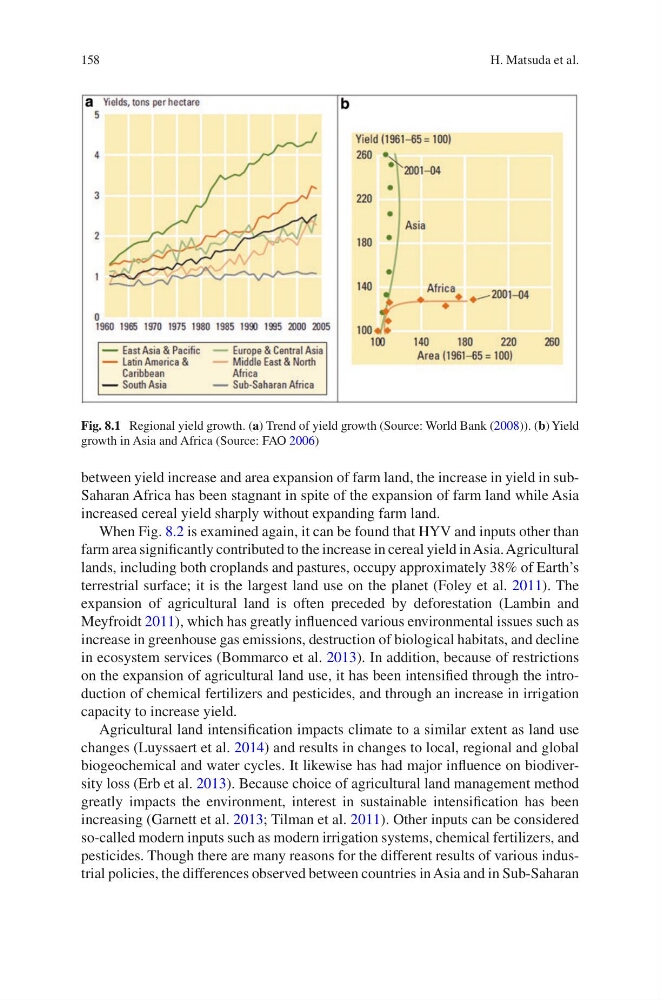
between yield increase and area expansion of farm land, the increase in yield in subSaharan Africa has been stagnant in spite of the expansion of farm land while Asia
increased cereal yield sharply without expanding farm land.
When Fig. 8.2 is examined again, it can be found that HYV and inputs other than
farm area significantly contributed to the increase in cereal yield in Asia. Agricultural
lands, including both croplands and pastures, occupy approximately 38% of Earth’s
terrestrial surface; it is the largest land use on the planet (Foley et al. 2011). The
expansion of agricultural land is often preceded by deforestation (Lambin and
Meyfroidt 2011), which has greatly influenced various environmental issues such as
increase in greenhouse gas emissions, destruction of biological habitats, and decline
in ecosystem services (Bommarco et al. 2013). In addition, because of restrictions
on the expansion of agricultural land use, it has been intensified through the introduction of chemical fertilizers and pesticides, and through an increase in irrigation
capacity to increase yield.
Agricultural land intensification impacts climate to a similar extent as land use
changes (Luyssaert et al. 2014) and results in changes to local, regional and global
biogeochemical and water cycles. It likewise has had major influence on biodiversity loss (Erb et al. 2013). Because choice of agricultural land management method
greatly impacts the environment, interest in sustainable intensification has been
increasing (Garnett et al. 2013; Tilman et al. 2011). Other inputs can be considered
so-called modern inputs such as modern irrigation systems, chemical fertilizers, and
pesticides. Though there are many reasons for the different results of various industrial policies, the differences observed between countries in Asia and in Sub-Saharan
Fig. 8.1 Regional yield growth. (a) Trend of yield growth (Source: World Bank (2008)). (b) Yield
growth in Asia and Africa (Source: FAO 2006)
H. Matsuda et al.
between yield increase and area expansion of farm land, the increase in yield in subSaharan Africa has been stagnant in spite of the expansion of farm land while Asia
increased cereal yield sharply without expanding farm land.
When Fig. 8.2 is examined again, it can be found that HYV and inputs other than
farm area significantly contributed to the increase in cereal yield in Asia. Agricultural
lands, including both croplands and pastures, occupy approximately 38% of Earth’s
terrestrial surface; it is the largest land use on the planet (Foley et al. 2011). The
expansion of agricultural land is often preceded by deforestation (Lambin and
Meyfroidt 2011), which has greatly influenced various environmental issues such as
increase in greenhouse gas emissions, destruction of biological habitats, and decline
in ecosystem services (Bommarco et al. 2013). In addition, because of restrictions
on the expansion of agricultural land use, it has been intensified through the introduction of chemical fertilizers and pesticides, and through an increase in irrigation
capacity to increase yield.
Agricultural land intensification impacts climate to a similar extent as land use
changes (Luyssaert et al. 2014) and results in changes to local, regional and global
biogeochemical and water cycles. It likewise has had major influence on biodiversity loss (Erb et al. 2013). Because choice of agricultural land management method
greatly impacts the environment, interest in sustainable intensification has been
increasing (Garnett et al. 2013; Tilman et al. 2011). Other inputs can be considered
so-called modern inputs such as modern irrigation systems, chemical fertilizers, and
pesticides. Though there are many reasons for the different results of various industrial policies, the differences observed between countries in Asia and in Sub-Saharan
Fig. 8.1 Regional yield growth. (a) Trend of yield growth (Source: World Bank (2008)). (b) Yield
growth in Asia and Africa (Source: FAO 2006)
H. Matsuda et al.