

112
based on how places were used by people in the past, not only on how places look
like today. Such in-depth understanding about places in their town allowed them
to re-examine the value of places today.
Thirdly, after taking the picture of today at the same locations as in the old pictures the participants had chosen, the participants shared the stories of the past and
the present. They described the old pictures they chose, shared what they found
interesting in the old pictures, and how they felt by visiting those places. By utilizing old pictures and the pictures participants took by themselves on the day of workshop, the participants discussed what kind of community they want to actualize in
the future. This last process corresponds to the process to collectively envision the
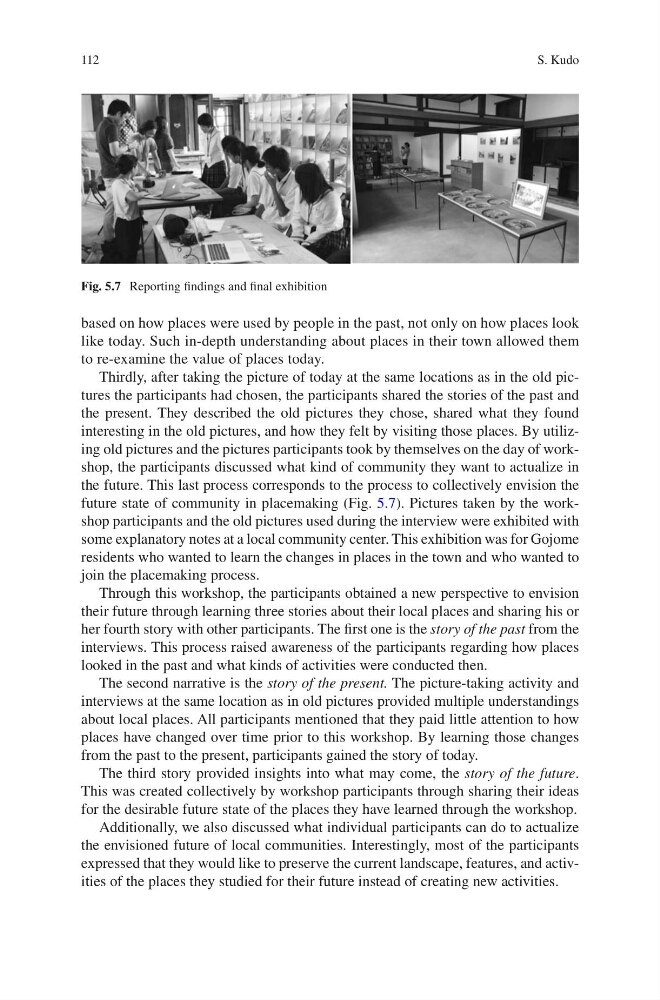
future state of community in placemaking (Fig. 5.7). Pictures taken by the workshop participants and the old pictures used during the interview were exhibited with
some explanatory notes at a local community center. This exhibition was for Gojome
residents who wanted to learn the changes in places in the town and who wanted to
join the placemaking process.
Through this workshop, the participants obtained a new perspective to envision
their future through learning three stories about their local places and sharing his or
her fourth story with other participants. The first one is the story of the past from the
interviews. This process raised awareness of the participants regarding how places
looked in the past and what kinds of activities were conducted then.
The second narrative is the story of the present. The picture-taking activity and
interviews at the same location as in old pictures provided multiple understandings
about local places. All participants mentioned that they paid little attention to how
places have changed over time prior to this workshop. By learning those changes
from the past to the present, participants gained the story of today.
The third story provided insights into what may come, the story of the future.
This was created collectively by workshop participants through sharing their ideas
for the desirable future state of the places they have learned through the workshop.
Additionally, we also discussed what individual participants can do to actualize
the envisioned future of local communities. Interestingly, most of the participants
expressed that they would like to preserve the current landscape, features, and activities of the places they studied for their future instead of creating new activities.
Fig. 5.7 Reporting findings and final exhibition
S. Kudo
based on how places were used by people in the past, not only on how places look
like today. Such in-depth understanding about places in their town allowed them
to re-examine the value of places today.
Thirdly, after taking the picture of today at the same locations as in the old pictures the participants had chosen, the participants shared the stories of the past and
the present. They described the old pictures they chose, shared what they found
interesting in the old pictures, and how they felt by visiting those places. By utilizing old pictures and the pictures participants took by themselves on the day of workshop, the participants discussed what kind of community they want to actualize in
the future. This last process corresponds to the process to collectively envision the
future state of community in placemaking (Fig. 5.7). Pictures taken by the workshop participants and the old pictures used during the interview were exhibited with
some explanatory notes at a local community center. This exhibition was for Gojome
residents who wanted to learn the changes in places in the town and who wanted to
join the placemaking process.
Through this workshop, the participants obtained a new perspective to envision
their future through learning three stories about their local places and sharing his or
her fourth story with other participants. The first one is the story of the past from the
interviews. This process raised awareness of the participants regarding how places
looked in the past and what kinds of activities were conducted then.
The second narrative is the story of the present. The picture-taking activity and
interviews at the same location as in old pictures provided multiple understandings
about local places. All participants mentioned that they paid little attention to how
places have changed over time prior to this workshop. By learning those changes
from the past to the present, participants gained the story of today.
The third story provided insights into what may come, the story of the future.
This was created collectively by workshop participants through sharing their ideas
for the desirable future state of the places they have learned through the workshop.
Additionally, we also discussed what individual participants can do to actualize
the envisioned future of local communities. Interestingly, most of the participants
expressed that they would like to preserve the current landscape, features, and activities of the places they studied for their future instead of creating new activities.
Fig. 5.7 Reporting findings and final exhibition
S. Kudo