

50
son by cause of death and the cause of accidents that occurred indoors in which
injured persons were taken to hospitasl by ambulance. As a result, seasonal fluctuations were found in the cause of death due to the vasculature/cardiovascular system
and the cause of death in residences. There are many cases of heat shock in the
winter when the blood pressure rapidly changes due to temperature differences in
the bathroom and dressing room. Houses with large temperature differences have a
higher risk of people falling sick.
A report by Professor Shunji Ikaga of Keio University presented at the
Architectural Institute of Japan is also very interesting. According to a questionnaire
conducted for 5500 houses and 19,000 people living in highly insulated and highly
airtight houses, there was a clear difference in the prevalence rate of illness before
and after the people moved in. An 84% improvement was seen in cerebrovascular
diseases, while an 81% improvement was seen in heart diseases. Improvements
were also seen in all 10 diseases investigated including allergic rhinitis and atopic
dermatitis.
Since insulated houses have uniform indoor temperature, vascular diseases such
as heat shock are unlikely to occur. Also, since highly condensed and airtight houses
are less susceptible to dew condensation that cause molds, it is thought that various
symptoms such as allergy and atopy have improved. Higher insulation and higher
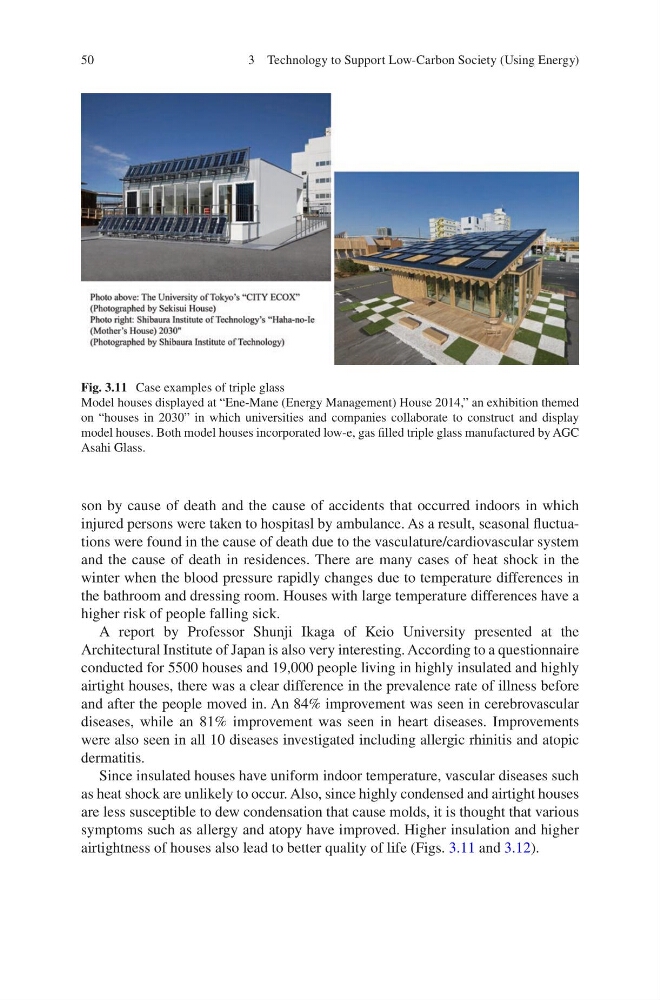
airtightness of houses also lead to better quality of life (Figs. 3.11 and 3.12).
Fig. 3.11 Case examples of triple glass
Model houses displayed at “Ene-Mane (Energy Management) House 2014,” an exhibition themed
on “houses in 2030” in which universities and companies collaborate to construct and display
model houses. Both model houses incorporated low-e, gas filled triple glass manufactured by AGC
Asahi Glass.
3 Technology to Support Low-Carbon Society (Using Energy)
son by cause of death and the cause of accidents that occurred indoors in which
injured persons were taken to hospitasl by ambulance. As a result, seasonal fluctuations were found in the cause of death due to the vasculature/cardiovascular system
and the cause of death in residences. There are many cases of heat shock in the
winter when the blood pressure rapidly changes due to temperature differences in
the bathroom and dressing room. Houses with large temperature differences have a
higher risk of people falling sick.
A report by Professor Shunji Ikaga of Keio University presented at the
Architectural Institute of Japan is also very interesting. According to a questionnaire
conducted for 5500 houses and 19,000 people living in highly insulated and highly
airtight houses, there was a clear difference in the prevalence rate of illness before
and after the people moved in. An 84% improvement was seen in cerebrovascular
diseases, while an 81% improvement was seen in heart diseases. Improvements
were also seen in all 10 diseases investigated including allergic rhinitis and atopic
dermatitis.
Since insulated houses have uniform indoor temperature, vascular diseases such
as heat shock are unlikely to occur. Also, since highly condensed and airtight houses
are less susceptible to dew condensation that cause molds, it is thought that various
symptoms such as allergy and atopy have improved. Higher insulation and higher
airtightness of houses also lead to better quality of life (Figs. 3.11 and 3.12).
Fig. 3.11 Case examples of triple glass
Model houses displayed at “Ene-Mane (Energy Management) House 2014,” an exhibition themed
on “houses in 2030” in which universities and companies collaborate to construct and display
model houses. Both model houses incorporated low-e, gas filled triple glass manufactured by AGC
Asahi Glass.
3 Technology to Support Low-Carbon Society (Using Energy)