

17
expected 50-year service life of a home. A look at the number of new housing starts
in recent years shows that it falls largely within this range.
Thinking about saturation of man-made objects in terms of what stage of economic development a developing country is at, we see it begins with infrastructure
such as roads and railroads being laid down. As the country becomes a little more
affluent, it extends to the high-tech products of daily life such as televisions and
electronic goods. Finally, it reaches the expensive purchase that is the automobile.
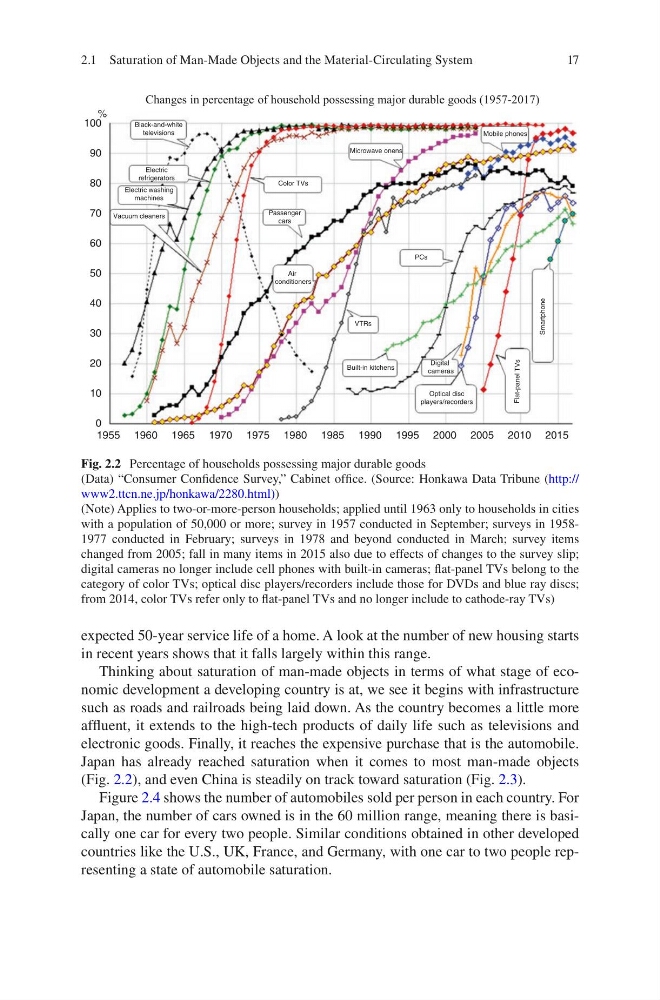
Japan has already reached saturation when it comes to most man-made objects
(Fig. 2.2), and even China is steadily on track toward saturation (Fig. 2.3).
Figure 2.4 shows the number of automobiles sold per person in each country. For
Japan, the number of cars owned is in the 60 million range, meaning there is basically one car for every two people. Similar conditions obtained in other developed
countries like the U.S., UK, France, and Germany, with one car to two people representing a state of automobile saturation.
100
90
80
70
60
50
40
30
20
10
0
1955 1960 1965 1970 1975 1980 1985 1990 1995 2000 2005 2010 2015
%
Black-and-white
televisions
Electric
refrigerators
Electric washing
machines
Vacuum cleaners
Color TVs
Passenger
cars
Air
conditioners
VTRs
Built-in kitchens
Microwave onens
Mobile phones
PCs
Digital
cameras
Optical disc
players/recorders
Flat-panel TVs
Smartphone
Changes in percentage of household possessing major durable goods (1957-2017)
Fig. 2.2 Percentage of households possessing major durable goods
(Data) “Consumer Confidence Survey,” Cabinet office. (Source: Honkawa Data Tribune (http://
www2.ttcn.ne.jp/honkawa/2280.html))
(Note) Applies to two-or-more-person households; applied until 1963 only to households in cities
with a population of 50,000 or more; survey in 1957 conducted in September; surveys in 19581977 conducted in February; surveys in 1978 and beyond conducted in March; survey items
changed from 2005; fall in many items in 2015 also due to effects of changes to the survey slip;
digital cameras no longer include cell phones with built-in cameras; flat-panel TVs belong to the
category of color TVs; optical disc players/recorders include those for DVDs and blue ray discs;
from 2014, color TVs refer only to flat-panel TVs and no longer include to cathode-ray TVs)
2.1 Saturation of Man-Made Objects and the Material-Circulating System
expected 50-year service life of a home. A look at the number of new housing starts
in recent years shows that it falls largely within this range.
Thinking about saturation of man-made objects in terms of what stage of economic development a developing country is at, we see it begins with infrastructure
such as roads and railroads being laid down. As the country becomes a little more
affluent, it extends to the high-tech products of daily life such as televisions and
electronic goods. Finally, it reaches the expensive purchase that is the automobile.
Japan has already reached saturation when it comes to most man-made objects
(Fig. 2.2), and even China is steadily on track toward saturation (Fig. 2.3).
Figure 2.4 shows the number of automobiles sold per person in each country. For
Japan, the number of cars owned is in the 60 million range, meaning there is basically one car for every two people. Similar conditions obtained in other developed
countries like the U.S., UK, France, and Germany, with one car to two people representing a state of automobile saturation.
100
90
80
70
60
50
40
30
20
10
0
1955 1960 1965 1970 1975 1980 1985 1990 1995 2000 2005 2010 2015
%
Black-and-white
televisions
Electric
refrigerators
Electric washing
machines
Vacuum cleaners
Color TVs
Passenger
cars
Air
conditioners
VTRs
Built-in kitchens
Microwave onens
Mobile phones
PCs
Digital
cameras
Optical disc
players/recorders
Flat-panel TVs
Smartphone
Changes in percentage of household possessing major durable goods (1957-2017)
Fig. 2.2 Percentage of households possessing major durable goods
(Data) “Consumer Confidence Survey,” Cabinet office. (Source: Honkawa Data Tribune (http://
www2.ttcn.ne.jp/honkawa/2280.html))
(Note) Applies to two-or-more-person households; applied until 1963 only to households in cities
with a population of 50,000 or more; survey in 1957 conducted in September; surveys in 19581977 conducted in February; surveys in 1978 and beyond conducted in March; survey items
changed from 2005; fall in many items in 2015 also due to effects of changes to the survey slip;
digital cameras no longer include cell phones with built-in cameras; flat-panel TVs belong to the
category of color TVs; optical disc players/recorders include those for DVDs and blue ray discs;
from 2014, color TVs refer only to flat-panel TVs and no longer include to cathode-ray TVs)
2.1 Saturation of Man-Made Objects and the Material-Circulating System