

xlii
similar to the pollution problem. A mechanism to internalize these externalities into
the economy should be built as soon as possible (Figs. 27 and 28).
Many of the activities directed toward a platinum society consist of providing
services to enhance QOL. Manufacturing and selling automobiles and television
sets outside of the market economy are unlikely, but it is not unlikely for services to
be performed outside the market economy. However, it should be possible to internalize those activities and turn them in the direction of increasing the GDP.
In the era in which society developed and the economy grew in developing countries because of their material demands, GDP was an appropriate social indicator.
However, the index to enhance the QOL must of course be that which represents
quality. The United Nations has proposed the IWI (Inclusive Wealth Index), which
is a comprehensive indicator that includes the environment and sustainability.
In a platinum society, we should think about the indicators of economic scale and
QOL—for example, both the GDP and IWI—as important indicators.
Platinum Industry and Economic Growth
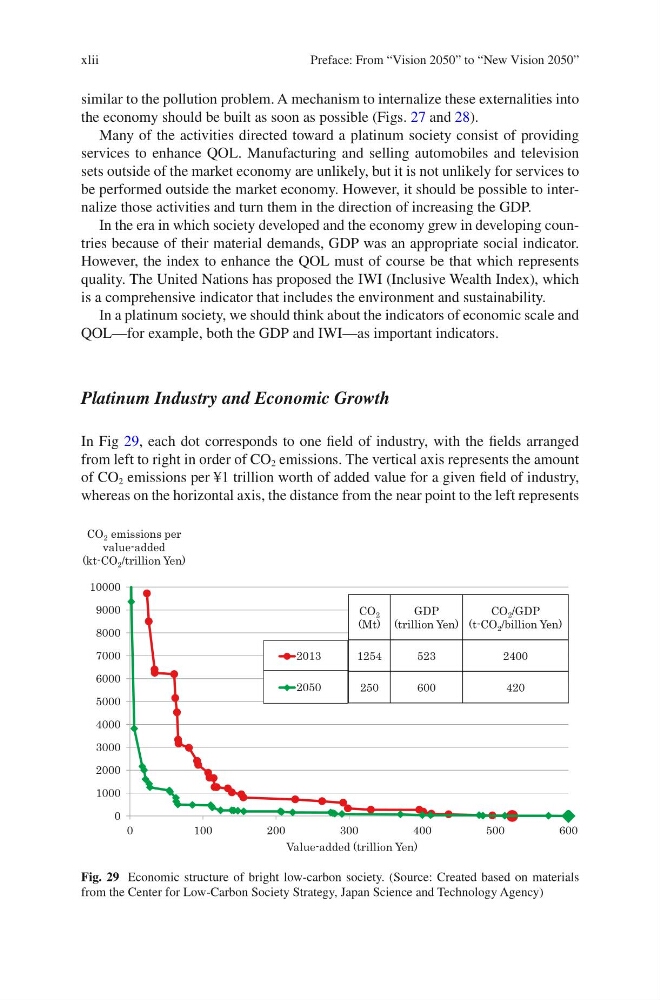
In Fig 29, each dot corresponds to one field of industry, with the fields arranged
from left to right in order of CO 2 emissions. The vertical axis represents the amount
of CO 2 emissions per ¥1 trillion worth of added value for a given field of industry,
whereas on the horizontal axis, the distance from the near point to the left represents
0
1000
2000
3000
4000
5000
6000
7000
8000
9000
10000
0
100
200
300
4 00
500
6 00
2013
2050
CO 2 emissions per
value-added
(kt-CO 2 /trillion Yen)
CO 2
(Mt)
GDP
(trillion Yen)
CO 2 /GDP
(t-CO 2 /billion Yen)
1254
523
2 400
250
6 00
420
Value-added (trillion Yen)
Fig. 29 Economic structure of bright low-carbon society. (Source: Created based on materials
from the Center for Low-Carbon Society Strategy, Japan Science and Technology Agency)
Preface: From “Vision 2050” to “New Vision 2050”
similar to the pollution problem. A mechanism to internalize these externalities into
the economy should be built as soon as possible (Figs. 27 and 28).
Many of the activities directed toward a platinum society consist of providing
services to enhance QOL. Manufacturing and selling automobiles and television
sets outside of the market economy are unlikely, but it is not unlikely for services to
be performed outside the market economy. However, it should be possible to internalize those activities and turn them in the direction of increasing the GDP.
In the era in which society developed and the economy grew in developing countries because of their material demands, GDP was an appropriate social indicator.
However, the index to enhance the QOL must of course be that which represents
quality. The United Nations has proposed the IWI (Inclusive Wealth Index), which
is a comprehensive indicator that includes the environment and sustainability.
In a platinum society, we should think about the indicators of economic scale and
QOL—for example, both the GDP and IWI—as important indicators.
Platinum Industry and Economic Growth
In Fig 29, each dot corresponds to one field of industry, with the fields arranged
from left to right in order of CO 2 emissions. The vertical axis represents the amount
of CO 2 emissions per ¥1 trillion worth of added value for a given field of industry,
whereas on the horizontal axis, the distance from the near point to the left represents
0
1000
2000
3000
4000
5000
6000
7000
8000
9000
10000
0
100
200
300
4 00
500
6 00
2013
2050
CO 2 emissions per
value-added
(kt-CO 2 /trillion Yen)
CO 2
(Mt)
GDP
(trillion Yen)
CO 2 /GDP
(t-CO 2 /billion Yen)
1254
523
2 400
250
6 00
420
Value-added (trillion Yen)
Fig. 29 Economic structure of bright low-carbon society. (Source: Created based on materials
from the Center for Low-Carbon Society Strategy, Japan Science and Technology Agency)
Preface: From “Vision 2050” to “New Vision 2050”